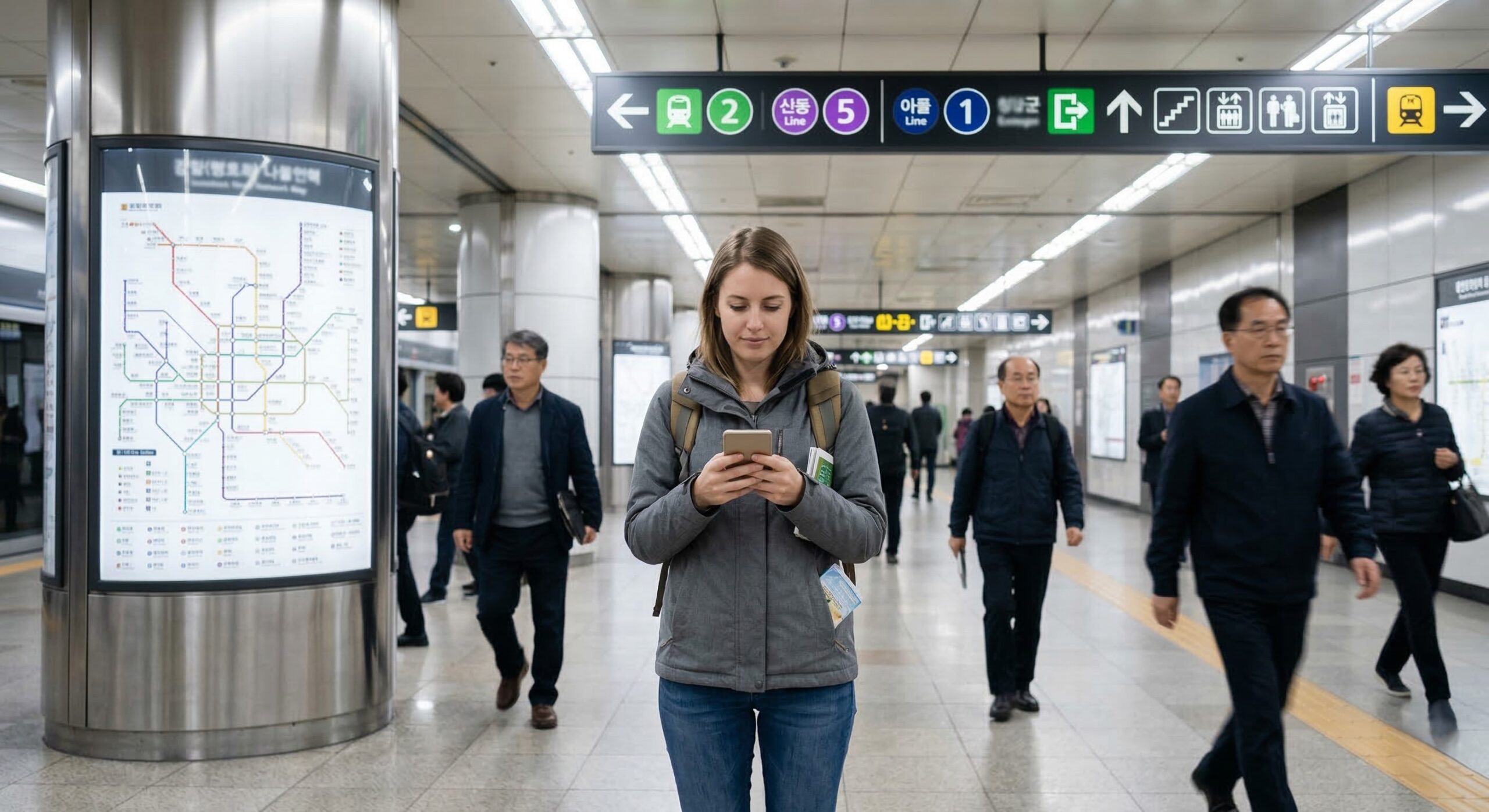
Before entering a Seoul subway gate, settle four details: your destination station, line number, travel direction and final exit. A station name alone does not tell you which platform to use, and the shortest route on a screen may include an inconvenient transfer with luggage.
What a ride costs
Seoul’s published adult base fare is ₩1,550 with a transport card or ₩1,650 for a single-journey ticket. The base covers 10 km; distance supplements apply beyond it. The published card fares for teenagers and children are ₩900 and ₩550, with eligibility and registration requirements. These are base fares, not flat prices for every journey or every rail service.
Use the official route planner for the complete fare. A single-journey machine may collect a refundable ticket deposit in addition to the fare; follow its displayed instructions and retain the ticket for exit and any deposit refund. For several rides and bus connections, a rechargeable transit card reduces repeated ticket purchases.
Plan a route you can follow
- Find the exact venue or hotel, including the correct branch. Choose its nearest useful station and entrance, not simply the nearest pin.
- Compare the suggested routes. Count transfers and walking sections as well as train minutes.
- Record the line, interchange, destination station and exit. Save the Korean station names too.
- If you have a suitcase, stroller or limited mobility, check station facilities and elevator access before choosing an exit. A numbered exit is not a guarantee of a step-free path.
Seoul Metro’s Cyber Station is an official starting point for route and fare lookup. Use station-specific timetable information for your travel day. There is no single last-train time that safely covers every station, direction and onward connection.
At the station: line first, direction second
Follow the line number and color, then compare the platform’s next-station signs with your route. The train’s displayed terminus may be farther away than your stop; it is a direction cue, not an instruction to ride to the end. On a branching line or with express and local services, confirm that this train actually stops at your destination.
Planning example: for a simple one-line journey, write “Line number → next station in my direction → my stop.” For a transfer, add a second line with the interchange and next station after it. This is an illustrative note format, not a live journey result. It makes a wrong-direction platform easier to spot before the doors close.
Tap, transfer and exit
Tap your transit card at the entry gate and wait for acceptance. Keep the same card ready for the exit. At a rail interchange, follow the transfer signs for the next line; avoid street-exit signs unless your route specifically requires leaving. Some connections have additional gates or separate fare arrangements, so follow the posted instructions instead of assuming every gate ends the journey.
At your destination, check the neighborhood map before choosing an exit. An exit on the wrong side of a large road may add more walking than one extra stop would have. With luggage, finding an elevator can be more useful than following the numerically closest exit.
Fixing common mistakes
- Wrong train direction: get off safely at the next station and consult signs or staff before changing platforms. Do not cross a closed area or force a gate.
- Gate rejects the card: check the message and balance. Ask staff before switching to another card, because the first card may hold your entry record.
- Missed last connection: check the whole remaining journey, not just whether a train is still arriving. Compare a taxi with waiting for another permitted service.
- Phone loses data: use saved station names and a station map; live arrival estimates and rerouting may no longer be available.
For airport travel, distinguish the AREX all-stop route from the reserved-seat Express service. For KTX, use the separate intercity ticket and boarding instructions. A local subway card does not make those services interchangeable.
Sources and verification
Official information checked October 22, 2026. Prices and policies can change; confirm your date and selected service before paying. This is a desk-researched guide, not a report of a personal visit or device test.
Related: T-money purchase and reloads · Bus transfers · Map apps