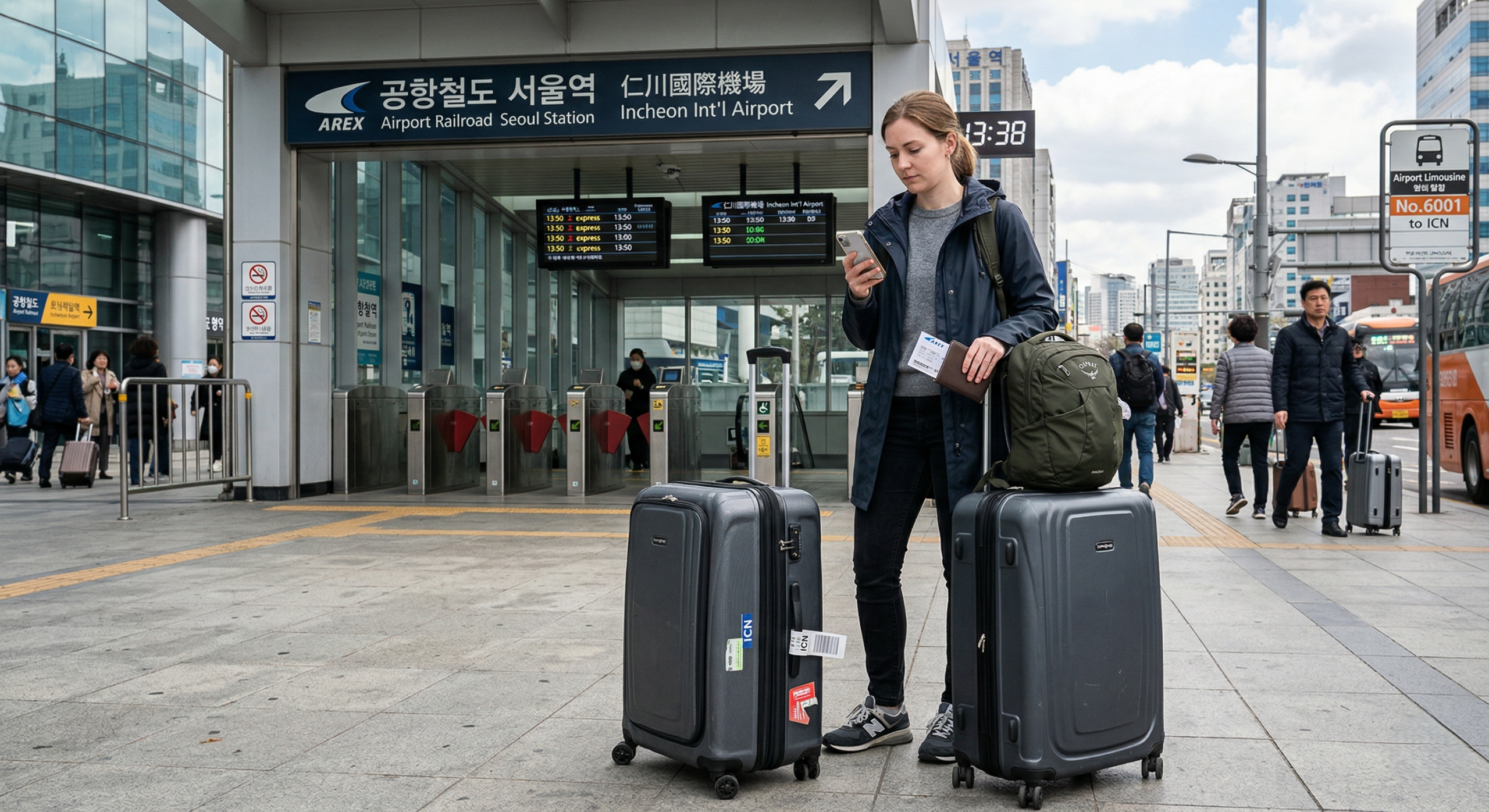
Korea Departure Day Guide
Leaving Korea smoothly is usually not about the airport itself. It is about how many small things are still attached to your last few hours in the city.
A lot of foreign travelers assume departure day is straightforward. Check out, get to Incheon Airport, check in, and leave. In practice, the day tends to unravel earlier than that. The hotel checkout time does not line up neatly with the flight. The suitcase feels heavier than it did on arrival. The subway route looks manageable until stairs, transfers, and exit choices start stacking up. The airport bus sounds convenient until you realize the stop is not as close as it looked on the map. A taxi feels easy until road time becomes the variable you can no longer control.
That is why the real departure-day question is not simply how to get to Incheon Airport. The better question is how to get there without turning your last few hours in Korea into a chain of avoidable mistakes.
For most travelers, the airport trip itself is not the hard part. The hard part is matching luggage, timing, route type, and energy level well enough that the trip still feels under control when it matters most. A route that works perfectly with a backpack can feel genuinely irritating with a large suitcase. A transfer that seemed easy on day two can feel much worse on departure day when you are carrying shopping, checking the time repeatedly, and no longer willing to gamble on a wrong exit.
What departure day is really deciding
A lot of travelers compare airport transportation the wrong way. They ask which option is fastest in general, cheapest in general, or easiest in general. Departure day rarely rewards general answers.
The route that works best depends on four things happening at once: where you are starting, how much luggage you are moving, how tightly the day is scheduled, and how much uncertainty you can still absorb before reaching the airport.
Those four factors matter more on departure day than they do on arrival. On arrival, travelers are usually willing to forgive some confusion because the trip is just beginning. On departure day, that tolerance drops sharply. People are less patient with long transfers, vague bus stops, wrong exits, or route choices that save a little money but introduce too much friction.
This is why the same traveler can honestly prefer the subway on one day and the airport bus on another. That is not inconsistency. It is context. Airport transportation is not a personality choice. It is a baggage-and-timing decision.
A useful way to think about the final trip
- If your main concern is cost and the luggage is manageable, rail often makes the most sense.
- If your main concern is fewer transfers with a large suitcase, the airport bus can be the better fit.
- If your main concern is door-to-door simplicity and the timing margin is already thin, a taxi may be the cleaner call.
The three airport options most travelers actually use
For most foreign visitors leaving Seoul, the practical decision comes down to airport rail, airport bus, or taxi.
Airport rail
Rail is often the cleanest option when you want predictable movement and can handle the station side without too much friction. It removes most road uncertainty and gives you a clearer relationship with time.
But rail only feels clean if the city-side route is also clean. The weak point is rarely the airport train itself. It is getting from your hotel to the correct station entrance, through the station, and onto the platform with luggage.
Rail is strongest when
- your accommodation connects easily to a station
- your luggage is manageable enough for station movement
- you want timing that is insulated from road traffic
- you are comfortable handling one or two clear transit steps
Airport bus
The airport bus often looks like the most comfortable middle ground. It usually involves less luggage friction than the subway and less navigation stress than a multi-step transit chain.
The problem is that people often read “airport bus” as “easy from hotel to airport,” when it really means “possibly easier, if the stop is genuinely useful for your hotel.” Some bus stops are practical in a real sense. Others are only close on a map.
Airport bus works best when
- the stop is clearly and easily reachable from your hotel
- the luggage is heavy enough that rail transfers feel like a burden
- you want fewer movement decisions
- the schedule has enough buffer for road-based travel
Taxi
A taxi is rarely the cheapest answer, but it is often the easiest to understand. No station stairs, no transfer corridors, no uncertainty about which stop is yours, and no need to manage a suitcase through public movement when you are already mentally leaving the country.
That does not make a taxi automatically the right move. A taxi can reduce physical friction while increasing dependence on traffic conditions. That trade can be worth it, but it should be understood clearly before you commit.
Taxi makes most sense when
- the luggage setup is genuinely difficult for public transit
- the path from hotel to station is worse than the airport ride itself
- the budget can absorb the fare difference
- you want the lowest possible physical friction before the terminal
The departure-day mistake that causes the most stress
The biggest departure-day mistake is not leaving too late in any dramatic sense. It is planning around the airport segment while underestimating the city segment that comes before it.
Travelers spend a lot of time thinking about Incheon Airport and not nearly enough thinking about how they will actually leave the hotel, move the bags, and begin the trip. That is where the day starts to drift.
A plan can look solid in the abstract:
Check out at 11. Grab lunch. Take the subway around 1. Reach the airport around 2:30.
Nothing in that plan looks obviously wrong. Then the actual day begins. Checkout takes longer than expected. The front desk needs one more minute. The elevator is slow. The suitcase feels worse than it did yesterday. The nearest station entrance is not the one you pictured. The first transfer is longer than it looked on the map. One wrong exit forces a backtrack. Suddenly the airport portion is still fine, but the city portion has already eaten through the cushion.
That is why the real risk on departure day is rarely one catastrophic mistake. It is a sequence of small underestimates. Departure day should be planned backward from the airport, but executed forward from the hotel door.
Luggage changes the right answer more than most travelers expect
A lot of airport advice is too abstract because it treats all luggage as equivalent. It is not. A backpack and a cabin-size carry-on do not create the same departure-day equation as a large checked suitcase, shopping bags, skincare purchases, winter clothing, and an extra tote that did not exist when the trip began.
This is one of the main reasons travelers make poor final-day decisions. They apply the same route logic they used earlier in the trip, even though the bag situation has changed. The route may still work technically, but it no longer fits comfortably.
If you have light luggage
Rail often becomes more attractive. The station environment costs less effort, transfers are less punishing, and recovering from a small mistake is easier.
If you have medium luggage
This is where travelers most often misjudge. A medium suitcase still looks doable, but it changes stairs, escalators, transfer distances, and your willingness to recover from a wrong exit.
If you have large or awkward luggage
The best route often becomes the one that minimizes handling rather than the one that looks best on a transit map. This is where airport buses and taxis gain real value.
Practical rule: if your luggage changes how confidently you move through stations, your airport plan should reflect that before the day starts — not after the first difficult transfer.
Why the hotel-to-airport trip is often harder than the airport-to-hotel trip
Many travelers assume departure day should be easier because they already know the city better than when they arrived. That sounds logical, but it misses what actually changes.
Arrival day is protected by energy and optimism. Even tired travelers tend to absorb friction because the trip is just beginning. Departure day is different. You are likely carrying more. Your tolerance is lower. Your shopping is no longer theoretical. Your checkout time is fixed. Your flight creates a hard deadline.
There is also a psychological dimension. On arrival, the route ends at a hotel. On departure, it ends at an airport, and airports punish poor timing more harshly. That changes how every small delay registers. A wrong turn that would have been mildly annoying earlier in the trip now feels like lost margin.
When rail, bus, or taxi becomes the better choice
When rail is the best departure-day choice
Rail is often the strongest choice when timing clarity matters and you can honestly manage the station side of the trip. It is especially well-suited when the hotel is close to a practical station entrance, the route does not involve a difficult transfer, and your priority is reducing uncertainty around how long the main airport leg will take.
But rail only deserves to be called the best option if you have already resolved the station side properly. Which entrance? Which platform? Which transfer, if any? Which part of the station is easiest with the luggage you are actually carrying today?
When the airport bus is the smarter final-day move
The airport bus becomes the better choice when the city-to-stop segment is genuinely manageable and the station burden of rail no longer feels worth it. The bus earns its place when the stop is truly usable — not just technically nearby.
The important caution is timing. The airport bus should be chosen with buffer built in, not on the hope that traffic cooperates. If the day depends on a tight arrival window, rail may still be the stronger call.
When a taxi is worth the extra cost
A taxi becomes the right answer when the airport route is less about transit efficiency and more about removing friction from the final urban leg. That is especially true when your hotel is awkwardly positioned for both rail and bus, or the luggage is difficult enough that public movement keeps looking worse.
The smart use of a taxi is not simply “I want comfort.” It is “the city-side cost of public transit has become more expensive than the fare difference.”
The luggage-storage question that quietly shapes the whole day
Departure day becomes significantly easier when you resolve the luggage problem before pretending the rest of the day is simple.
This matters most when your flight is late and checkout happens well before you need to leave for the airport. Many travelers inadvertently make the final hours harder by keeping the suitcase attached to the day after it has stopped being useful.
If you still plan to move around the city after checkout, luggage storage often becomes the real first decision of the day. The bag may stay with the hotel. It may go into a station locker if the route genuinely supports that. The cleaner approach is simple: if the suitcase will only make your last city hours worse, separate from it early enough that the rest of the day stays usable.
Timing mistakes that feel small but cost a lot
Treating checkout time as if movement starts instantly
Checkout is not teleportation. There is still the elevator, the front desk moment, the luggage handoff, the walk to the station or bus stop, and the first segment of the airport route.
Treating station time as total travel time
A train that takes a certain number of minutes does not mean the full route takes that number of minutes. Station entry, platform finding, and transfer walking all add up.
Leaving the route choice too late
Some travelers decide between rail, bus, and taxi only after checking out. That is too late for a final day that needs to feel controlled.
Overestimating how cheaply you can recover from one wrong turn
A wrong exit or small misread is usually fixable, but departure day is not only about fixability. It is about how much calm each correction costs.
A practical framework for choosing your airport route
Step 1
Start with the luggage reality, not the map.
Step 2
Assess the hotel-side friction honestly.
Step 3
Decide whether timing certainty or reduced handling matters more.
Step 4
Protect the weakest part of the route.
Step 5
Commit before checkout.
What travelers usually regret
By the end of departure day, the regrets tend to be remarkably consistent.
- keeping the suitcase with them too long
- choosing a route that looked efficient but felt wrong with luggage
- assuming the bus stop or station entrance was simpler than it actually was
- treating departure day like a normal sightseeing day with one airport ride tacked on at the end
- thinking they still had plenty of time after several small delays had already accumulated
Leaving Korea smoothly is mostly about removing one unnecessary problem at a time
Departure day does not need to be elegant. It needs to stay controlled.
That usually means choosing the route that honestly fits your luggage, resolving the storage question early if the day is split by checkout, deciding between rail, bus, and taxi before you are already outside, and accepting that the city-to-airport segment involves more friction than the ride time alone suggests.
Rail is strong when timing clarity matters and station friction stays manageable. The airport bus is strong when the stop is genuinely useful and the luggage burden of rail has become real. A taxi is strong when the final city leg has become more costly in effort than the fare difference justifies.
There is no universally correct answer. There is only the route that fits your final day well enough that you are not spending your last hours in Korea fighting small problems that should have been removed earlier. That is what a smooth departure usually looks like: not a perfect plan, just fewer avoidable mistakes between the hotel door and Incheon Airport.