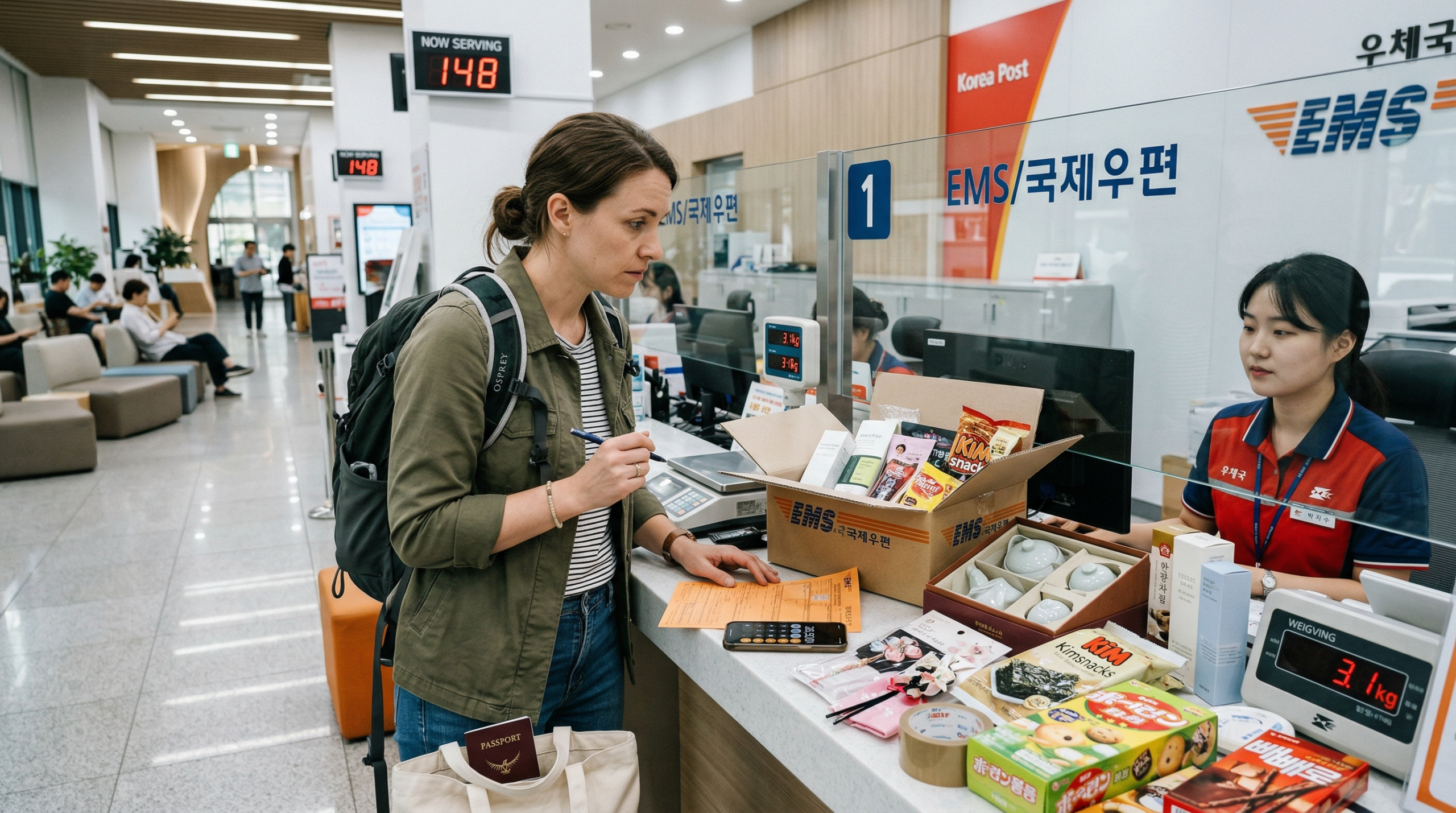
How to Ship Souvenirs Home from Korea: EMS, Customs Forms, Shipping Costs, and What Not to Mail Before You Fly
Sometimes the smartest departure-day move is not finding more suitcase space. It is deciding which purchases should stop traveling with you at all.
If you bought more in Korea than your suitcase can realistically handle, the real question usually is not whether shipping is possible. It is whether shipping solves the problem better than dragging the same problem to the airport.
That distinction matters more than most foreign travelers expect. A box of skincare, packaged snacks, stationery, clothing, or gifts can look completely manageable in a hotel room and then become the reason departure day starts to unravel. The bag is heavier. Liquid rules matter more. Tax refund items still need to stay sorted. You spend the last day protecting purchases instead of moving normally. By the time you are on the way to Incheon, the issue is no longer shopping. It is logistics.
Mailing souvenirs home from Korea can be a smart move, but only when you understand what shipping actually solves, what it complicates, and what should never be mailed in the first place.
This is not a broad introduction to international shipping. It is a practical guide for foreign travelers in Korea who need to decide whether to mail items home, how to prepare a parcel at a Korean post office, what information matters on a customs form, what tends to get blocked, and when mailing something home is cleaner than carrying everything through the airport.
The first decision is not “Can I ship this?”
The better question is: Will shipping this remove more friction than it creates?
That is the comparison that actually matters on a Korea departure day.
Start with the real question: should you ship this at all?
A lot of travelers make the wrong comparison. They compare the shipping fee to the value of the item and stop there. That is too shallow.
The better comparison is the total cost of carrying the purchase through the rest of the trip. That cost is not only money. It includes weight, airport stress, luggage space, liquid restrictions, breakage risk, tax refund confusion, and the simple fact that departure day gets harder when too many unresolved items are still attached to it.
The smartest travelers do not start with Can I mail this? They start with Will mailing this remove more friction than it creates?
What foreign travelers usually regret
The most common regret is not shipping too late. It is deciding too late.
Most people only start thinking about international mailing after the suitcase has already become the problem. They have packed once, repacked twice, separated the liquids, realized some gifts are awkwardly shaped, and finally admitted that one box leaving Korea separately would make the whole departure easier. At that point the shipping decision is still possible, but the margin is worse. You are working around your luggage instead of planning ahead of it.
The second regret is mailing the wrong things. Not everything that feels inconvenient in a suitcase should be mailed. Some items are sensitive, restricted, breakable in ways that matter, or too hard to describe correctly on customs paperwork. Others are better carried personally even when they are slightly inconvenient.
The third regret is mixing tax-refund logic with shipping logic. If an item needs to stay accessible, unused, or clearly grouped for a refund-related process, mailing it too early can create a different problem from the one you were trying to solve. The real skill is not knowing how to send a parcel. It is knowing which items should stop traveling with you.
The easiest items to ship versus the items that need caution
The easiest items to ship are the ones that are easy to describe, easy to pack, and not part of your final airport workflow.
Usually easier to mail
- clothing
- stationery
- books
- sealed souvenirs that are not hazardous
- non-fragile gifts
- small household items
- beauty products, but only when their mailing status is clearly allowed and destination-country rules are confirmed
Pause hard before mailing
- anything containing batteries, including Bluetooth speakers, portable fans, electric face massagers, or electronic accessories with lithium cells
- aerosols or pressure-type products
- perfumes or alcohol-heavy cosmetic items
- flammable products
- food items that may trigger destination-country restrictions
- liquids you cannot clearly classify
- fragile ceramics or glass
- anything expensive enough that loss or damage would be a serious problem
- tax refund items you may still need to keep accessible or unused
A practical rule helps here. If you would struggle to describe the item in one plain line on a customs form, stop and think harder before mailing it. The more vague your description needs to be, the more likely this is not a clean tourist parcel.
Where travelers usually send parcels from in Korea
For most tourists, a regular Korean post office is the right default. It matches the problem you actually have: you are a foreign visitor who needs a legitimate international mailing channel, not a complicated private logistics arrangement.
The useful question is not What is the best shipping company in Korea? It is What can I realistically use with the least friction before my flight?
Korean post offices usually offer international services including EMS, which is generally the fastest tracked mainstream option for many destinations, and slower parcel options that can cost less but take longer. For most tourists, EMS is the first practical option worth checking because it is easier to understand, easier to track, and easier to justify when the parcel contains items you would rather not gamble on during the last days of the trip.
Slower options can still make sense when the contents are genuinely low-priority, non-fragile, and not time-sensitive. But that only helps if the delivery time actually matches your expectations. Cheap shipping that arrives much later than you assumed is not always a good deal.
For most travelers, practical execution usually means:
- go to a post office while there is still time
- bring the items, destination details, and identification-ready information
- pack clearly enough that the contents are legible
- treat the customs form as part of the shipment, not as an afterthought
Do not assume airport mailing is the cleanest answer. In theory it feels efficient because departure is already on your mind. In practice, the more complicated your last day becomes, the more valuable it is to separate shipping from airport logistics entirely.
A city-side post office visit the day before departure is usually cleaner than trying to sort everything while you are emotionally leaving the country. In major tourist districts, post offices are often close enough to plan around. Finding one in advance is more useful than improvising on the morning you want to mail the box.
That is also why this decision belongs with your wider departure plan, not outside it. If you are already deciding what still needs to stay accessible for airport movement and final packing, it helps to think about where your luggage should stay during the day and how the trip to Incheon Airport will actually work before you decide what should leave Korea separately.
What to prepare before you walk into the post office
A good postal visit starts in the hotel room, not at the counter.
If you show up with a loose pile of purchases, vague address notes, and no clear customs description plan, the entire step takes longer than it needs to. Before leaving for the post office, prepare the following.
1. Final destination details
You need the receiver’s name, full address, postal code, country, and phone number in a format you can read clearly and copy accurately. A hotel Wi-Fi screenshot, a copied message thread, and a half-remembered apartment number are not the same as a clean delivery address. Write the full address into a note before you leave the hotel. Include the country in English, the postal code, and a working phone number. If the destination uses a non-Latin script locally, keep the English or romanized version ready too.
2. A realistic item list
Know exactly what is going into the parcel before you arrive. Not a poetic summary. A real list.
Not:
souvenirs from Korea
More like:
- T-shirts ×3
- notebooks ×2
- sheet face masks ×10
- socks ×4 pairs
- packaged snacks ×6
- postcards ×5
That level of clarity matters because customs forms are built for contents, not moods. Quantity matters too. A vague item label plus an unclear quantity is how a simple parcel starts to look less clean than it really is.
3. A packing decision
Do not arrive still undecided about which items stay with you and which leave separately. Finish that choice before you go. If you are still sorting at the counter, you are creating your own stress at exactly the point where the process should be getting easier.
4. A box or packaging decision
Korean post offices often sell boxes, but knowing the approximate parcel size before you arrive helps a lot. If your items are already grouped, you can estimate whether you need a small, medium, or large box. Fragile items should be wrapped before you arrive. Do not count on the counter to solve delicate packing for you.
5. A separation from tax-refund items
If some purchases are still tied to refund decisions, or should stay with you until departure logistics are fully settled, keep them out of the parcel. Do not decide this at the counter. Know it before you leave the hotel.
6. A timing decision
Do not treat the post office like a tiny optional stop you can squeeze into a rushed afternoon. If the parcel matters, give it a real time block. A straightforward parcel with clear contents and a ready address can still take meaningful time. If the contents, form, or destination details are unclear, it takes longer.
How to think about the customs form without overcomplicating it
The customs form worries travelers more than it should. Usually the problem is not the form itself. It is that people arrive at the form with unclear contents.
When the parcel is simple, the form becomes manageable. Your goal is not to write elegant descriptions. Your goal is to describe the contents plainly enough that the shipment makes sense to someone reading it quickly.
The more generic the language, the less useful it becomes. Some practical notes help.
- For clothing, material helps when you know it. “Cotton T-shirts” is stronger than “shirts.”
- For skincare, “sheet face masks, cosmetic use” is clearer than “beauty products.”
- For food, write the product type. “Dried seaweed snacks” is better than “food.”
- For stationery, “paper notebooks” or “ballpoint pens” reads more cleanly than a vague bundle term.
A second mistake is treating quantity and category as unimportant. If there are six shirts, say so. If there are ten packets of snacks, do not compress that mentally into “food stuff.” Be simple, but not evasive.
A third mistake is failing to decide what the shipment actually is. Personal items, gifts, or shopping being sent home are not always identical in the way customs systems read them. The form is not asking you to tell the story of your trip. It is asking you to make the parcel legible to a stranger who will spend only a few seconds reading it.
The address problem tourists underestimate
Many travelers assume the customs side is the hard part and the address side is easy. In practice, bad address handling ruins clean parcels all the time.
What matters is not whether the destination is obvious to you. It is whether the receiver’s delivery details are complete and unambiguous to a postal system that does not know you or them.
- the receiver’s name is complete
- the street address is complete
- apartment, suite, or unit numbers are included if relevant
- the postal code is correct
- the country name is explicit
- the phone number is usable
- the address reflects how mail actually reaches that person in that country
Do not rely on “my family already knows where it is going” logic. Postal systems do not work on familiarity. They work on formatted destination data.
This matters even more when the destination uses building codes, apartment numbering, or a delivery format you do not personally use often. If you are sending to the US, UK, Canada, Australia, Japan, or most of Europe, the address format is often standardized enough to check in advance. A parcel that reaches the destination country but cannot be delivered because of an address error is effectively lost from a tourist’s point of view.
What not to mail before you fly
Do not treat the post office as a fix for anything that feels annoying to carry. International mail has its own restrictions, and destination-country rules can block items even when the Korean side feels physically straightforward.
Battery-containing items
If a product contains lithium batteries or similar components, do not assume it is fine just because it looks like an ordinary consumer product. Portable chargers, wireless earbuds, small electric beauty devices, LED goods, and rechargeable accessories all belong in the caution zone.
Aerosols, pressure products, and flammables
Dry shampoo, spray sunscreen, compressed canisters, and similar products can quickly become non-starters in international air mail.
Perfume and alcohol-heavy cosmetics
These are often more complicated than ordinary skincare. A low-alcohol toner and a perfume bottle do not belong in the same mental category.
Food
Food is not one category. Meat-based snacks, products containing egg or dairy, fresh or dried fruits, honey, and some agricultural products are restricted in many countries, even when they look harmless in sealed packaging. “It is just snacks” is not a real compliance standard.
Items with unclear chemical or hazardous status
If you cannot explain what the product contains or why it is safe to mail, do not build your departure plan around it.
Items still tied to tax refund logic
If a purchase needs to stay accessible, grouped with paperwork, or clearly unused, mailing it away can backfire even when it would otherwise have been easy to send.
Very high-value items
If a lost, delayed, or questioned parcel would be genuinely painful, financially or otherwise, think carefully before sending it. High-value items that you want to arrive safely and without complications are often better carried personally.
Practical rule: if an item’s postal eligibility feels even slightly ambiguous, resolve that before committing. Do not gamble on “probably okay.”
The shipping cost decision tourists actually need
Tourists usually ask the wrong cost question. They ask, “How much does shipping cost?” The better question is, “How much of a problem am I paying to remove?”
A shipping fee is easier to justify when the parcel removes one or more of these:
- excess baggage risk
- airport repacking stress
- liquid-rule anxiety
- breakage risk in checked luggage
- last-day luggage drag
- the need to carry gifts through a final day when you would rather not
A shipping fee is harder to justify when:
- the parcel is small enough to carry comfortably
- the shipment creates new paperwork stress without removing much from the suitcase
- you are mailing things mainly because packing feels annoying, not because the items genuinely disrupt the trip
- destination-country import risk is too uncertain to ignore
The honest comparison is not shipping fee versus zero. It is shipping fee versus excess baggage risk, airport friction, damaged goods, your own energy on the last day, and the value of a simpler departure.
If you are deciding between paying for an extra checked bag and mailing a parcel from a post office, the math is often less close than it first appears. Sometimes a mid-sized EMS parcel can be easier to justify than one more airline baggage problem, especially when the parcel leaves your hands earlier and makes the final day lighter.
When shipping is better than excess luggage
Shipping usually beats paying for extra luggage when the parcel contains lower-priority items that do not need to arrive with you personally and would otherwise make the airport day heavier, slower, or more fragile.
Examples:
- gifts for family
- duplicate skincare purchases
- non-urgent shopping
- heavier clothing items you no longer need on the trip
- boxed souvenirs that waste shape more than weight
Shipping is usually worse when:
- the item is time-sensitive
- it is fragile and emotionally important
- it may face customs confusion on arrival
- it is expensive enough that you would rather keep it under your own control
- the parcel only removes a small burden from the suitcase
A useful test helps. Ask whether the item would cause you any meaningful concern if it arrived two to three weeks after you did. If the answer is yes because of value, urgency, or emotional importance, carry it. If the answer is no, that is often the parcel.
The tax refund conflict that travelers must not ignore
This is where people get sloppy. A product can be genuinely annoying in your luggage and still be the wrong thing to mail.
If you bought goods that may still matter for tax refund handling, export condition, or final sorting, do not throw them into a parcel just because shipping feels easier. Mailing an item away can solve one logistics problem and create another if that item still needed to stay accessible, grouped with paperwork, or visibly unused before departure.
This comes up most often with cosmetics, fashion items, gifts tied to refund paperwork, and purchases you have not clearly sorted into refund-safe and non-refund-safe groups.
The clean move is simple: decide the tax refund status first, then the shipping status. Not the other way around.
The strongest departure-day strategy
The cleanest approach usually is not “pack everything, then ship what does not fit.” It is this:
- Separate what must stay with you.
- Separate what can safely leave the trip now.
- Confirm destination details.
- Confirm parcel contents in plain language.
- Visit the post office before last-day pressure starts building.
- Keep the airport workflow lighter by the time you are back at the hotel.
That order matters because the parcel should reduce departure stress, not become one more thing attached to it.
Ideally, the parcel leaves Korea at least a little before departure pressure peaks. One day before can still work when the post office visit is the first real task of the day, not the last one left over after everything else.
The mistakes that waste the most time
- Packing first, deciding later. They build the suitcase before deciding what should have left the trip entirely.
- Treating all purchases as one category. Gifts, liquids, tax-refund items, and clothing should not all collapse into the same late-night packing logic.
- Bringing vague destination details. The parcel is ready. The receiver information is not.
- Using weak customs descriptions. The box contains ordinary items, but the form says “souvenirs” or “gift items.”
- Mailing under pressure. They try to fit the post office into a schedule already competing with checkout, transport, and airport timing.
- Shipping the wrong kind of item. They use postal shipping as an escape route for items that are restricted, risky, or still tied to other departure-day decisions.
- Skipping the packaging step. They assume the post office will solve all packing. Sometimes it helps, but arriving organized saves time and stress.
- Believing the airport solves everything. It usually does not.
What to do if you are already close to departure
If your flight is close, do not force shipping just because the suitcase feels unmanageable. At that point, the decision has to get more ruthless.
Ask yourself:
- Does this parcel clearly simplify the final day?
- Are the contents simple enough to describe and mail right now?
- Is the destination information ready, complete, and correct?
- Will this conflict with any refund or airport workflow?
- Do I still have enough time to do this without creating a new problem?
If those answers are not clean, let the idea go. A rushed parcel is not always better than an inconvenient suitcase. Sometimes the right late-stage move is to carry the items, accept the extra weight, and admit that the shipping window passed.
If you are within roughly half a day of departure, the calculation changes sharply. Packing, forms, transit to the post office, and the return back into airport logistics can consume more time and energy than the parcel is worth.
Final practical checklist before you ship
- Have you decided exactly which items are leaving the trip?
- Are any of those items still tied to tax refund logic?
- Can you describe every item plainly on a customs form, with quantity?
- Is the receiver’s full address complete, including apartment or unit number if relevant?
- Do you have the correct postal code and a working phone number for the receiver?
- Have you separated anything with batteries, aerosol pressure, alcohol-heavy contents, or other restrictions?
- Are fragile items already wrapped or protected before you arrive?
- Do you know approximately what box size you will need?
- Have you chosen your shipping method based on speed and cost?
- Does mailing this parcel actually remove enough friction to justify the step?
- Are you doing this early enough that it simplifies departure instead of crowding it?
If those answers are clear, mailing souvenirs home from Korea can be one of the most useful decisions in the final stretch of a trip.
If those answers are vague, the problem usually is not the post office. It is that the parcel still belongs to an undecided part of the departure plan.
What matters most
Mailing purchases home from Korea is valuable when it removes the right burden.
The wrong way to think about it is this: “I bought too much, so maybe shipping will save me.”
The better way is this: “These specific items no longer need to stay attached to my trip, and mailing them now will make the rest of departure cleaner.”
That is the whole principle. A good parcel reduces airport friction, protects the last day, and leaves you with a lighter and more controlled exit from Korea. A bad parcel is just a suitcase problem in a cardboard box.
Keep the decision practical. Keep the box simple. Keep the form clear. Do it early enough that it actually helps. When those conditions are met, shipping can be one of the most useful tools a foreign traveler has in the final days of a Korea trip.