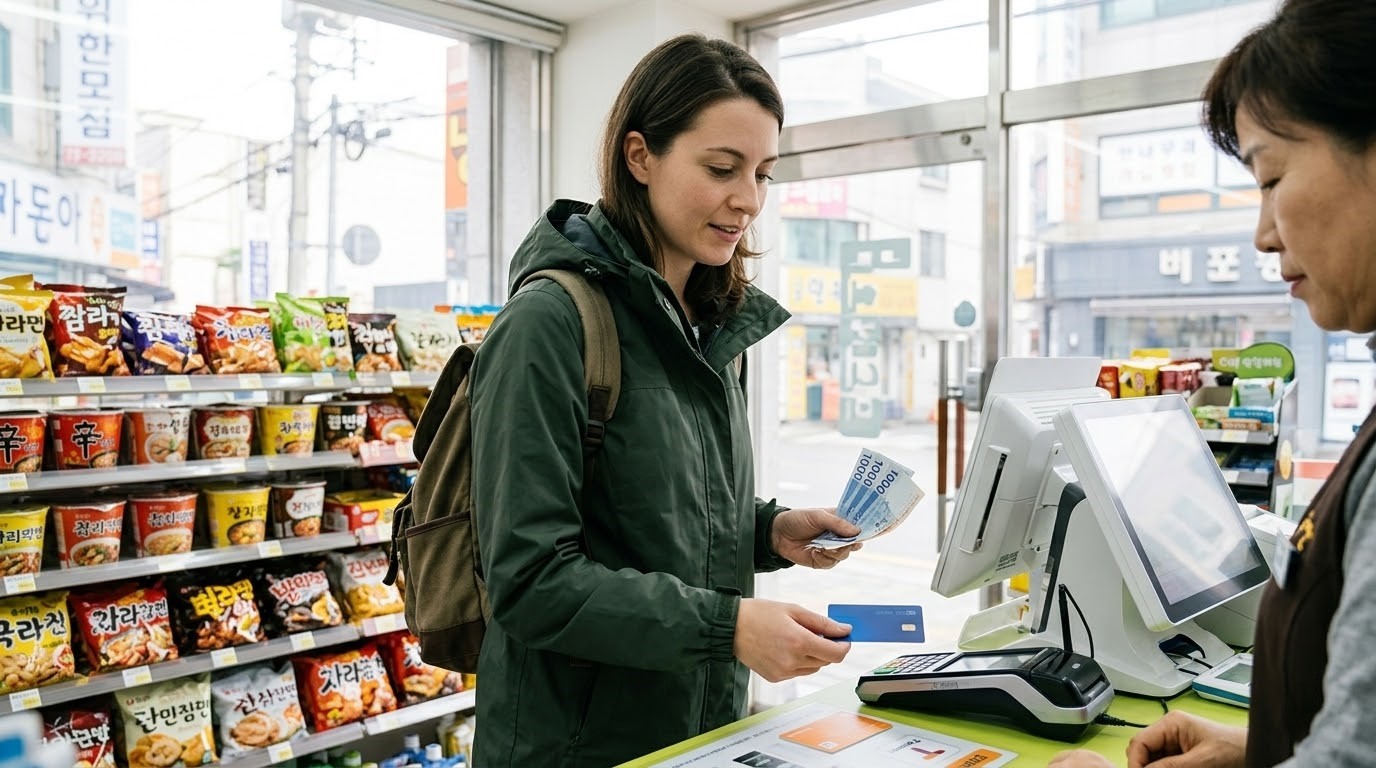
You do not really think about payment systems when they are working well.
That is why Korea can feel deceptively simple at first. You land, buy a drink, pick up a few things at a convenience store, tap into the subway, pay for a taxi, and the whole trip begins to feel neatly organized. Card use is widespread, public transport runs on a consistent prepaid system, and most chain businesses process transactions without hesitation. For many visitors, that early run of smooth payments starts to feel like a pattern they can count on.
The trouble starts when they treat it as one.
A card can work at ten places in a row and still fail at the eleventh — not because anything dramatic has happened, but because the payment setup in front of you is slightly different from the one before. A transportation card covers far more ground than a subway turnstile, but it is not a general-purpose wallet. A staffed counter gives you room to recover; a vending machine does not. Korea is genuinely easy to pay in across most of daily life, but that ease is not uniform, and the gaps tend to show up at the worst moments.
Understanding where those gaps are — before you hit one — is most of what this article is about.
Why payment in Korea feels easy at first
Most of the places you spend money in Korea are set up for card payment. Hotels, convenience stores, chain cafés, department stores, pharmacies, most sit-down restaurants — all of it moves on card. Once you settle into that rhythm, the trip feels light. You are not counting notes after every small purchase or worrying about exact change.
That convenience matters more than people realize. Travel fatigue rarely comes from one big problem. It accumulates from small interruptions — a moment of confusion at the register, a wrong turn at a vending machine, a pause that should have taken ten seconds stretching into two minutes. When paying feels easy, those moments do not happen, and the city feels easier as a result.
But smooth early payments create a specific kind of overconfidence.
After a day or two of tapping and swiping without friction, travelers stop distinguishing between different payment environments. They stop noticing that some counters are staffed and some are not, that transport payments operate on different logic than retail payments, that certain machines are rigid in ways that a person behind a counter would not be. The system has not changed. The traveler has simply stopped paying attention to it.
Role separation matters more than method selection
Most payment problems in Korea are not caused by the wrong card or not enough cash. They come from asking one tool to cover situations it was not built for.
The setup that holds up across a full trip has three parts, and they do not overlap:
| Tool | Best use | Why it matters |
|---|---|---|
| Main card | Restaurants, cafés, shopping, accommodation | This is where a card saves the most time and decision-making energy. |
| Transportation card | Buses, subways, many taxis | Movement runs more smoothly when you are not fumbling with a wallet at the gate or the meter. |
| Korean won | Smaller local places, certain machines, fast fallback moments | Cash fills the gaps when a card does not work and you would rather keep moving than troubleshoot. |
A main card handles the bulk of daily spending — restaurants, cafés, shopping, accommodation. This is where a card earns its place, and where it saves the most time and decision-making energy. A transportation card handles movement. Buses, subways, and many taxis run more smoothly when you are not fumbling with a wallet at the gate or the meter. Korean won in small denominations fills the gaps — markets, smaller local restaurants, certain machines, and any moment when a card simply does not work and you would rather keep moving than troubleshoot.
Those three tools do different jobs. The mistake most visitors make is trying to collapse them into one. A transportation card is not a replacement for a bank card. Cash is not a backup for everything. Each covers a defined part of the day, and when the roles stay clear, very little goes wrong.
Why transport payments are where confusion usually starts
T-money and similar prepaid transportation cards are among the most useful things a first-time visitor to Korea can pick up. You can buy them at convenience stores and reload them there or at subway ticket machines. They work on public transportation and can also be used at affiliated stores that display the T-money logo, which makes them feel more versatile than they actually are.
That is where the misreading begins.
The fact that a T-money card works at a convenience store does not mean it works everywhere a debit card would. It works within a defined network. Outside that network, it does not. Travelers who have spent two days using a transportation card for small purchases sometimes arrive at a counter where it is not accepted and assume something has gone wrong. Nothing has gone wrong. They have just reached the edge of the network.
Taxis add to the confusion because they accept almost everything — cash, credit card, T-money — and that flexibility makes the whole transport system feel more interchangeable than it is. Most regular taxis and many app-based taxi rides can be paid multiple ways, which is convenient. But that flexibility is specific to taxis. It does not carry over to every other payment situation in the city.
A useful rule of thumb
A transportation card can cover more than transportation.
That still does not make it a general-purpose payment tool for the rest of your day.
The counter-versus-machine distinction nobody talks about
One of the most overlooked things about paying in Korea is how differently staffed counters and machines behave when something does not go as expected.
At a staffed counter, there is room to adapt. A cashier can tell you which methods are accepted, suggest trying again, or wait while you switch to something else. The interaction has give to it.
Machines do not. A ticket vending machine, a subway locker, an automated parking barrier — these are efficient when your assumption is correct and completely unhelpful when it is not. They do not offer alternatives. They do not explain what went wrong. They just stop.
This distinction matters in specific places at Incheon and Gimpo airports, and in Seoul’s transit infrastructure more broadly. The Airport Limousine Bus ticket office accepts both cash and credit card. The nearby ticket vending machine accepts credit cards only — not transportation cards, not cash. That is not a flaw. It is just how that specific machine was configured. But if you arrive at the machine expecting it to work the same way as the counter three meters away, you will be confused.
Subway lockers at major stations — Seoul Station, Hongik University Station, Express Bus Terminal — vary by location. Some accept T-money, some accept bank cards, some accept cash, some accept combinations of the above. The signage is usually in Korean. If you walk up without a plan, you are guessing.
Before using any machine
Have a second payment method ready.
Do not assume that what worked at the last machine will work at this one.
Why small payments cause the most disruption
Large payments get planned. Hotel bills, flights, major shopping — travelers think about these in advance. The payments that actually derail days are the small ones.
Coffee. A bottle of water. A convenience store stop between sights. A locker at a museum. A top-up for a transportation card running low. A taxi when the subway has closed for the night.
None of these feel significant. That is exactly the problem. Because they feel trivial, they do not get planned. And because they happen constantly — five, ten, fifteen times in a single day — a fragile payment setup gets tested over and over again.
Having Korean won available in small denominations is not about Korea being a cash-dependent country. It is about keeping low-stakes transactions low-stakes. A 1,500 won coffee that takes ten seconds with cash takes three minutes when your card is declined, you retry it, switch to another card, and finally decide whether to leave. The money is not the issue. The interruption is.
Carry enough won to cover a few rounds of small purchases without thinking about it. That kind of buffer is usually more valuable than trying to be perfectly cashless.
On cash: what it is actually for
Cash in Korea is not a statement about the country’s payment infrastructure. It is a contingency.
Most of the time, you will not need it for ordinary spending. The convenience stores, restaurants, and shops that make up the majority of daily travel spending in Korea all take cards. Carrying a large amount of Korean won is not necessary and, in practice, means more to manage.
What cash does is absorb the situations that cards and transportation cards cannot. Smaller traditional market stalls may prefer cash or accept nothing else. Some older or smaller local restaurants — not the ones in tourist-heavy areas, but the neighborhood places — do not take foreign cards. Certain vending machines and lockers, as noted, have narrower payment options than you might expect.
None of this is frequent enough to make cash your primary method. All of it is frequent enough to make going completely cashless a bad idea.
The other thing cash does is protect your pace. Minor payment failures are only minor if you can resolve them quickly. If the resolution requires hunting for an ATM, checking whether your card has overseas fees, waiting for bank approval, or explaining a problem to someone who does not speak English, a minor failure becomes a genuine disruption. A few thousand won in your pocket keeps it minor.
Currency exchange at Incheon Airport is straightforward. Exchange rates and service conditions can vary by location and provider, while banks generally operate Monday through Friday during daytime hours and offer a more predictable process if your timing works. ATM availability for foreign cards also varies by location, network, and issuing bank, so it is better not to rely on one exact spot unless you have already checked it.
Why the airport gives a skewed picture
Incheon Airport is one of the more visitor-friendly international entry points in the world, and that creates a specific problem: it sets expectations that the rest of Korea does not always match.
At the airport, you have exchange desks, transportation card machines with English interfaces, signs in multiple languages, and staff who are accustomed to passengers who do not speak Korean. Payment decisions that might be confusing elsewhere feel manageable there because the environment is built to handle uncertainty.
Outside the airport, the support infrastructure thins out. Not dramatically — Seoul is a large, internationally connected city — but enough that the confidence built at the arrival hall can lead to assumptions that do not hold up.
The airport is a good place to handle logistics: exchange some cash, pick up a T-money card, figure out which transport you are taking into the city. What it is not is a reliable preview of how payment works in a local restaurant in Mapo-gu or at a coin locker at a regional train station.
Take care of the basics at the airport. Do not use it as a basis for assuming the rest of the trip will be equally well-signposted.
When your card does not work
A declined card in Korea is usually a minor event. It feels larger than it is because it happens in public, often with people waiting behind you, and the immediate cause is not always clear.
Foreign cards can fail for several reasons, including terminal settings, issuer-side rules, and differences in accepted card networks. None of these is automatically a trip-level problem. In many cases, the fastest solution is simply to switch methods and move on.
If your first payment fails
- Try once more if someone suggests it.
- If that does not fix it, switch methods quickly.
- If you have another card, use it.
- If you have cash and the place accepts it, use it.
- If the purchase is not urgent, step away and return later rather than holding up the line while you diagnose the issue.
What helps most is deciding your fallback in advance. Not in the abstract, but concretely: if card A fails, use card B; if both fail, use cash; if you have no cash, skip this purchase and sort out access to money before the next stop. Travelers who have thought this through stay calm because the moment is a logistical switch, not a crisis. Travelers who have not thought it through turn a thirty-second problem into a five-minute one.
The setup that holds up across a full trip
The payment structure that works for most first-time visitors to Korea is not sophisticated. It is just complete.
One main card — ideally with low overseas friction and broad international acceptance — for hotels, restaurants, shopping, and most daily spending. A T-money card, loaded with enough balance for the first day or two of transit, refillable at convenience stores or subway machines. Korean won in small bills, enough to cover several small purchases and unexpected cash-only or cash-easier situations, but not so much that you are carrying more than you need.
Beyond the tools, two habits make a real difference. First, treat machines and staffed counters as different environments. At a machine, have a backup method ready before you start. At a counter, you have more room to work through options. Second, when a payment fails, switch methods immediately rather than retrying the same method multiple times. One retry is reasonable. More than that rarely changes the outcome and wastes time.
A clean daily setup
- Keep your main card ready for ordinary spending.
- Make sure your transportation card has enough balance before you start moving around.
- Carry enough Korean won to cover several small purchases and one awkward gap.
- At any machine, prepare a second payment method before you begin.
- If something fails, switch methods quickly instead of repeating the same failed attempt.
Korea is straightforward to move through financially once you stop expecting every payment point to behave identically. Most will. The ones that do not are predictable enough, once you know where to look, that they stop being surprises.