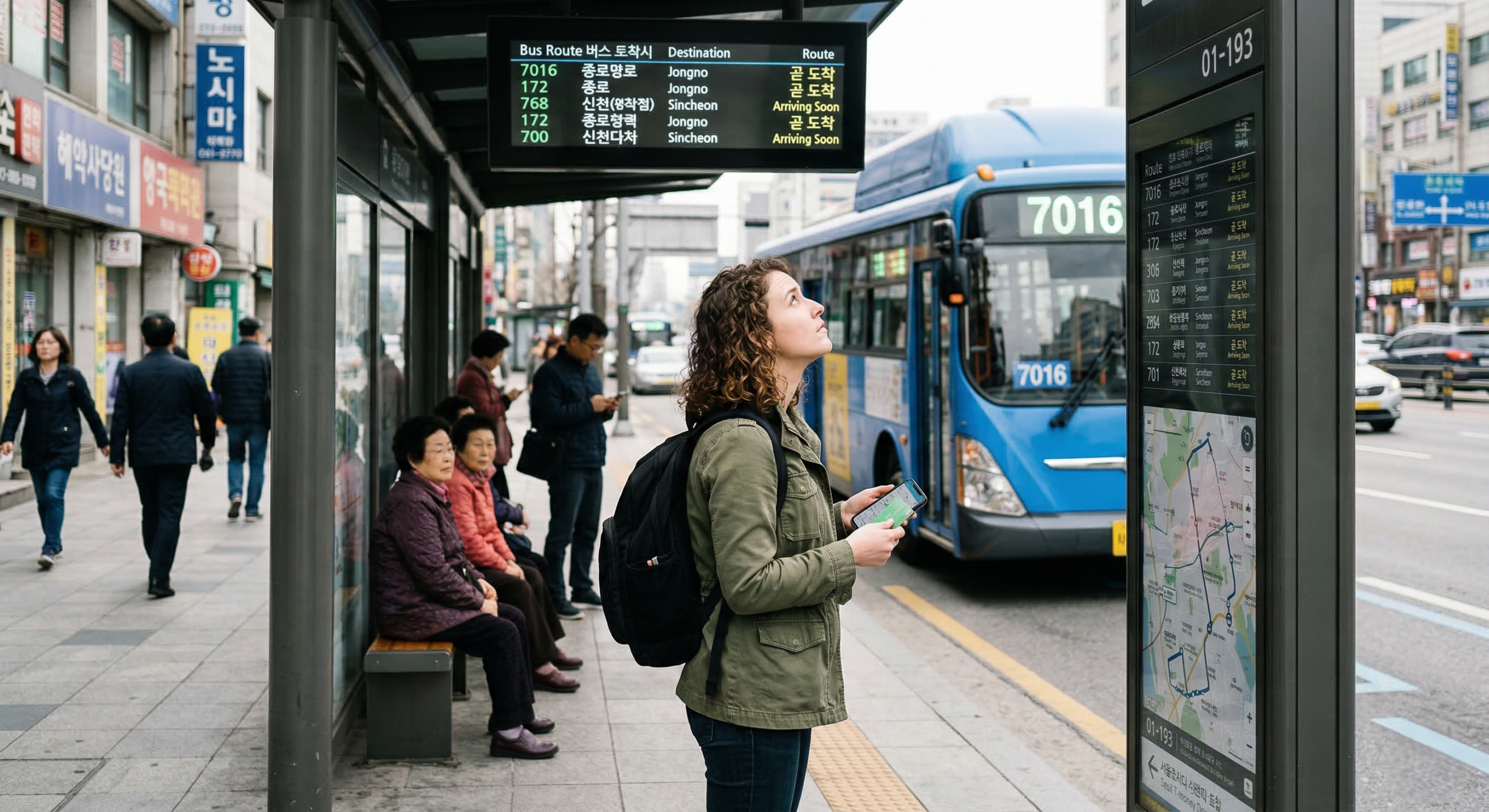
A Seoul bus trip usually goes wrong before you sit down — or after you stand up to leave.
That is the part many first-time visitors miss. The system itself is not especially hard, but the decisions that matter happen at the stop and at the exit: choosing the correct direction, reading the front display fast enough, closing the segment with the back-door tap, and understanding why a transfer can stay linked without turning into a free ride.
If you only think of Seoul buses as the rougher alternative to the subway, they feel chaotic. If you read them as a structured last-mile tool, they become one of the most useful parts of the network — especially for hotel areas, neighborhood streets, hills, and districts where the subway gets you close but not close enough.
Many first-time riders assume the hard part is simply getting on. In practice, that is rarely where the trouble starts. Most errors happen when the route number looks familiar but the stop direction has not been checked, when the bus is chosen too late because the rider waited passively at the curb, or when the bus ride feels finished physically even though the fare system never got a clean record of how it ended.
That is why Seoul buses can feel more technical than the subway on day one. A subway station does more sorting for you after you step inside. Platform, line, direction, and transfer corridors narrow the choice quickly. A bus stop leaves more of that work in your hands. The structure is still there, but it sits out in the open. Once you start treating the stop as the first working screen of the trip rather than a place to stand and wait, the network becomes much easier to manage.
The stop matters more than most visitors expect
The most common beginner mistake is reducing the whole decision to one question: Is this my bus number? In Seoul, that is rarely enough. The number matters, but the number by itself cannot tell you whether you are standing on the correct side of the road, whether the destination shown on the front display matches your direction, or whether this bus creates the best connection for the next leg of the route.
This is where hesitation becomes expensive in a way that looks small at first. A bus can pull in, open, and leave again before a first-time visitor has finished checking the stop display against the route on a phone. Most wrong boardings do not happen because someone ignored the route number completely. They happen because the number looked familiar, the destination was only half-read, and the decision came two or three seconds too late.
Street-level rule: if your main route question is still unresolved when the front door opens, the decision came too late. Seoul buses become easier when the route is mostly settled while the vehicle is still approaching.
Direction is where a lot of visitors lose control of the trip. Two stops can have the same name while serving opposite directions. That is how someone ends up boarding the right number in the wrong direction. Before the bus is close enough to create pressure, check three things together: the route number, the destination text on the arriving bus, and whether your stop actually serves the direction you need.
Bus colors also help more than many travelers expect because they tell you what kind of job the route is probably doing. You should not choose a line by color alone, but color is often the fastest clue about whether the bus is acting like a trunk route, a neighborhood connector, a central circulator, or a broader metro-area service.
That color logic matters when several buses are due at once and more than one looks usable. A blue bus may be the stronger choice for a longer city segment, while a green bus may be the cleaner last connector from a station to a hotel area. The point is not to memorize everything. The point is to understand the role of the bus before you commit to it.
It also helps to remember that Seoul’s bus numbers belong to a structured system rather than a random naming habit. You do not need to decode the whole numbering logic to ride well, but it is useful to understand that the stop is presenting organized information, not street chaos. That changes the way you behave. You stop chasing buses and start choosing them.
Once that mindset settles in, the stop becomes less stressful. You no longer stare only at the approaching vehicle. You read the stop itself, compare the direction, and decide whether this bus fits the full route or only looks close enough in the moment.
What usually goes wrong at the curb
- The rider looks only at the route number.
- The phone check starts after the bus is already near the curb.
- The destination text is glanced at rather than read.
- The stop side is assumed rather than confirmed.
- The first workable bus is boarded before the cleaner option is considered.
Boarding is simple. Getting off correctly is what shapes the next leg.
The physical sequence on a Seoul bus is straightforward: board through the front door, tap in, ride until your stop, press the bell before arrival, move toward the back, tap out at the rear reader, and exit through the back door. The mechanics are not especially hard. The part visitors underestimate is the final tap.
Out on the street, the bus can feel more informal than a subway station because you are not moving through a controlled interior. The operating pattern itself is not informal. Entry and exit are separated for a reason. That structure keeps the stop flowing when riders are boarding and leaving at the same time. It also makes your own ride smoother because you are not scrambling upright at the last second while trying to guess whether the bus will stop long enough for you to get out cleanly.
It is finished when the system receives a complete record of how that segment ended. That is why the back-door tap matters even when it feels small in the moment.
The back-door tap is where many first-time riders quietly create trouble for themselves. In some cities, tapping out feels optional or matters mostly on rail. In Seoul, that last tap helps the fare system close the segment you just finished so the next segment can be read correctly. Miss it, and the next bus or subway leg may no longer be treated the way you expected.
What the card is doing in this article
On a Seoul bus, a card like T-money matters less as a product and more as a trip record. The system reads the taps, not your intention. If you tap in and tap out correctly, the ride becomes a complete recorded segment that can connect to the next one. If you miss the final tap, the rest of the chain becomes harder for the system to interpret cleanly.
This is also why physically correct travel is not always system-correct travel. You can get off at the right stop, walk away feeling the ride was handled properly, and still leave behind an incomplete record if the exit tap was missed. For a first-time rider, that is one of the most important Seoul bus lessons to absorb early.
The useful mindset shift is simple: the card in your hand is not just paying for the ride you are on now. It is recording whether the ride can be linked cleanly to the next part of your day.
Check the route number, destination text, and direction while the bus is still approaching rather than when the doors are already open.
By the time you step into the doorway, the route choice should already be mostly settled.
Do not wait until the bus is already braking to figure out where you need to get off.
Late bell timing often creates unnecessary rush around the rear exit, especially on crowded buses.
That final tap closes the segment for the fare system and affects how the next leg is treated.
What the transfer system actually does — and what it does not promise
One of the biggest reasons Seoul buses are worth learning is the transfer system. It is also the place where visitors most often misread what happened. Many people hear transfer discount and assume the next ride should be free. That is not how Seoul’s integrated fare logic works in practice.
A linked trip can still show an added charge even when everything was processed correctly. The fare structure is not a flat promise that each additional leg costs nothing. Once the journey goes beyond the base distance range, additional distance-based fare can apply. In real use, that means you can ride a bus, change to the subway, then change to another bus, and still see a higher total even though the trip remained properly linked from start to finish.
| What you see | What it often means | What to check next |
|---|---|---|
| A later leg shows an added charge | The trip may still be linked correctly, but the total distance may have pushed the fare higher. | Check whether every tap was done properly and whether the route stayed inside the transfer window. |
| The next leg feels like a fresh trip | The chain may no longer qualify as a transfer. | Check for a missed exit tap, a broken time window, or same-route re-boarding. |
| You boarded the same number again and paid again | The system does not treat that the same way it treats a new connecting leg. | Check whether you re-boarded the same route after getting off. |
| The route looked right but the result still felt wrong | The destination display, stop side, or next connection may have been the real issue rather than the number itself. | Check direction, display text, and whether the bus set up the next step cleanly. |
The transfer clock is stricter than many travelers expect. After getting off, the next bus or subway generally needs to be boarded within 30 minutes for the transfer to count. Between 9 PM and 7 AM the next day, that window extends to 60 minutes. That helps at night, but it is still a real deadline. If you get turned around after leaving the bus, spend too long working out the right station exit, or stop somewhere before the next leg, the chain may no longer meet the conditions.
Two other rules deserve more attention than they usually get. The first is that the same route does not qualify the way many first-time riders expect. That catches people who get off too early, walk a short distance, and then board the same-numbered bus again because it still feels like part of the same movement. The second is that transfers are capped. Most visitors will never come close to that limit, but the rule makes the larger point clear: Seoul is working from a defined rule set, not from whatever happens to feel fair at the curb.
Section 04The fare result that confuses people most
Consider a very normal Seoul day: a green bus from a residential area to a subway station, a subway ride across part of the city, then a blue bus for the last stretch into a museum district, hotel zone, or market area. You tapped in and out correctly, and you changed within the allowed window. If the final boarding still is not free, the likely explanation may be distance-based fare on a correctly linked trip rather than a broken transfer.
That is where many first-time riders misread the system. They see a non-zero charge and assume something failed. Often nothing failed. The trip was recorded, the transfer conditions were met, and the total journey simply crossed the point where more fare was added. When you understand that, the fare history becomes easier to read and much less frustrating.
Now compare that with a different case. You get off the first bus and forget to tap out. Or you get off one stop too early, wait a few minutes, and then board the same-numbered bus because it still looks like your route. Those are not distance issues. Those are condition failures.
The practical distinction
- Extra charge can mean the linked trip simply became long enough to cost more.
- Failed transfer usually points to a broken condition such as a missed exit tap, missed time window, or same-route re-boarding.
Both situations can look similar on payment history because both can produce a charge you did not expect. The fix, however, is completely different. One is about understanding how Seoul prices a longer linked journey. The other is about using the system precisely enough for the trip to stay linked in the first place. That difference is the line between guessing and troubleshooting.
Section 05The mistakes that waste time before they waste money
If you are still comparing route options when the front door opens, the decision came too late. The smoother habit is to settle the route while the bus is still approaching, then board without second-guessing in the doorway.
Several buses can appear workable at once. The best one is not always the first one you can physically catch. A slightly later bus may leave you closer to the correct station entrance, shorten the uphill walk later, or create a cleaner transfer.
Seoul rewards people who think one segment ahead. If a subway ride follows, your current exit tap already matters. If another bus follows, the route relationship and the transfer window matter even more. The ride you are on now is often only one recorded piece inside a larger chain.
At street level, getting off, walking a little, and catching the same-numbered bus again can feel like continuing the same trip. The fare system does not necessarily treat it that way. That gap between human logic and system logic is one of the quieter reasons Seoul buses frustrate beginners.
You can get off at the correct stop and still leave behind an incomplete trip record if the final tap was missed. That is why Seoul buses should be understood as a system, not just as a vehicle ride.
Niche situations that catch visitors off guard
Paying for two people with one card
This is the kind of detail generic travel posts often skip, but it matters the moment you actually need it. One-card payment can handle the boarding moment, but it does not automatically give a group the same flexibility on the transfer side. That becomes important if the trip continues by subway or if the group may split later.
Using your phone instead of a physical card
Phone-based transit payment can be convenient, but convenience is not the same as clean setup. If multiple transit payment apps or overlapping payment configurations are active at once, the chance of duplicate charging or transfer confusion rises. On a bus-subway-bus day, the safer choice is usually the simpler one.
When a bus is actually better than the subway
The subway usually wins for obvious trunk movement. Buses become stronger when rail gets you close but not all the way there: hotel areas slightly uphill from a station, neighborhood streets outside the easiest exit, districts where the last walk is longer than it looked on the map, or routes where one bus removes a clumsy transfer plus ten minutes of walking.
This is where many foreign travelers change their mind about Seoul buses. The subway feels more orderly at first because the structure is visible inside the station. Buses start to feel better once you realize they often solve the awkward final approach more cleanly than rail does.
If the subway gets you into the district but still leaves a long uphill walk, a confusing final turn, or a hotel area that feels farther than it looked on the map, that is often the kind of trip a Seoul bus handles better.
A practical routine that works from day one
A workable Seoul bus routine starts before the vehicle is in front of you. Check the stop display or your map app while the bus is still approaching. Confirm the route number, then confirm the destination text, then decide whether this bus fits the transfer logic of your full trip rather than only the next ten minutes.
When the bus arrives, keep the physical sequence simple. Board through the front, tap in, settle early, and decide in advance when you need to move toward the exit. Press the bell before the stop, not while the doors are already opening. Then close the segment properly by tapping out at the back-door reader before you step off.
If your route continues, keep the transfer clock in mind as part of the route rather than as a technical footnote. The more you treat the card as a trip record instead of only a payment tool, the easier Seoul’s bus logic becomes. That one shift ties together almost everything in this guide: the stop decision, the exit tap, the transfer window, the extra charge that was not really an error, and the same-route re-boarding problem that keeps surprising first-time riders.
What makes Seoul buses feel manageable
Seoul buses stop feeling unpredictable once three things become visible at the same time: the stop is giving you structured information, the ride is being recorded as a segment rather than a one-off event, and the next leg is affected by how you finish the current one.
That is the difference between merely getting on a bus and actually using the system well. Read the stop before the pressure starts, board only after the route decision is already clear, and finish the ride with the back-door tap that keeps the next segment clean. Once those habits settle in, Seoul buses stop looking like a gamble and start working like the precise urban tool they were designed to be.