Korea Travel Practical Guide
Tax refund in Korea gets much easier once you stop treating it like one quick airport errand.
Many first-time visitors hear tax free, tax refund, immediate refund, refund kiosk, refund counter, and duty free and mentally fold them into one vague shopping discount. That is usually where the confusion begins, and it often does not show up until departure day, when you are holding a stack of receipts and trying to remember what still needs to be done before security.
The more useful question is not “Can I get money back?” It is “What kind of refund am I dealing with, and what step is still waiting for me?” In Korea, that distinction matters because the refund path is not always the same from one store to the next. Sometimes the tax is handled at checkout. Sometimes the real work starts after you leave the store.
At the Store
Ask whether the purchase is an immediate tax refund or a later refund claim. That one question determines almost everything that follows.
Paperwork
A normal sales receipt and a tax refund receipt or refund voucher are not always the same document. Protect the right one.
Departure Day
Airport refund is often a small process, not just a quick machine stop. Timing, baggage access, and document sorting still matter.
The cleanest mental model is this: tax refund in Korea is an exit process attached to shopping. The store is only the first half. Your departure plan is the second half. If you treat it that way from the start, the system feels much less random.
Tax refund and duty free are not the same thing
One of the most common mistakes travelers make is treating tax refund shopping and duty-free shopping as interchangeable. They are not.
Duty-free shopping is built around an international travel channel from the start. Tax refund shopping works differently. You buy from a regular participating store in the city, pay under that store’s refund rules, and then either receive the tax benefit immediately or collect the paperwork needed to claim it later.
This is where a lot of confusion begins. A traveler walks out of a cosmetics shop, fashion store, or souvenir shop after showing a passport and assumes the purchase was “duty free.” Sometimes what actually happened was an immediate tax refund. Sometimes nothing was fully processed yet, and the only thing that changed was that a refund voucher was printed and tucked into the shopping bag.
That is why the question you ask at the counter matters. “Is this tax free?” is too vague. A much better question is: “Is this an immediate tax refund, or do I need to claim the refund separately later?”
Immediate tax refund vs regular refund
Immediate tax refund
If a participating store offers it and your purchase qualifies, this is usually the lowest-friction path.
The tax is adjusted at checkout, which means there is less administrative tail to deal with later. For short-term travelers, late-trip shopping, or anyone who hates managing receipts across several days, this is generally the easiest version of the system.
Regular refund
If the store does not finish the refund at the register, you are in the later-claim flow.
That usually means you pay the full tax-inclusive price, leave with a separate tax refund receipt or refund voucher, and finish the claim later through an airport refund counter, self-service refund kiosk, downtown booth, mailbox submission, or a mobile process depending on the operator.
Immediate refund feels simple because it removes a later step. But it is a mistake to assume that because one store processed the refund that way, every other store will do the same. That is how travelers end up mixing immediate-refund purchases with later-claim purchases and no longer remembering which document belongs to which situation.
If you shop at several stores in a single day, it helps to note on the back of each receipt whether it was immediate refund or pending claim. It takes almost no time and can save a surprising amount of airport confusion later.
Regular refund means the paperwork matters more than most travelers expect
Once the refund is not completed at checkout, the real challenge is no longer the purchase itself. It is document control.
A regular store receipt and a tax refund receipt are not always the same piece of paper. Sometimes they look similar. Sometimes they do not. If staff hands you a separate refund document, treat it like something tied to your departure, not like an ordinary receipt you can fold into a coat pocket and forget until the airport.
Travelers often protect the wrong paper. The sales receipt survives. The refund voucher disappears into a shopping bag, a wallet pocket, or a pile of subway receipts and café bills. By the time the airport step starts, the issue is no longer the refund system. The issue is that the traveler cannot produce a clean, readable claim trail.
The mental shortcut that causes trouble is simple: “I bought it at a tax refund store, so the refund is basically done.” It is not. In the regular flow, the store only confirms that the purchase can enter the system. Whether the refund actually gets completed depends on what you do afterward.
Who qualifies and what the store is really checking
At the traveler level, the refund system is more rule-based than many people expect. It is designed around foreign visitors staying in Korea for a limited period, purchases that meet the required threshold, and goods that are meant to leave the country within the allowed timeframe rather than be fully used up inside Korea.
This is why the store asks for your passport, and why the condition of the goods can matter later. The underlying logic is tied to export, not simply to the fact that you are a tourist spending money.
From a practical point of view, three things matter from the moment you buy: your eligibility as a visitor, whether the purchase amount qualifies, and whether the goods will still be in acceptable condition when you leave Korea. Most travelers remember the first point and forget the other two.
The most common self-inflicted problem starts when someone buys with refund intentions and then immediately stops behaving as though the refund conditions still matter. They open the skincare box that night, wear the new jacket the next morning, throw away the packaging, and still expect the airport step to treat the purchase as neatly export-ready merchandise.
What to ask at the counter before you pay
The best time to prevent airport stress is still at the store. You do not need a long conversation. You need clear answers.
- Is this an immediate tax refund or a later refund claim?
- Is there a separate tax refund receipt or refund voucher I need to keep?
- Does this purchase amount qualify under the current rules?
- If I need to claim later, which refund operator is handling this transaction?
Most travelers ask only the first question, if they ask anything at all. But the fourth one matters later, especially if you are thinking about using a downtown refund booth instead of handling everything at the airport. Different operators may run different claim points, and showing up at the wrong booth with a mismatched pile of paperwork is still a fixable problem that wastes time.
It is also safer not to assume that a passport photo on your phone will always substitute for the physical passport. The cleaner habit is to have the original document ready at checkout when you are doing tax-refund-related purchases.
The words on signs that still confuse experienced travelers
Part of the confusion is vocabulary. “Tax Free,” “Tax Refund,” “Immediate Tax Refund,” and “Refund Counter” can all appear close together in a shopping district, but the differences are not cosmetic.
Immediate tax refund usually means the tax benefit is being handled at the point of sale. Refund counter or self-service refund kiosk usually means a later step still exists for that purchase. Duty free belongs to a different shopping channel altogether and should not be used as shorthand for every store purchase where a passport was shown.
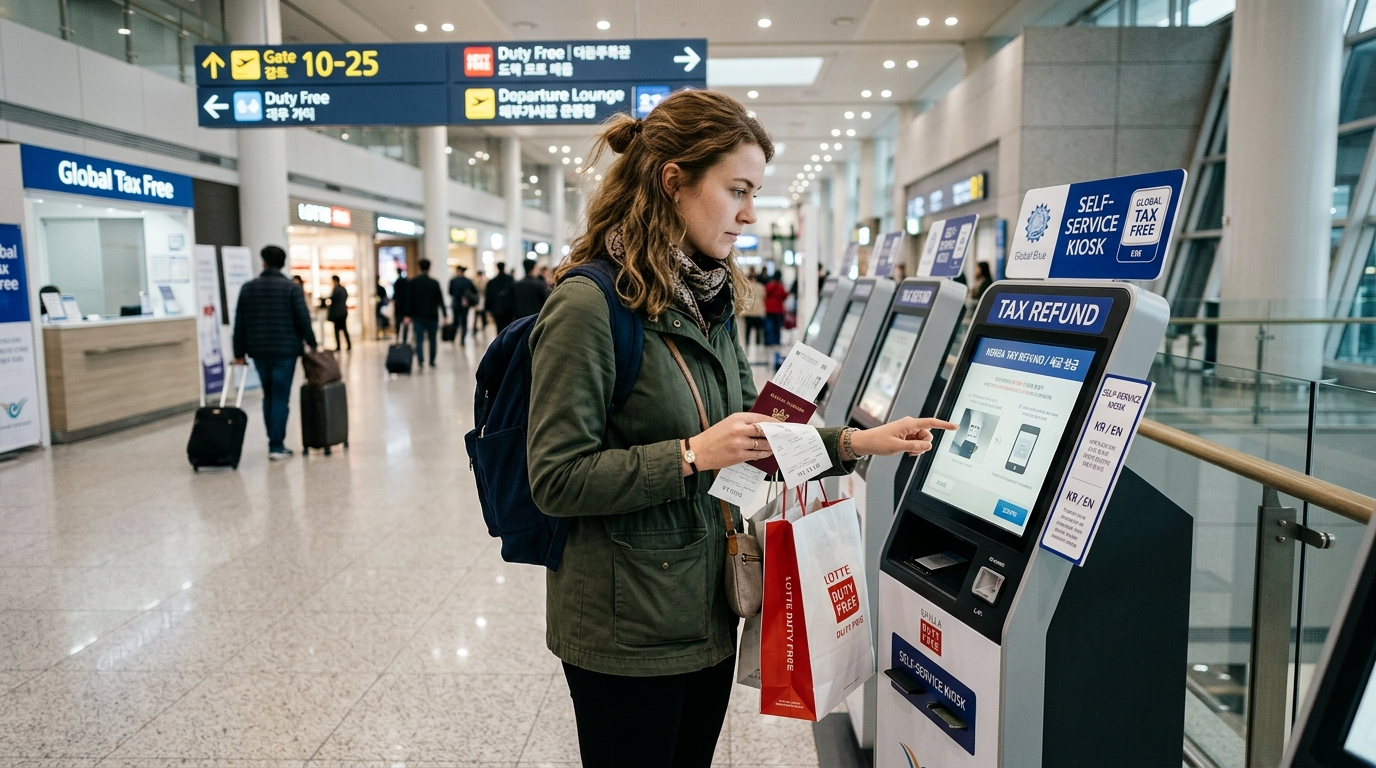
The word kiosk causes its own misunderstanding. It sounds like a self-contained machine that resolves everything in under a minute. In practice, the machine only processes what has already been prepared correctly. It does not fix unclear paperwork, poor sorting, missing documents, or bad baggage timing.
This is also why travelers search using different terms even when they are trying to understand the same thing. One person looks for “VAT refund Korea,” another searches “tax free shopping Seoul,” and someone else types “Incheon airport refund kiosk.” A good guide needs to be readable for all of those people without blurring important distinctions.
When your goods stop being refund-safe
This is one of the most practical friction points in the system, and it is the part many blog posts gloss over. Travelers often assume the refund depends only on the receipt. In reality, the condition and handling of the goods matters too because the claim is connected to export.
If you want to protect the refund claim, the safest habit is to treat refund items differently from ordinary personal-use purchases until the relevant steps are done. Keep the original box where possible. Do not partly use consumables you plan to claim on. Do not let a sealed cosmetic product migrate into your hotel toiletries before the process is truly behind you.
A shopping bag full of goods still in original store condition and a collection of opened products loosely repacked in a hotel pouch do not create the same airport situation. The closer your shopping is to departure day, the more important this becomes.
The temptation to open things early gets stronger when the flight is close. That is exactly when discipline matters most, because once you are already at the airport, there is almost no time left to fix a condition-related problem.
How the airport refund process actually feels in real life
Airport tax refund becomes stressful when travelers imagine it as one quick stop near the gate. The more useful mindset is that airport refund can be a small process, not just a small stop.
If your purchases were not handled through immediate refund at the store, you may arrive at the airport needing your passport, boarding pass, refund paperwork, and the goods themselves all accessible at the same time. If some of those items are already inside checked luggage and your refund situation still requires a confirmation step tied to the goods, baggage timing becomes part of the strategy.
The real question is often not just “Where is the refund counter?” It is “At what point in the departure flow do I still need access to these goods?” Those are different questions, and travelers who confuse them tend to create problems for themselves.
At Incheon Airport, refund locations can appear at multiple points in the departure flow. That does not mean you should improvise. It means you should assume your case may involve more than one stage and leave more buffer than you think you need.
Travelers who handle this well usually do one thing differently: they separate refund-related goods, paperwork, and the plan for both before they leave the hotel, not after they reach the airport.
The airport mistake that causes the most panic
Losing a receipt is bad, but it is not the most disruptive mistake. The most damaging one is handing over the wrong bag too early.
If goods you still needed for a confirmation step are now inside checked luggage that has already left your hands, the problem is no longer theoretical. You are trying to complete a refund claim connected to items you cannot even access anymore.
That is why the decision about what goes into checked luggage and what stays with you matters before the check-in counter, not after. Anything that may still need to be presented, checked, or visually verified should remain accessible until you are sure that stage is finished.
The second major mistake is arriving with no document sorting logic at all. Refund vouchers, department store receipts, café bills, and boarding pass printouts all folded into the same pocket may feel manageable at the hotel. At a refund counter with a queue behind you, it becomes a real problem.
The third major mistake is arriving late and then being surprised that the whole system feels rushed. Airport facilities may be built for tourist volume. Your personal departure margin is still yours to manage.
Downtown booths, airport counters, mailboxes, and mobile options do not suit every traveler equally
Multiple refund methods exist, but they are not interchangeable in practice.
A downtown refund booth can save time if your paperwork is tidy, your purchases fall under the same operator, and you want to reduce departure-day admin. It becomes much less attractive when your shopping is spread across several stores and different operators and you are no longer sure which paperwork belongs where.
Airport refund counters are often the more reliable fallback for mixed shopping because they are built around the full range of departure-day cases. They are not automatically more convenient in every scenario. They are simply more forgiving when the paperwork is messier and the shopping trail is more complicated.
Mailbox submission and mobile refund options sound frictionless, but they still depend on the same fundamentals: correct paperwork, the right operator match, and realistic expectations about how and when the money will come back.
The honest rule is to choose the method that fits your actual behavior, not the one that sounds most efficient in theory. If you are organized and leaving from a major airport with time to spare, airport handling is a strong universal option. If your claim is neat, simple, and clearly matched to one operator, a downtown option may reduce pressure later.
How the refund actually comes back to you
This is another place where traveler expectations and reality often drift apart. Some people picture every tax refund ending with cash counted out on the spot. That is not always how it feels in real life.
Depending on the refund method, the operator, and the payment setup, the money may come back through different channels and on different timelines. Some refund paths feel close to immediate. Others are slower and less visible, especially if the traveler was expecting something that looked more like a store return.
The practical takeaway is simple: do not build your last-day budget around instant refund cash unless you already know exactly how that specific purchase will be paid out. If you are counting on refund money to cover airport food, last-minute transport, or an extra baggage charge, you are putting unnecessary pressure on something that is already time-sensitive.
It is better to think of tax refund money as recovered trip budget. You may get it back, but not necessarily in the exact form or timing you imagined when you were shopping.
The mistakes that delay or lose a refund
- Never separating immediate refund from later refund claim in your own head.
- Not asking the right questions before paying.
- Saving the sales receipt but losing the actual tax refund receipt or refund voucher.
- Opening, wearing, or using refund items too early.
- Packing refund-sensitive goods into checked luggage before you are certain no further access is needed.
- Assuming every downtown refund point can handle every receipt.
- Arriving late and treating time pressure as the airport’s fault.
- Expecting a self-service refund kiosk to fix unclear or incomplete paperwork.
When the refund is worth chasing — and when it is not
For most travelers, the refund is worth pursuing when three things are true at the same time: the amount is meaningful, the paperwork is intact, and the departure plan still leaves enough room to finish the process without turning the airport experience into a stressful sprint.
When those conditions line up, the tax refund is a real part of your trip budget. It is not just a theoretical benefit. It is money worth recovering, and the system is set up to let you recover it if you have handled the earlier steps properly.
It becomes less worth the effort when the amount is small, the paperwork is questionable, and departure day is already compressed. In that situation, the better question is not “Does Korea have a tax refund system?” It is “Did I structure this purchase in a way that makes the refund realistic for me?”
A practical departure checklist for foreign tourists leaving Korea
- Did each purchase already get an immediate tax refund, or are you still holding a claim document that has not been processed?
- Do you have the actual tax refund receipt or refund voucher for every pending claim, not just the normal sales receipt?
- Do your refund items still look new, unused, and appropriately packaged for an export-based claim?
- Have you confirmed that no refund-sensitive goods are buried inside checked baggage before you are sure no further access is needed?
- Have you left enough time for a refund counter, a self-service refund kiosk, or any related confirmation step — not just enough time to find the machine?
- Are you expecting immediate cash from a refund method that may not actually pay out that way?
If your answers are clear, the process usually feels manageable. If your answers are vague, the problem probably did not begin at the airport. It usually started earlier — at the store, in the way the paperwork was handled, or in the gap between how the system works and what you assumed it would do.
Final practical notes
If a participating store offers an immediate tax refund and your purchase qualifies, take it. For most short-term visitors, it remains the simplest option.
If you are in the regular refund flow, separate your refund paperwork from ordinary receipts the moment you leave the store. Not later at the hotel. Not on the morning of departure. Right away.
If the goods may still matter for any airport step, pack like someone who may need to show them. Do not pack like someone who assumes the whole process will be solved by one machine in under a minute.
The shift that makes the entire system easier is simple: stop treating tax refund in Korea as a shopping bonus and start treating it as part of your departure logistics. Once you do that, the steps feel less random and much easier to follow.