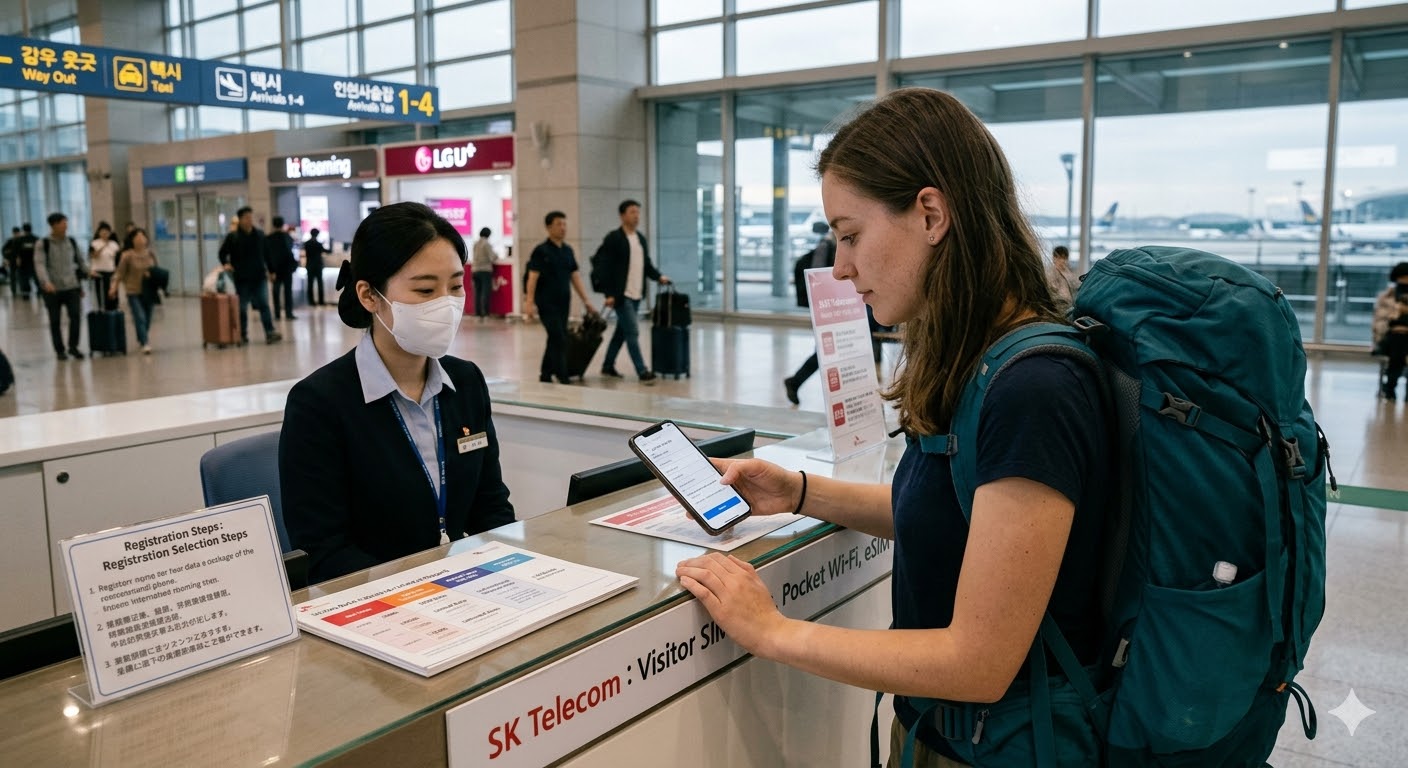
Korea Travel Connectivity Guide
For most short-term visitors, the real priority in Korea is not a local number. It is reliable data, easy access to maps and messages, and a setup that actually matches how the trip works day to day.
A Korean 010 number becomes useful in a narrower set of situations: local callbacks, same-day changes, restaurant waitlists, pickup coordination, domestic-style contact fields, and services that still feel more comfortable with a Korean-format number than with an overseas one.
That is why the better question is not simply “Do I need a Korean phone number?” The better question is what kind of problem you are actually trying to solve in Korea: internet access, local contact, or Korean-style mobile verification. Those are different layers, and treating them as the same thing is exactly how travelers end up paying for the wrong setup.
What matters first
For maps, translation, messages, reservations, tickets, and hotel communication, data usually matters more than a Korean number.
Where friction starts
The missing number becomes noticeable when a service expects local calls, text follow-up, or a domestic contact field.
Most common mistake
A tourist 010 number is mainly a contact tool. It is not the same as full Korean mobile identity verification.
Many first-time visitors get stuck on this topic because “getting connected in Korea” sounds like one decision when it is actually several decisions at once. A lot of travel advice collapses everything into one easy answer and says to buy a local SIM, but that shortcut often ignores the real question hiding underneath. Some travelers only need reliable data. Some need to be easy to reach locally. Others think they need a Korean number because a local app looks blocked, when the deeper issue is authentication rather than contact.
Once you separate those situations, the topic stops feeling vague. You are no longer deciding whether a Korean number sounds useful in theory. You are deciding whether it solves an actual bottleneck in your own trip.
Three things travelers often mix up
1) Mobile data
This covers the basics that shape most days in Korea: maps, messaging apps, translation, email, booking confirmations, transport lookup, and browser-based planning.
2) A Korean 010 number
This helps when a service wants a local-looking contact number, or when a hotel, restaurant, driver, or activity provider may need to call or text you inside Korea.
3) Korean-style mobile verification
This is the deeper authentication layer used by some local platforms. A tourist line can still fall short here even when it gives you service and a Korean number.
What usually works without a Korean phone number
A short Korea trip is much easier without a local number than many visitors expect before they land. If you have steady mobile data, a large part of the trip is already covered: navigation, translation, hotel communication, transport searches, attraction lookup, digital tickets, reservation screenshots, and ordinary daily problem-solving.
That matters because many trips are not actually built around local calling. They are built around moving between the airport, hotel, subway, restaurants, attractions, and shopping areas with a phone that stays online. In that kind of trip, the missing piece is rarely “I do not have a Korean number.” The more common issue is weak data, device incompatibility, or an app choice that assumes local users.
Public Wi-Fi also takes some pressure off the situation. It is available in places such as airports, subway stations, train stations, and some bus stops. That is not a replacement for dependable mobile data, but it does help explain why many short-term visitors move through Korea with no local number at all and still feel connected enough for normal travel use.
| Travel task | Usually okay with data only | A Korean number may help |
|---|---|---|
| Maps, translation, browser search, email, chat apps | Yes | Usually not necessary |
| Hotels and standard pre-booked stays | Usually yes | Helpful if same-day contact matters |
| Taxi booking through foreigner-friendly services | Often yes | Useful if you want easier callbacks |
| Restaurant reservations and waitlists | Sometimes | Often helpful |
| Apps using Korean-style mobile verification | Sometimes blocked | A tourist number may still not solve it |
The most useful way to read this is not “everything works without a Korean number.” That is not true. The more accurate point is that a surprising amount of ordinary travel works perfectly well with data, while the local number only becomes important in more specific, contact-heavy situations.
Where the missing number actually starts to hurt
The weak point is not sightseeing. It is coordination.
Problems usually show up when something needs to move quickly inside the day. A restaurant may want to call the next party. A driver may need to explain a confusing pickup point. A hotel or tour operator may need to confirm arrival timing. A platform may technically accept a foreign number format but still behave as if the real user is someone with a Korean contact number.
That is why travelers sometimes misdiagnose the problem. They think their connection is fine because their data works. But being online and being easy to reach inside Korea are not the same thing. If a business expects a phone call, a domestic text, or a clean Korean-format contact field, a traveler with perfect data can still feel awkwardly out of place in that last step.
The second friction point is app logic. Some apps feel foreigner-friendly at first, even in English, and then become clumsy exactly when a domestic phone field or text-based confirmation step appears. That is why the problem feels inconsistent. It does not block everything. It only shows itself in specific corners of the trip.
A Korean number helps most when…
- Your trip has repeated same-day changes
- You rely on pickup or arrival coordination
- A business may call or text you directly
- You keep hitting domestic contact fields
A Korean number helps much less when…
- Your hotels are already confirmed
- You mainly use public transport
- Your trip is already structured
- Data already covers your actual daily needs
A Korean number is not the same as Korean mobile verification
This is the point that saves travelers the most money and the most disappointment.
A tourist line can make you easier to contact in Korea. It can sometimes give you a Korean 010 number. But that still does not turn the line into a resident-style mobile identity tool. Some local services are built not just around a Korean-looking number, but around a deeper mobile verification layer that tourist products may not unlock.
That is why some travelers buy a tourist SIM, see a Korean number attached to it, and still run into barriers during sign-up, payment, or authentication. The number may be real and useful for contact. The missing piece is that the service is expecting more than contact. It is expecting resident-style mobile authentication.
If you understand that distinction early, the whole topic becomes easier to manage. You stop asking whether a Korean number sounds useful in general, and start asking whether it solves your real problem or only gives you a false sense of coverage.
Important distinction
- A tourist 010 number can help with calls, texts, booking contact, and local number fields.
- It does not automatically unlock full Korean-style mobile identity verification.
- If the service is blocked by authentication rules, a tourist number may reduce friction without removing the deeper barrier.
What a tourist 010 number can actually do
Its value is real, but narrower than many visitors expect.
First, it makes you easier to reach locally. If a hotel, restaurant, driver, or activity provider prefers to call or text a Korean-format number, that interaction usually becomes smoother. Even when a service could technically work through email, some same-day moments simply move faster when your contact looks familiar to the local business.
Second, it reduces friction in booking systems that do not handle overseas numbers gracefully. This is not a universal rule, but it is common enough to matter. A Korean-format contact number can turn a messy contact step into a straightforward one.
Third, it earns its cost more clearly when your trip is fluid rather than fixed. If your schedule involves repeated changes, restaurant queues, pickups, or any situation with voice-heavy coordination, the value of a local number rises quickly. If your trip is organized around confirmed bookings, public transport, and predictable movement, the value drops just as quickly.
The best way to think about it is simple: a tourist 010 number is a travel contact tool. It is not a magic key to the full Korean digital ecosystem, and it is not the default first purchase every traveler should make.
Late-night arrivals change the equation more than people expect
Arrival-night reality check
If you land late, the real question is not just “Should I get a Korean number?” It is “Do I need local voice and text working tonight, or will data get me through the first few hours?”
Many travelers assume that once they buy the right telecom product, every feature will be ready the moment they land. In real travel, that is not always how it feels. Data may be available before voice and text are fully ready, depending on the product and verification flow.
This matters most on arrival nights with hotel coordination, pickup timing, or any service that expects you to be reachable by local call or text immediately. A traveler who only needs maps, messages, hotel information, and the route into the city can often get through the first night with a data-first setup. A traveler who needs same-night contact may care much more about activation timing.
That difference is easy to miss in generic SIM guides because they treat “connectivity” as one switch that turns on all at once. In real travel, different functions can come online on different timelines, and that is exactly why late-night arrivals deserve a separate decision.
How tourists can actually get a Korean phone number
Short-term visitors usually do not need a resident-style mobile contract. The practical route is a tourist SIM or tourist eSIM sold through official inbound travel products.
This matters because it changes what you should expect from the process. You are not trying to become a regular Korean mobile customer. You are choosing a short-term travel product built for visitors. That product may include data only, or data plus voice and text, depending on what the carrier offers and what you actually need from the trip.
In practical terms, most travelers choosing whether to get a Korean number are deciding between three broad setups: home-country roaming, a data-only tourist SIM or eSIM, or a tourist SIM/eSIM that includes voice, text, and a Korean 010 number.
| Setup | Best for | Main limit |
|---|---|---|
| Home-country roaming | Keeping your usual number active | Not a domestic Korean contact number |
| Data-only tourist SIM / eSIM | Maps, translation, email, messaging, booking | No real local voice-text advantage |
| Voice-enabled tourist SIM / eSIM | Trips needing local calls, texts, or easier callbacks | Still not the same as resident-style authentication |
What the buying process actually looks like for tourists
The process is simpler than a resident phone contract, but more structured than many first-time visitors expect. Four decisions matter:
Step 1
Choose the right type: data only, or voice and text as well.
Step 2
Check your phone: unlocked device, eSIM support if relevant, and compatibility before you fly.
Step 3
Prepare documents: passport-based registration or verification is not just paperwork. It can affect activation timing.
Step 4
Decide where to finish setup: airport handling for less arrival friction, or pre-arrival eSIM if data is all you need.
The reason this process feels confusing to so many travelers is that those four decisions often get blurred together. People think they are choosing one product, when they are really making several smaller decisions at once: what functions they need, whether their device is ready, whether their documents are in order, and when they want the setup completed.
Once you separate those decisions before you fly, the process becomes much easier to manage and much less likely to go wrong on arrival day.
Where foreign travelers can actually check before paying
This is where the article stops being theory and becomes useful.
One of the biggest reasons travelers overpay or choose the wrong setup is that they start with random summaries instead of official routes. If you want a broad travel-side answer first, start with VISITKOREA. That is the place to check airport roaming centers, tourist SIM and eSIM basics, public Wi-Fi information, and general foreign-visitor connectivity guidance.
VISITKOREA first
Best for broad travel-side questions: airport roaming centers, public Wi-Fi, prepaid SIM/eSIM basics, and foreign-visitor travel setup.
1330 Helpline
Best for live help when the problem is not a telecom spec sheet but a real trip issue: arrivals, tourist support, service confusion, or where to go next.
Official carrier pages
Best when you are comparing products directly: LG U+, SK Telecom, and KT all provide official inbound tourist options.
Tourist Information Centers
Best after arrival if the issue is already happening on the ground and you need a practical next step rather than another blog article.
If the question is not “which carrier plan is cheapest?” but “what should I do as a traveler in this situation?” then 1330 is often more useful than comparing telecom pages immediately. It helps when the real issue is airport arrival, tourist support, a confusing service, or figuring out whether a local route is foreigner-friendly in the first place.
If you already know you are comparing telecom products, then move directly to the official carrier pages. That is where product structure, pickup options, voice-versus-data differences, and setup limits become clearer. If you are already in Korea and the question is happening in real time, Tourist Information Centers can be more useful than another round of online searching because they move the issue from theory to action.
The key point is that foreign travelers do not need to guess from random summaries. There are official travel-side and carrier-side routes for checking the basics before spending money.
What to use when the local app or service does not work for foreign travelers
This is another place where weak advice goes wrong. If a local app becomes awkward for foreigners, the answer is not always “buy a Korean number and try again.” Very often, the smarter move is to switch to a foreigner-facing route instead of forcing the resident-facing one.
That matters because some travel problems are not telecom problems at all. They are route problems. You may be using the wrong version of the service, the wrong signup path, or the wrong expectation about what a tourist line can fix.
| Need | Foreigner-friendly path | Why it matters |
|---|---|---|
| Taxi booking | k.ride | Email / Google / Apple paths reduce dependence on a Korean-number-only flow |
| Restaurant reservation | Catchtable Global | Designed for foreign users without forcing a Korean phone number at sign-up |
| Dining / reservation / delivery help | Creatrip | Useful when the standard local route is too tied to Korean mobile verification |
When a local app starts asking for Korean-style contact or verification, work through three questions in order: Is there an official foreigner-facing version? Can the service be handled by email, web booking, or hotel staff instead? Is the real problem simple contact, or is it deeper authentication that a tourist number may not solve anyway?
That simple sequence can save both money and frustration. It keeps you from treating every blocked service as proof that you need a Korean number, when sometimes the real answer is just to stop using the resident-facing flow.
When paying for a Korean number is worth it — and when it is wasted money
Worth paying for
- Repeated same-day changes
- Restaurant queues or waitlists
- Airport / hotel pickup coordination
- Trips where businesses may need to call quickly
- Longer stays with repeated local contact friction
Close to wasted money
- You mainly need maps, messages, and hotel communication
- Your trip is already structured
- You assume any 010 number unlocks every Korean app
- The real barrier is mobile authentication, not simple contact
A Korean number is worth paying for when local contact is genuinely part of how the trip operates. It becomes poor value when it is being purchased to solve the wrong problem, especially when the real need is data access or when the hidden barrier is mobile verification rather than ordinary contact.
So who should actually get one?
A Korean number makes the most sense for travelers whose trip genuinely depends on being easy to reach inside Korea. That includes people handling multiple bookings, same-day changes, pickup coordination, waitlists, or services where staff may prefer to call instead of communicating slowly through email.
It makes much less sense for visitors with a clean, structured trip: confirmed hotels, public transport, simple food plans, and a willingness to use foreigner-friendly routes when local apps become awkward. In that kind of trip, data is usually the real priority and a Korean number becomes optional.
The trap to avoid is treating a Korean number as a default travel purchase because it feels more complete. More complete is not the same as more useful. The better purchase is the one that removes the real bottleneck in your specific trip.
The simplest decision rule
If all you need is internet access, buy data.
If you need local calls or texts and want a Korean contact number that businesses in Korea can actually use, buy a tourist SIM or eSIM with voice support.
If you think you need a Korean number because a local app or service appears to rely on Korean-style verification, pause before buying. Check whether a foreigner-facing route exists first. In many cases, the real problem is not that you failed to buy a Korean number. The real problem is that you bought the wrong kind of connectivity for the wrong reason and expected it to solve something it was never designed to solve.
For most tourists, a Korean number is not the foundation of a successful trip. Reliable data is. Data covers the parts of the trip that matter most every day: maps, translation, messages, reservations, transport, and basic problem-solving once you are already in Korea.
A Korean number becomes genuinely valuable only when your trip depends on local contact in a more direct way. If businesses may need to call you, if same-day changes are likely, or if domestic-style contact fields keep getting in your way, paying for one can make sense.
But that value has a ceiling. A tourist 010 number is best understood as a contact tool, not a resident identity tool. It can help with calls, texts, reservation handling, and local number fields. It does not automatically turn a short-term travel product into full Korean mobile verification, and it does not guarantee that every local app or sign-up flow will behave the way it would for a Korean resident.
The cleanest decision usually comes from identifying the real problem first. If the problem is internet access, buy data. If the problem is local contact, buy a product with voice support. If the problem is Korean-style verification, do not assume that buying any Korean number will fix it. Check the service itself, and look for a foreigner-facing route before spending money on the wrong workaround.
Most tourists do not need a Korean phone number to travel well in Korea. Some clearly benefit from having one, and for the right kind of trip it can remove a surprising amount of recurring friction. But it is useful only when it matches the actual shape of your trip. Once you stop treating it as a default purchase and start treating it as a specific tool, the decision becomes clearer, cheaper, and much less likely to disappoint you after you land.