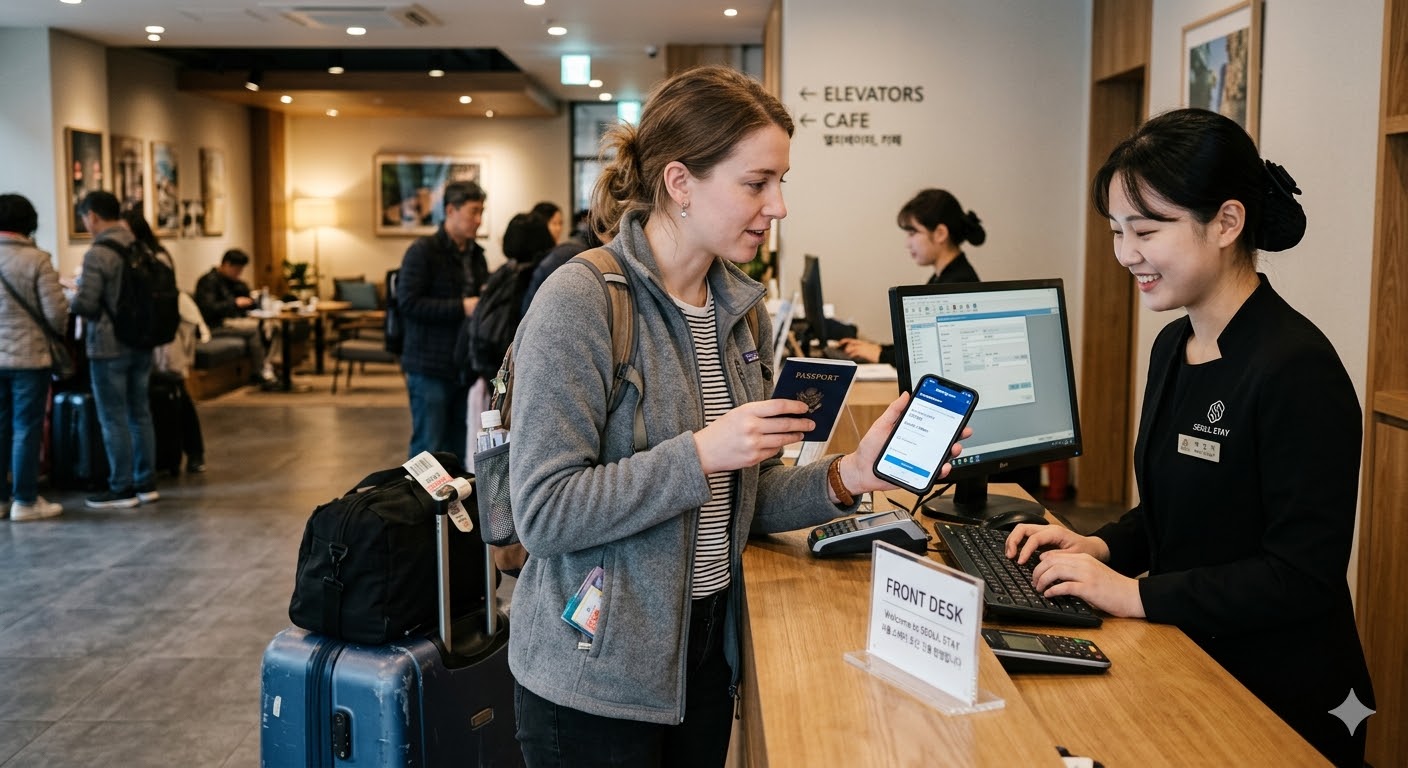
There is a particular kind of travel slowdown that does not look serious from the outside. You have already left the airport, reached the right neighborhood, and found the property. Nothing is visibly wrong. But the room is not ready yet, the booking name is not appearing exactly the way you expected, the front desk asks for a card even though the reservation says it is paid, and the entrance that looked obvious on the map turns out to be less obvious in person.
That is the version of hotel check-in in Korea that catches first-time visitors off guard. Not because the process is unusually difficult, but because many travelers mentally treat the hotel lobby as the finish line. In practice, arrival at the property and successful check-in are often two separate stages, and the friction usually sits in the gap between them.
This guide is built around the real moments when foreign travelers get slowed down: arriving too early, handling passport checks, dealing with booking-name mismatches, figuring out whether a card request is normal, choosing between a kiosk and a front desk, finding the actual entrance, and making sense of late arrival instructions without turning a simple check-in into a tired half-hour detour.
You reached the hotel, but the room is not ready
This is usually a timing issue, not a sign that something is wrong with the reservation.
The booking exists, but the name is not matching cleanly
This is common when another traveler made the reservation or the account name differs from the passport name.
The reservation says paid, but the desk still wants a card
That often reflects a hold, authorization, or verification step rather than a second payment.
The address is right, but the entrance is not obvious
That is often a building-layout issue, especially in mixed-use Korean city buildings.
Why check-in friction feels bigger after a long arrival day
Hotel check-in in Korea is usually efficient. In large cities and at properties that regularly host international guests, staff are used to moving arrivals along quickly. The process is not hard in a formal sense. The reason it feels harder than expected is timing.
By the time many foreign travelers reach the hotel, they have already used up their best attention on the parts of the trip they expected to be difficult: immigration, money, maps, airport transfer, phone data, and public transportation. Once they step into the lobby, they are no longer in problem-solving mode. They assume the room key is close. That is exactly why ordinary front desk issues feel disproportionately irritating.
Most of the time, the check-in itself is not failing. The traveler is just hitting several small operational details at the worst possible moment: low energy, luggage still in hand, battery partly drained, and a mental picture of the journey already being over.
The most useful expectation: getting to the hotel and getting into the room are often connected, but they are not always the same event.
When early arrival is the real issue
Many international flights into Korea land in the morning, while hotel check-in often starts later in the afternoon. That gap is one of the most common sources of front desk friction for foreign travelers.
A guest can reach the hotel perfectly on time from a transportation point of view and still be too early from the property’s point of view. The room may still be occupied. It may still be in cleaning. A specific room type may not be ready even if another room category already is. Sometimes the property can move faster; sometimes it cannot. That is why early arrival often feels uncertain when travelers are hoping for a simple yes-or-no answer.
The most practical arrival-day assumption is not “I will probably get early check-in.” It is “I may be able to leave my luggage and come back later.” That expectation matches reality more often and makes the interaction with the front desk much less frustrating.
| What happens | What it usually means | Best response |
|---|---|---|
| The room is not ready when you arrive | The previous guest may have checked out late, or housekeeping is still turning the room over. | Ask about luggage storage first and treat room access as the second question. |
| The staff cannot promise early check-in | Room availability depends on same-day turnover, not only written policy. | Get a realistic return time instead of waiting in uncertainty in the lobby. |
| Another room seems available, but not yours | Your booked room type may not be ready yet even if the hotel is already cleaning others. | Do not assume the desk is being difficult; room-type timing can matter. |
Luggage storage matters much more than many travelers realize. Once your bags are no longer on your shoulders, the whole timing problem becomes smaller. You can get food, take a short walk, buy basic essentials, or simply rest without forcing the front desk to solve a room-readiness problem it may not yet be able to solve.
Useful arrival-day rule: if you are very early, solve the luggage problem before you mentally fixate on the room key.
When the passport and the booking do not line up smoothly
One of the most common surprises for foreign guests is how quickly the front desk asks for a passport. This is normal. The property usually needs to verify and record the identity of the guest checking in. What feels repetitive to the traveler is often simply a standard registration step for the hotel.
The passport issue becomes slower when it overlaps with a booking-name mismatch. That can happen in very ordinary ways:
- the booking was made by a spouse, friend, or travel companion
- the reservation uses a shortened version of the name
- the passport uses a full legal name while the reservation uses a familiar one
- a middle name appears in one place but not the other
- the person who booked the room is not the first person who reaches the desk
In most cases, this is still easy to resolve. What wastes time is not the mismatch itself, but the fact that the actual explanation often appears too late. The front desk starts searching one name, the traveler assumes the reservation has gone missing, and only then does the real detail come out.
The fastest version of this interaction is usually short and factual. If the booking may be under another name, say that immediately. If the reservation was made by someone else, say that immediately. If the desk needs more context, the supporting information that helps most is usually:
- the booking number
- the reservation confirmation email
- the app booking screen
- the phone number attached to the reservation
- the passport name
What travelers often assume
“The hotel cannot find my reservation.”
What is often actually happening
The reservation exists, but the guest and the booking are not matching in the most direct way on first search.
That is why the simplest arrival-day preparation still matters: make the passport easy to reach before you walk into the lobby, and keep the reservation open on your phone instead of buried in email.
When the front desk asks for a card even though the booking says “paid”
This is another moment that makes first-time visitors pause. The booking app shows the stay as paid. The confirmation looks complete. Then the front desk asks for a card anyway.
This does not automatically mean the hotel is charging you twice. A card may still be requested for:
- a deposit or temporary authorization
- incidentals such as room service or minibar charges
- identity or booking verification
- property-specific handling between the booking platform and the hotel’s own system
The emotional reaction comes first. Travelers worry that something failed or that a hidden charge has appeared. In many cases, the issue is much smaller than it feels at the desk.
The most useful question is precise: “Is this for payment, or is this a deposit / authorization?” That wording usually gets a cleaner answer than a broad question about why the card is needed.
Not every property handles this the same way. Larger hotels and more international-style properties are more likely to use a card authorization or incidentals system. Smaller guesthouses may be simpler. Residence-style stays can fall somewhere in between. The point is not to guess the policy in advance with perfect accuracy. The point is to avoid assuming that “paid online” automatically ends every payment-related conversation at the desk.
The cleanest arrival-day setup is still basic:
- passport accessible
- reservation open on your phone
- the card used for the booking available if possible
When a kiosk looks available, but speaking to staff is still the faster move
Self check-in kiosks are increasingly common in Korea, especially at newer hotels and business hotels. In simple cases they work well. If the booking is straightforward, the name matches cleanly, the passport scan works, and the arrival is at a normal hour, the kiosk can move things along quickly.
The problem is that kiosks are best when everything is already aligned. Foreign travelers often reach them precisely when something is not fully aligned yet.
| Kiosk usually works well when… | Front desk is usually better when… |
|---|---|
| The reservation is straightforward and the passport details are matching cleanly. | The name may be under another traveler or the booking needs clarification. |
| You do not need to ask about room timing or special requests. | You arrived early and need luggage storage before anything else. |
| The machine flow feels easier than speaking to someone. | The language flow, scan step, or instructions are slowing you down. |
| You do not need to ask about payment holds or deposit handling. | You want confirmation about charges, access, room type, or late-night entry details. |
The fastest check-in method is not always the most automated one. It is the one that fits the actual condition of your arrival.
When the address is correct but the entrance still feels wrong
One of the most overlooked hotel-arrival problems in Korea has nothing to do with the front desk itself. It is finding the actual entrance.
This happens more often than many foreign travelers expect because some small hotels, guesthouses, and residence-style properties are not always presented as single-use buildings with a large, unmistakable lobby facing the main road. Some sit inside mixed-use buildings. Some occupy only certain floors. Some use side entrances, elevator lobbies, or shared building access points that are easy to miss if you are walking quickly with luggage.
A map pin can therefore take you to the correct address while still leaving you in front of:
- the wrong side of the building
- a side entrance instead of the main one
- a shared building lobby
- a directory board rather than a visible hotel sign
Travelers often read this as a navigation failure. Most of the time, it is a building-layout problem.
If the address looks right but the hotel feels invisible, stop searching for a classic street-facing hotel facade. Look instead for a building name, elevator directory, floor listing, small signage, or instructions in the booking messages.
This is one reason why “I already arrived” can still turn into another ten minutes of unnecessary searching. You are at the right place in a geographic sense, but not yet at the right door in a practical sense.
Late-night check-in usually depends on the access method more than the room
Late arrivals are common in Korea, especially after evening airport transfers. Many larger hotels in major cities are set up to handle them well. But the right question is not only whether you are arriving late. It is what kind of property you are arriving late to.
A late arrival at a major hotel with a staffed front desk is one thing. A late arrival at a guesthouse, keypad-entry property, or residence-style stay can feel different because the friction is usually about instructions rather than room availability.
That is where travelers often lose time:
- not reading access instructions before reaching the building
- missing keypad or access-code information in booking messages
- assuming someone will always be sitting at the desk
- arriving with too little battery left to retrieve the check-in details
For late arrivals, the room is rarely the main issue. The real question is how the property expects you to access it when you get there.
What usually makes the whole process feel harder than it is
Hotel check-in in Korea rarely becomes stressful because of one major failure. More often, it feels difficult because several small issues overlap at the worst possible moment: you are tired, carrying luggage, low on battery, a little hungry, and mentally convinced the difficult part of the trip should already be finished.
That is why short, practical front desk communication matters more than long explanations. In many situations, the fastest path is the most specific one:
- “The reservation may be under another name.”
- “I know I’m early. Can I leave my luggage first?”
- “Is this a payment or a deposit?”
- “Is check-in through the kiosk or the desk?”
These are not elegant travel phrases. They are useful operational phrases. That is why they work.
A better way to think about arrival
You do not need to treat hotel check-in as one big event. It usually works better when you read it as a short sequence:
- Find the correct building
- Find the correct entrance
- Match the booking to the guest
- Handle luggage if room access is not ready
- Clarify card use only if needed
- Get the room access step done last
When travelers focus only on the room key, every interruption feels like a problem. When they expect the sequence, the same interruptions feel normal.
What first-time visitors should remember most: the lobby is not always the finish line. In Korea, hotel arrival often becomes smoother when you stop treating check-in as a single moment and start treating it as a series of smaller tasks that become easy once they are handled in the right order.
Bring your passport within easy reach. Keep the booking open. Assume that early arrival may mean luggage first, room later. Ask directly whether a card request is a payment or a hold. And if the building looks right but the hotel does not, assume an entrance or layout issue before assuming the map failed.
That approach removes most of the unnecessary friction without making the article thinner or more generic.