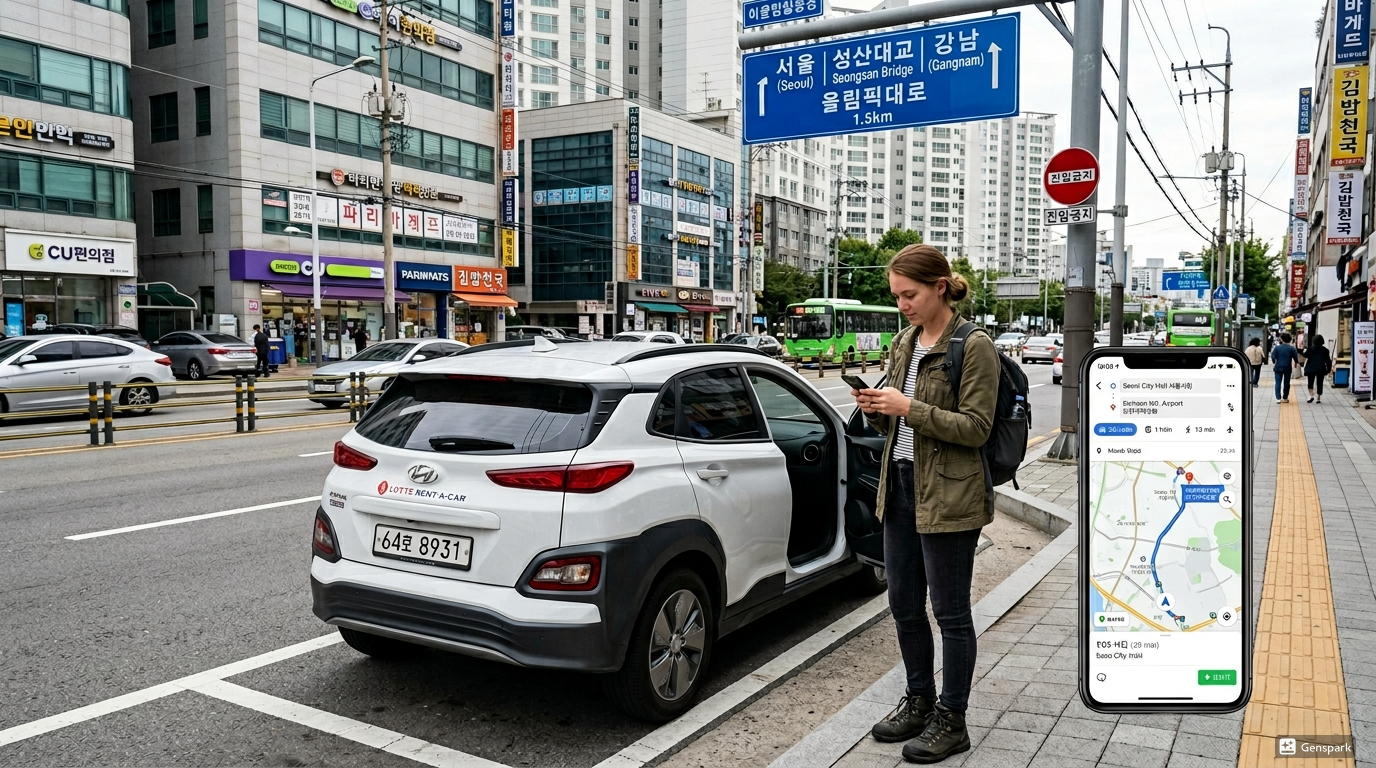
Can Tourists Drive in Korea? Car Rental Rules, IDP Limits, and the Navigation Problems That Catch First-Time Drivers
Driving in Korea as a tourist is possible. But the version that works smoothly requires deliberate preparation—and avoiding the small return-day mistakes that quietly drain your budget.
A lot of first-time visitors ask the wrong question. They ask whether foreigners are allowed to drive in Korea, hear “yes,” and then treat the rest like a normal rental decision. That is where the trouble starts.
The more useful question is not simply whether you can rent a car. It is whether renting one actually improves your itinerary, whether your documents are solid enough for pickup, whether your navigation setup is realistic, whether your insurance choices are clear, and whether you understand the small return-day details that can quietly make the rental more expensive than it looked at booking.
Korea is not a place where rental car decisions come down to daily rates alone. They hinge on route type, city density, parking realities, tolls, navigation capability, branch location, fuel return rules, and how much of your trip falls outside the rail-and-subway network. If you are staying mostly in central Seoul, renting too early can turn a practical trip into an expensive inconvenience. If you are heading to Jeju, rural Gangwon-do, coastal routes, smaller cities, mountain areas, or destination chains where public transportation becomes slower and more fragmented, a rental car can quickly become one of the highest-value decisions in the whole trip.
The real question is this: when is a rental car in Korea actually worth the money, what do foreign tourists need to prepare, and what catches first-time drivers even after they think they are ready?
Yes, tourists can rent a car in Korea — but document requirements are stricter than most expect
Short-term foreign visitors can rent a car in Korea if they meet the basic conditions. In practical terms, that usually means being old enough to satisfy the rental company’s minimum age policy, entering Korea as a tourist rather than a long-term resident, carrying a valid passport, presenting a valid International Driving Permit, and paying with a card in the driver’s own name. Some companies also require the driver’s original home-country license, which is why treating the IDP as your only document can create unnecessary stress at pickup.
Many travelers make an avoidable mistake. They assume “I have an IDP” means “I am done.” It does not. The real question at pickup is whether your document set is complete enough for the specific agency in front of you. A foreign tourist who arrives with only a digital copy, a missing passport, a card in another traveler’s name, or an IDP that does not clearly match the vehicle class can lose significant time before the trip has even started.
The safest approach is straightforward: bring the original passport, the original IDP, your original home-country driver’s license, and a usable credit card in the renter’s name. Even when a company’s public guide sounds slightly more relaxed, the pickup desk is where theoretical eligibility becomes a practical yes or no.
The best-value strategy for many tourists is not renting from day one
For a lot of foreign travelers, the most cost-effective approach in Korea is not to rent a car for the whole trip from the moment they land. It is to rent only for the segment where a car starts creating real time savings.
If your first days are mostly in Seoul, getting from the airport into the city is already easy and well-served. AREX, subway lines, airport limousine buses, and taxis all work well, and a rental car often adds cost before it adds value. The meter starts running the moment you pick up the car, but during a Seoul-heavy stretch you may be paying for parking, congestion, tolls, and hotel complications while using the car far less than you imagined.
For many travelers, the cleaner approach is this: use public transportation for the Seoul portion, then rent a car only when the itinerary moves into territory where trains and buses become slower and more fragmented. That typically means Jeju, outlying coastal routes, smaller-city loops, mountain areas, national park circuits, or countryside stops where getting around by transit would require multiple transfers and long waits. In those situations, the car is not just transport. It becomes a tool for recovering time and flexibility.
Airport pickup is also not automatically the best-value option. It feels convenient, but convenience and efficiency are not the same thing. If you are not driving straight from the airport into a car-dependent itinerary, you may be paying rental hours too early. City-branch pickup after your Seoul stay can sometimes be cheaper, calmer, and better aligned with how you actually plan to move.
The value move is not “book the car as early as possible.” It is “start paying only when the car begins solving a real transportation problem.”
Car size matters more than most tourists realize
Another common mistake is renting by imagination rather than by actual need. A lot of travelers browse rental listings and drift upward too easily: a larger sedan, an SUV, something that feels more comfortable for travel. Sometimes that is genuinely justified. Often it is not. If you are a solo traveler, a couple, or even two adults with moderate luggage, a compact or economy-class vehicle is usually the value baseline worth checking first.
That matters in Korea because the rental rate is only one part of the real expense. Fuel, parking, and maneuverability all factor in. A larger vehicle can feel reassuring in theory and then become genuinely inconvenient in hotel parking lots, narrow side streets, underground garages, older parking structures, and busy tourist zones. Unless your route benefits from extra size, or you are moving a family-scale luggage load, going bigger simply adds more expensive friction.
The smarter play for most first-time foreign drivers is to match the size of the car to the actual shape of the trip. That usually means starting with the smallest class you can comfortably live with and moving up only if passenger count or luggage genuinely requires it.
Booking method changes the price more than most tourists expect
Choosing the right car is only part of the equation. Booking through the right channel and structuring the rental correctly matters too.
Some official English-language rental channels offer branch-level discounts, global-site discounts, and pricing rules that only apply once the rental crosses a certain time threshold. One concrete example: official pricing notes from LOTTE Rent-a-Car state that some discounts apply only to rentals longer than 24 hours. A traveler who books a short segment the wrong way may end up paying more than someone who structures the same driving need as a slightly longer, properly discounted rental.
If you are close to the 24-hour line, it is worth checking whether a different pickup or return time changes the pricing structure. That does not mean every longer rental is cheaper. It means Korean rental pricing can reward duration thresholds, branch promotions, and international booking channels more than travelers typically expect.
The practical lesson: do not judge value based on the first displayed daily rate. Check whether the official international booking page offers a better discount, whether your preferred branch has a stronger rate than the airport branch, and whether a 24-hour-plus structure changes the total in your favor.
What foreigners actually need to prepare before they land
The biggest pickup problems usually begin before departure, not at the counter. The first thing to settle is the IDP itself. This is not something to sort out on arrival. If you plan to drive in Korea, get the correct International Driving Permit from an authorized source in your home country before the trip, and make sure it matches the convention and validity conditions the rental company recognizes. Do not assume that a local-language “international license” card, an online certificate, or a document issued by a private organization is automatically sufficient. Bring the original, not a screenshot.
Second, carry your home-country driver’s license alongside the IDP. Even when travel guides suggest some companies may not always require it, that is not a risk worth testing at the counter.
Third, make sure the payment card is functional and belongs to the primary driver. Rental desks tend to be stricter about name matching than travelers sometimes expect.
Fourth, install your navigation apps before you travel, not after pickup. This matters more in Korea than in most countries because Google Maps does not function normally for turn-by-turn driving inside Korea. If you arrive assuming Google will handle the whole trip, you are already setting yourself up for a difficult first hour behind the wheel. Naver Map and Kakao Map are the better default setup, and you want both working before the rental desk hands you the keys.
Fifth, confirm pickup logistics, not just the reservation confirmation. Some airport-area rentals are not direct curbside handovers. A traveler who books the car but ignores shuttle transfer details, pickup building location, or return lane instructions can waste time before the trip has properly started.
The preparation checklist is not complicated, but it is specific: valid IDP, passport, home license, named card, working navigation apps, and clear pickup instructions.
Google Maps is not your driving solution in Korea
In most countries, navigation feels like a solved problem before the trip even starts. Everyone assumes Google Maps will carry them through. In Korea, that assumption breaks down for driving. Google Maps does not provide normal GPS navigation for drivers in Korea. You should not build your rental plan around it.
The correct move is to prepare Naver Map or Kakao Map in advance. Not as a backup, but as the primary tool. For most tourists, working navigation is a core part of rental readiness, not an optional extra. If you wait until the pickup lot to figure out which app will get you out of the airport area or through the city, you are already behind. The first drive is when stress runs highest, and that is exactly when you do not want to be downloading unfamiliar apps in a parking bay.
A tourist who is legally eligible to drive in Korea but has not solved the navigation layer is not actually prepared to drive in Korea. That does not make the trip impossible. It just means the real readiness line is not the rental contract. It is the moment your route guidance becomes dependable.
The first-time driver problem is usually not the road rules — it is the road itself
Many visitors assume the hard part of driving in Korea will be learning the traffic rules. For most first-timers, the harder part is something else entirely: the real-time translation between unfamiliar roads, an unfamiliar app, lane decisions made at speed, and the local driving rhythm.
Korea drives on the right side of the road, with the driver’s seat on the left. Speed and distances are in kilometers. Those facts are easy to learn. The trickier part is how quickly small decisions pile up when you are following navigation through dense urban roads, complicated intersections, toll gates, lane splits, and signage you have never seen before. When the navigation app itself is unfamiliar, even a simple wrong-lane choice can feel far more stressful than it would at home.
This is why first-time foreign drivers often do better when the opening rental segment is not a central Seoul stress test. If the whole point of the rental is a countryside route, a coastal drive, or a Jeju itinerary, the first hour on the road may feel entirely manageable. If the first hour is city driving with unclear parking, tight timing windows, and dense lane pressure, the experience can quickly feel more exhausting than it was worth.
Plan a first drive you can get through calmly.
Insurance is where tourists most often misread what is actually covered
Many travelers hear “insurance included” and assume the whole risk question is settled. It usually is not that simple.
Official guidance notes that rental costs in Korea typically include coverage for personal injury, third-party injury, and third-party property damage. That matters, but it does not automatically mean damage to the rental vehicle itself is fully covered. In many cases, protection for the car you are actually driving is either a separate option or depends on the specific insurance package you select.
This is exactly where tourists should slow down and read carefully. The most important question is not “Is insurance included?” It is “What is included, and what happens if the rental car itself is damaged?” If the answer is vague, the contract is not yet clear enough.
Some international-friendly operators make their foreign-customer rules more explicit. LOTTE’s official English guidance, for example, describes CDW for vehicle damage as separate from the basic rental charge and notes no-deductible CDW products for international customers. That is not necessarily universal across all Korean rental companies. Tourists should not assume a single line item labeled “insurance” covers every cost scenario that actually matters to them.
Before pickup, understand whether your package primarily covers damage to others, or whether it also protects the car you are driving.
Return day is where many tourists quietly lose money
Most travelers pay close attention when booking and again at pickup. Fewer bring that same attention to return day. That is exactly where small, avoidable costs tend to collect.
The reservation price is not the final figure by itself. Return day is where fuel policy, toll handling, timing, branch access, and vehicle inspection all come together. Arriving late, running low on fuel, unsure of the return lane, or still unclear about how tolls were handled can turn the last part of a rental into something more expensive and more stressful than it needed to be.
This is especially worth thinking about when the drop-off point is the airport. At that stage, most travelers are already mentally in departure mode — thinking about check-in, luggage, and flight timing rather than fuel gauge precision. That is exactly when people return the car below the required level and absorb refueling charges that were entirely avoidable with a bit of earlier planning.
The rental does not end when you enter the airport zone. It ends when the branch has inspected the vehicle, confirmed the fuel level, and closed the return cleanly.
If your return point is the airport, the fuel gauge matters more than you think
For official international-friendly rental channels such as LOTTE, the fuel policy is effectively full-to-full: return the car at the same fuel level it had at pickup. If the vehicle was handed over full, return it full. If it comes back below that level, refueling charges can be added at the return location.
That sounds obvious, but it matters because many travelers treat the fuel gauge loosely in the final hour. They assume “close enough” will be fine. They assume there will be a convenient station right near the airport. They assume return staff will interpret the gauge generously. Those assumptions are how return-day extra costs happen.
Treat the original fuel level as a contract condition, not a loose guideline. If the car was delivered full, plan to return it full. If the branch recorded a specific level at pickup, match that level on return. Do not leave it to negotiate at the desk after a long drive. If you skip this planning, you may not just pay for fuel. You may pay at the rental company’s own refueling rate rather than handling it yourself on your own terms.
For Incheon Airport returns, do not leave fuel planning until the final stretch
If your drop-off is at Incheon Airport or an airport-area rental branch, fuel planning should be sorted before the final airport run begins — not during it.
For drivers approaching via the Airport Expressway, the Yeongjong Bridge Rest Area is the key highway stop to know in advance. It is accessible only in the airport-bound direction, includes a gas station, and that station’s operating hours run from 06:00 to 22:00. That matters because once you are committed to the last stretch of the airport approach, you are not in a good position to be guessing whether another easy fuel stop will appear at the right moment.
Not every traveler returning to Incheon arrives by the same route, and individual approaches vary. But if your final airport drive uses the Airport Expressway corridor, identify your fuel stop before you are already locked into the last run. Do not assume you will find somewhere convenient near the airport without checking first. This is not sightseeing advice. It is cost control. If the car needs to be returned at pickup-level fuel, and airport return timing is already tight, knowing where you plan to refuel is a smarter position to be in than hoping something works out.
Tolls, fuel, and return conditions are part of the real cost — not side notes
Another common mistake is calculating rental value based only on the booking price. The real cost of driving in Korea includes toll handling, fuel policy, return conditions, parking exposure, and sometimes one-way location fees. Highway tolls in Korea can be paid directly at a toll gate or automatically through Hi-pass if the vehicle is equipped for it. That sounds simple, but if you are not sure how your rental car is set up, or how tolls will be charged back to you, the first toll road can become unexpectedly confusing.
Fuel is another detail that gets casually managed until it suddenly matters at return time. Official rental guidance from LOTTE notes that cars are generally rented with a full tank and that refueling charges can apply if the car is returned without meeting the required fuel level. That is standard rental logic, but it lands harder when a traveler is rushing to an airport drop, unfamiliar with local stations, or not fully confident in how closely the branch will inspect the gauge.
The highest-value renter is not the one who finds the lowest advertised rate. It is the one who understands how the final bill actually gets built.
When renting in Korea is worth it — and when it is not
For most foreign travelers, renting in Korea is worth it when the car removes real transportation friction rather than simply adding private comfort.
It tends to be worth it in Jeju, on rural or coastal itineraries, on mountain or national park routes, or on trips where multiple smaller stops would otherwise require repeated transfers and long waits. In those cases, a car buys back time, flexibility, and route control in ways that are genuinely hard to replicate with public transit.
It tends not to be worth it when the itinerary is mostly central Seoul, when parking will be awkward, when the traveler is not comfortable switching to Naver Map or Kakao Map, or when the first driving segment is likely to be dense urban traffic that adds stress without producing meaningful time savings.
The best-value rental strategy is often selective rather than maximal. Rent for the days the car solves a real problem. Stop paying for it when public transportation is already doing the job better.
What to actually do, in order
If you want the cleanest real-world process, the sequence matters.
Get your IDP before the trip. Bring your passport, home license, and a named credit card. Choose a route where a rental car creates genuine value. Book through an official international-friendly page where the conditions are clearly stated. Check whether discounts apply only to rentals longer than 24 hours. Decide whether airport pickup actually fits your itinerary, or whether a city-branch pickup after your Seoul stay is the smarter move. Install Naver Map or Kakao Map before arrival. Read the insurance scope carefully, especially the portion covering damage to the rental vehicle itself. Confirm fuel return policy, pickup instructions, and whether the branch uses a shuttle transfer. If your return is at the airport, identify your planned fuel stop before the final drive begins. If your approach uses the Airport Expressway corridor, check in advance whether the Yeongjong Bridge Rest Area fits your timing and route.
Only once those pieces are in place should you treat the booking as finished. That sequence sounds basic, but it is the difference between “foreigners can rent a car in Korea” as a theory and “I am actually prepared to pick up and return a car without losing money on avoidable mistakes” as reality.
Final practical note
Yes, tourists can drive in Korea. But the version that works well is usually narrower, calmer, and more deliberate than people first imagine.
For many travelers, the highest-value approach means not renting from arrival day, not sizing up beyond what the trip actually requires, and not paying for a car through Seoul days that public transportation already handles well. It means renting only when the route becomes genuinely car-dependent, booking in a way that qualifies for the better rate, sorting out navigation and insurance before pickup day, and treating airport return fuel planning as part of the rental strategy rather than an afterthought.
The most common first-time mistake is treating legal eligibility as full readiness. Legal eligibility is only the starting point. The real trip runs smoothly when your documents, payment, insurance, route, navigation, and return-day fuel plan all make sense together.
When those pieces line up, renting a car in Korea can be one of the most practical upgrades in the whole trip. When they do not, the car has a way of becoming an expensive lesson in the difference between being allowed to drive and actually being prepared to.