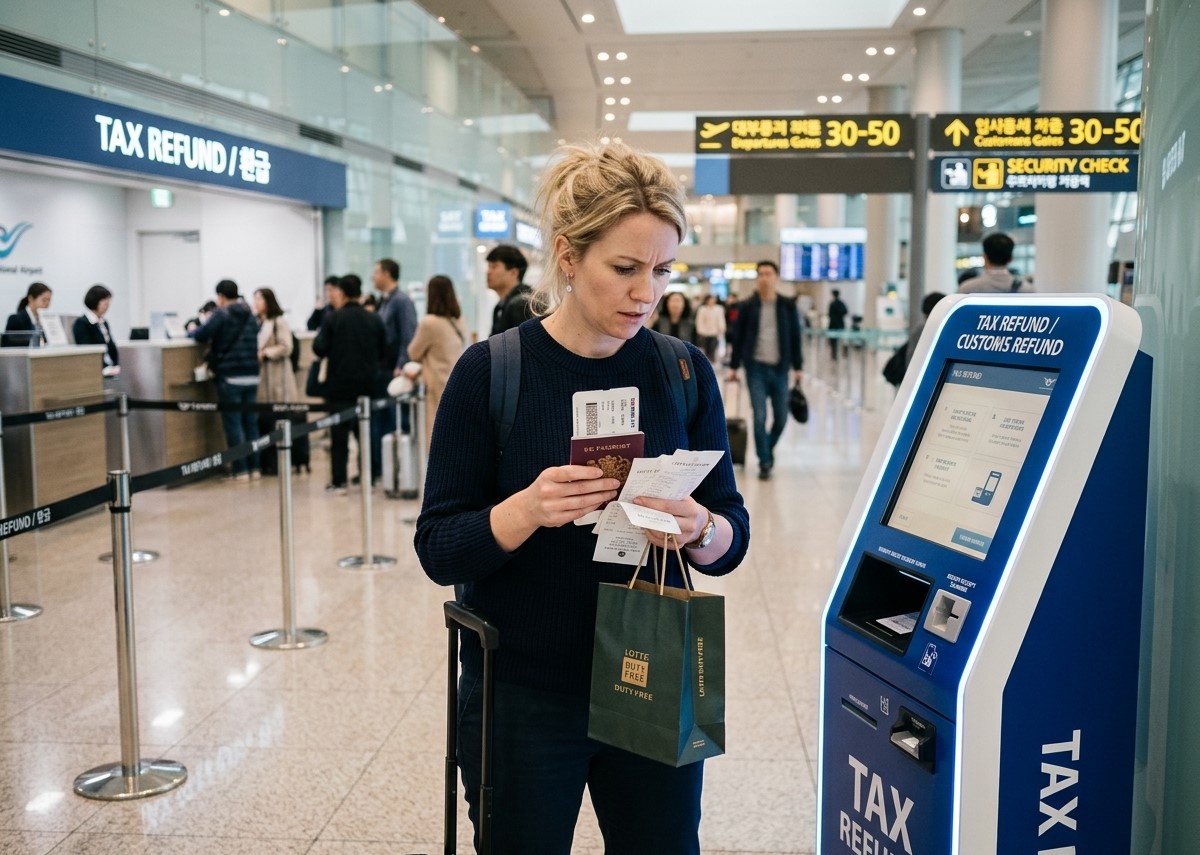
The airport is where tax refund pressure appears.
It is not where tax refund really begins.
Travelers lose time when they treat tax refund as something to figure out after they finish shopping. By departure day, the real problem is rarely the kiosk itself. It is the pile of unresolved choices that traveled with them to the terminal.
Tax refund in Korea usually goes wrong for one reason: travelers try to understand it too late. They shop first, keep receipts loosely, assume the airport will make the process obvious, and only start sorting the logic when they are already pulling luggage toward check-in. That is the worst possible moment to learn how the workflow actually behaves.
Once departure pressure begins, every small mistake starts feeling expensive. A missing voucher becomes a queue problem. A used item becomes a refund problem. A wrong sequence becomes a backtracking problem. And something that could have been handled calmly the night before suddenly feels urgent because the flight clock is already running.
The smartest way to use tax refund in Korea is to treat it as a shopping workflow with a departure-side finish. If you think of it as an airport task, the airport becomes stressful. If you think of it as a purchase decision that continues until departure, the airport becomes much easier to manage.
Tax refund is not one method, and that is where many travelers start losing time.
People often speak about tax refund as if every store, every voucher, and every departure process works the same way. It does not. What matters most is not just that you bought something eligible. What matters is which refund route you created when you paid.
Some purchases are handled as immediate refund at the store. Others stay in the general refund track and still need later processing. Some can be lightened through a downtown refund stop. Others remain airport-heavy. Duty-free shopping belongs in a different category entirely and should not be mentally mixed into the same workflow.
What actually qualifies, and why vague assumptions waste time later
Not every purchase is refundable, and not every traveler is automatically eligible. In general, Korea’s tourist tax refund system is intended for eligible non-resident travelers rather than long-term residents or people earning income in Korea. Goods also need to leave the country within the required window, and the physical condition of the goods matters more than many people expect.
This is the first place where travelers quietly create airport stress. They treat every store receipt as equally useful, every shopping bag as equally relevant, and every purchase as if it will be handled the same way later. That habit makes the airport feel more complicated than the process actually is.
A cleaner approach is to split purchases into three groups from the moment you buy:
- items already handled through immediate refund
- items still sitting in the general refund track
- items that are not part of the tax refund workflow at all
If you cannot make that distinction before departure day, the terminal will feel more chaotic than the system deserves.
What to keep from the moment you buy
Tax refund gets disorganized when travelers save the wrong thing. They keep the card receipt but lose the refund voucher. They keep the shopping bag but forget which document the process actually depends on. They stack everything into one pouch and tell themselves they will sort it out later. Later usually means check-in, and that is too late.
A better system is simple: build one clean refund set as you shop. Each eligible purchase should stay grouped with the goods, the right voucher, the relevant purchase proof, and a clear understanding of which refund category it belongs to.
This is especially important for cosmetics, skincare, gifts, fashion items, and accessories. Those are the purchases most likely to get opened, repacked, mixed with personal-use items, or buried in checked luggage long before the traveler has finished the refund workflow.
The airport does not create the problem. It exposes it.
If your paperwork is organized, your goods are still in refundable condition, and you understand which refund route applies to each purchase, airport handling is manageable. But if you arrive with mixed receipts, vague memories, opened goods, and no clear idea which items were already handled at the store, the terminal becomes a pressure machine.
That is why the useful question is not “Where is the refund counter?” The useful question is “What exactly still needs to be done by the time I reach the airport?”
For some travelers, the answer is very little. For others, it still includes customs confirmation, voucher processing, or kiosk and counter handling. The airport only feels chaotic when too many decisions were delayed until departure day.
The most common departure-day mistake is going to the wrong step first.
Many travelers imagine a neat sequence: arrive at the airport, find the refund counter, hand over the paperwork, collect the money, and move on. That sequence is not always correct.
For the general refund route, customs-side export confirmation may come before the refund counter or kiosk becomes meaningful. That is why the goods, the passport, and the refund voucher matter together. If customs confirmation is still part of your route, skipping ahead to the wrong location first can create avoidable backtracking with luggage and shopping bags.
Customs is not just a paperwork step. It is also a condition check.
Many travelers focus completely on documents and forget that the goods themselves are part of what may need to be confirmed. If an item is supposed to leave Korea as part of the refund process, its condition matters. This is exactly where otherwise careful travelers lose refunds they thought were safe.
This happens often with cosmetics, skincare, perfume, accessories, and gifts. Someone buys a product, starts using it during the trip, and still mentally files it under refundable shopping. Someone else repacks gifts too deeply into checked luggage. Another traveler checks bags too early and only then realizes that keeping the goods accessible would have made the process much cleaner.
Approach the airport process like someone who may still need to show the goods in clean, unused condition. If there is any real chance that the item still belongs in the refund flow, do not pack it in the most inconvenient location possible.
At Incheon, the biggest trap is usually not the kiosk location. It is accumulated delay.
Travelers often fixate on where the refund machine or counter is. But the larger problem is everything that happens before they reach it. They arrive later than planned because shopping ran long. Baggage check takes longer because the luggage is heavier than expected. The paperwork is still unsorted. One purchase turns out to have been immediate refund already. Another still needs customs handling. By that point, even a short line feels catastrophic.
If tax refund matters to you, do not calculate airport arrival time as if you were traveling with carry-on only and no administrative tasks. You are not. You are traveling with at least one departure-side process attached to the flight, and your airport buffer should reflect the complexity of your shopping, not just the boarding time on your ticket.
The airport does not punish tax refund users. It punishes late tax refund users.
The real time saver is arriving with fewer unresolved decisions.
Travelers often ask how to make airport refund faster. The most honest answer is simple: bring less confusion to the airport.
If you already know which items were handled through immediate refund, which still require customs or airport processing, and which are no longer part of the claim, the entire departure sequence becomes lighter. If everything is one mixed stack of receipts and half-remembered purchases, every step at the airport becomes another decision made under pressure.
This is why experienced travelers often look calm at refund counters. They are not lucky. They simply did not bring a sorting problem to the terminal.
Night-before rule: do a full refund review the evening before departure, not on the train to the airport and definitely not in the check-in queue.
Immediate refund, downtown refund, and airport refund do not create the same kind of stress.
If your specific goal is reducing airport friction, the comparison is practical rather than theoretical.
- Immediate refund usually creates the lightest departure-day workload because the tax handling already happened at the store within the qualifying limits.
- Downtown refund handling can meaningfully reduce airport pressure by moving part of the process out of the terminal environment, but it still requires careful document discipline.
- Airport refund is the most intuitive option for travelers who postponed everything, but it is also the most exposed to queue timing, sequencing mistakes, and customs confusion.
- Mailbox or mobile handling can serve as fallback structures in some cases, but they do not excuse vague thinking about what stage of the process you have already completed.
No single route is best for every traveler. But the worst route is almost always the same: leaving every refund decision open until you are standing in the departure terminal.
What to do if you are already late
Late travelers usually make one of two bad choices. They either try to process everything at once in a panic, or they give up without checking what is still realistically salvageable.
If time is genuinely short, the move is not to think emotionally. The move is to make triage decisions fast.
- Separate immediate-refund purchases from general-refund purchases first.
- Do not waste time reprocessing something that was already settled at the store.
- Identify whether customs confirmation still matters for the purchases that remain.
- Prioritize by refund value if time is genuinely tight.
- Stop repeatedly repacking bags. That usually costs more minutes than people realize.
When every minute matters, clarity beats ambition. Trying to rescue every small receipt at once is often the fastest way to execute nothing well.
What travelers often get wrong about duty-free and tax refund
These are not the same category, and mixing them creates unnecessary confusion. Duty-free shopping means taxes were excluded within that specific sales structure. Tax refund means you paid the full tax-inclusive price on eligible goods at regular retail and recover the tax later through the refund workflow.
Travelers who blur those two categories often arrive at the airport expecting the same documents, the same counters, and the same sequence to apply to both. That misunderstanding generates avoidable questions, unnecessary lines, and wrong expectations about what is still claimable.
The working rule is simple: if you bought something through a duty-free structure, do not assume it belongs in the same workflow as tax refund shopping.
Before leaving for the airport, check these five things.
- Do you know which purchases were immediate refund and which were not?
- Do you still have the correct refund vouchers, not just loose payment receipts?
- Are the refundable goods still accessible and in a condition that supports export confirmation if needed?
- Do you know whether customs confirmation comes before the refund counter for your route?
- Did you give yourself enough airport time for the actual refund complexity your shopping created, not just the flight itself?