Why KTX and Express Bus Bookings Fail in Korea: Cards, Pickup, Sold-Out Seats, and Wrong Terminals

Transportation

A failed booking in Korea is rarely one problem.

More often, it is a chain problem: the wrong system, the wrong terminal, the wrong assumption about ticket pickup, or the wrong idea of what “sold out” actually means.

KTX vs express bus vs intercity bus Wrong terminal risk Sold-out seat recovery Total trip cost logic

Booking a long-distance trip in Korea often feels more stressful than it should. A traveler looks up a route, finds several options, tries to pay, and then starts wondering whether the train is actually better, whether they have the right bus terminal, whether the ticket has genuinely been issued, and whether a sold-out screen means the trip is truly over.

That confusion usually does not happen because Korea lacks transport options. It happens because Korea has several strong transport systems that do not behave like one unified, foreigner-friendly network. Rail follows KORAIL logic. Express buses and intercity buses are not the same network. In Seoul, long-distance buses are spread across multiple departure points. And even after payment, some bus bookings may still require terminal-side confirmation or ticket printing depending on the route and the booking method.

So the real problem is rarely just my card failed. In practice, travelers lose time and money because several smaller mistakes stack together until the trip starts breaking apart.

What usually breaks first
1. The traveler searches the right city in the wrong system

A route may exist, but not inside the platform they are using.

2. The terminal is never verified early enough

A valid booking can still fail if the departure building is wrong.

3. Payment is mistaken for boarding readiness

What you paid for and what you must physically show can be different.

4. “Sold out” is treated like the end

In some cases, the real answer is not no seat — it is a different ticket type or a different purchase channel.

The first mistake is not choosing the wrong time. It is choosing the wrong system.

Many travelers search by destination alone. That is where the trouble starts.

KTX and other trains belong to the rail side of the system. Buses divide into express buses and intercity buses, and those two are not always handled from the same terminal. So you are never simply choosing between train and bus. You are choosing a network, a departure point, an arrival point, and a backup structure. Miss that, and you can waste serious time searching the wrong platform and conclude a route is unavailable when it exists perfectly well inside a different system.

This becomes sharper once you travel beyond the biggest cities. Busan, Daegu, Daejeon, and Gwangju can make Korea look simple because they are familiar names with strong trunk connections. But once you move toward places such as Tongyeong, Geoje, Namhae, Haenam, Taean, or county-level destinations, the useful booking logic often shifts away from fastest vehicle toward best final access.

Practical rule: if the station or terminal is not a true endpoint for your actual stay, the headline speed of the main segment stops being the most important number.

The second mistake is comparing only the ride, not the whole trip.

Most travelers compare the visible middle segment. They place the train time against the bus time and assume the shorter ride is the smarter choice. That comparison is incomplete.

The only comparison that really matters is total trip cost and total trip friction. That includes how hard it is to reach the right departure point in Seoul, whether the arrival point is genuinely useful for your hotel or meeting point, whether you need a taxi after you get off, whether the arrival time breaks easy local connections, and whether luggage turns one option into much more work than it first appears.

A higher train fare can still be the cheaper decision if it removes a long taxi ride, avoids a missed connection, or turns a half-day travel problem into a cleaner same-day move. A slower bus can still be the better-value option if it drops you closer to the real destination and eliminates an extra paid transfer.

Compare this Not just this Why it matters
Departure point access Ride time only A fast train is weaker if getting to the station is costly or awkward.
Arrival point usefulness Ticket price only A cheaper ticket can still lose once taxi or transfer costs are added.
Luggage and transfer difficulty Vehicle speed only One extra transfer with bags can erase the value of the faster segment.
Late arrival risk Base fare only A cheap arrival can become expensive if it breaks the last easy connection.
Airport arrival logic

If you land at Incheon, decide early whether you are solving a Seoul transfer or a regional transfer.

Many first-time visitors make this decision too late. They drift into central Seoul first, then start improvising. That usually adds time, friction, and one more layer of uncertainty.

If your final destination is best served by KTX, a clean move toward Seoul Station may be the right backbone. But if a direct regional bus already covers the route with less friction, routing yourself into Seoul first can add cost without adding real value.

For travelers carrying luggage, managing jet lag, or trying to make a same-day move, the smartest booking is often the one that removes one entire decision layer.

Busan and the wider Gyeongsang side: strong rail, but not always the right backbone

If you are going directly to central Busan, Dongdaegu, Gyeongju, or another city that sits neatly on a strong rail corridor, KTX is usually the first option worth pricing out seriously. The core rail backbone is reliable, familiar, and often cleaner than many travelers expect.

But southeastern travel stops being simple the moment the rail station is no longer the actual destination. This is where many travelers oversimplify the region and pay for it later.

If you are heading to Tongyeong, Geoje, Namhae, Hadong, Sacheon, or other places that sit more naturally in bus-terminal geography than rail geography, the bus may be the more rational backbone from the start. Not because buses are glamorous, but because they may reduce the number of things that can still go wrong after you arrive.

When KTX often wins

Your destination is close to the rail station, your schedule is tight, and the train removes an expensive or tiring final leg.

When the bus often wins

Your actual destination sits closer to a bus terminal, the train would only get you halfway cleanly, or late arrival makes the last mile riskier.

Smart savings tip: do not chase the lowest fare first. Chase the lowest total damage. A bus may look cheaper and still be the wrong choice if it forces a long taxi ride. A more expensive KTX seat may still be the better value if it removes two more paid steps.

Jeolla: where rail can look elegant but still leave you with the wrong trip

Jeolla is one of the easiest regions to misunderstand if you only think in terms of train prestige. Travelers hear that KTX is the fast option, so they stop thinking there. That is often too shallow.

If you are going to Jeonju itself, rail and bus can both deserve a serious comparison. But once you start moving deeper into coastal or county-level destinations, the train can become a half-solution: fast in the middle, awkward at the end.

That matters because the hidden cost in Jeolla is not always the main ticket. It is the weak regional tail after the main segment. A route that looks elegant on the first screen can still become the wrong move if it leaves you with another complicated paid leg after arrival.

Smart savings tip: do not pay premium money for speed that only gets you halfway to the useful place. In Jeolla, the slower bus is often operationally cleaner, and operational cleanliness has real value when you are tired, carrying bags, and still figuring out your actual final point.

Chungcheong: close enough to look easy, but easy to overpay

Chungcheong sits near enough to Seoul that many travelers approach it casually. That proximity is exactly why bad choices accumulate here without being noticed until the ticket is already bought.

If your destination is Daejeon or another clearly rail-linked city and timing genuinely matters, KTX can still be the cleanest option. But if your destination is smaller, more spread out, or better reached from a central bus terminal than from a rail station, the bus often provides better value even when the train saves a modest number of minutes.

The trap in Chungcheong is buying speed that does not really improve the trip. If the time difference is modest, the price gap is meaningful, and the bus arrival point is more useful, the bus often wins the full calculation.

Recovery strategy

What to do when online booking fails

This is where many travelers make their most expensive mistake: they panic too early and treat a broken booking screen as a final answer.

Rail recovery

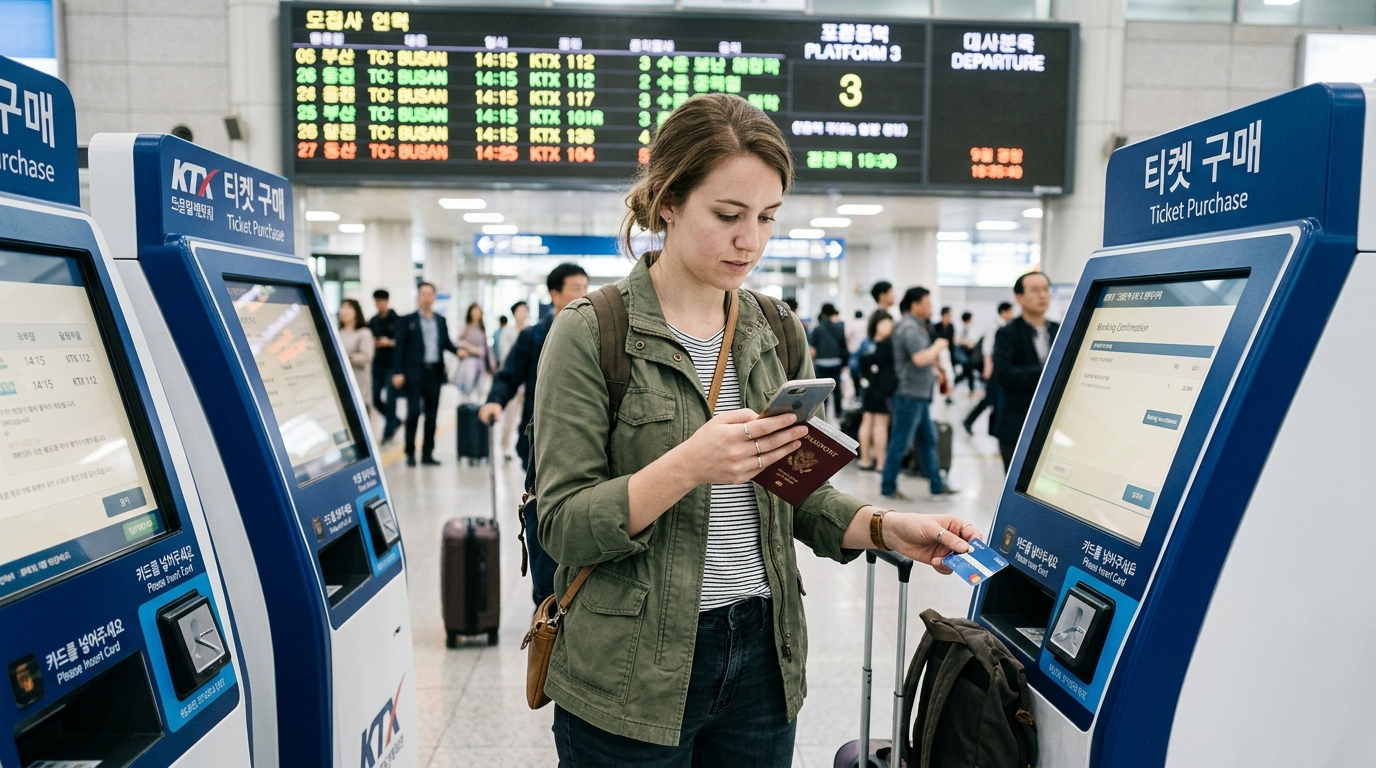
If KORAIL online booking fails, the trip is not automatically over. App, station vending machine, and station counter are real purchase channels. If you still have time, move to the next official channel instead of fighting the same broken screen.

Bus recovery

If a bus booking flow fails, terminal-side purchase can still be a practical fallback — but only if you have already solved the terminal question correctly.

  1. Ask whether the route itself is unavailable or whether only the booking channel failed.
  2. Check whether you are in the right system for that route.
  3. Verify the exact departure terminal or station before moving.
  4. Switch channels fast enough that recovery is still worth more than stubbornness.

What to do when regular seats are sold out

This is where one of the biggest misunderstandings begins. A traveler sees that reserved seats are gone and assumes the whole route is closed. That conclusion is often too final.

In some cases, regular reserved seats being unavailable does not mean the trip is impossible. KTX can also involve standing or non-reserved ticket types in certain situations, and that changes how a traveler should think under pressure. The important point is not to assume those options will always appear. The point is to understand that one sold-out screen is not always the same as a dead route.

Situation Smarter response Why
Reserved seat gone Check official alternatives before giving up A sold-out reserved seat is not always the end of the route.
Digital display unclear Verify again at a counter or vending machine A different channel can clarify what the screen is not showing cleanly.
Trip must happen today Compare standing, later seated departures, and bus options together The right answer is often about overall stress, not emotional loyalty to the first plan.

Standing is a tool, not a magic answer. It can be rational when you are traveling light, the timing matters more than comfort, and the segment is manageable. It becomes less attractive when you have heavy luggage, children, elderly companions, or a ride long enough to damage the rest of the day.

The real value of knowing about standing and non-reserved tickets is that it prevents you from quitting too early.

The smartest way to save money is to prevent the wrong combination, not just find the lowest fare.

A cheaper bus that arrives too late for the last easy local connection can become the more expensive trip once taxi cost, wasted time, and fatigue are added. A more expensive train that removes a taxi and saves half a day can become the better-value choice. A direct airport bus that eliminates a Seoul transfer can beat a rail plan that only looks faster in the middle.

Good travel decisions in Korea are less about fare hunting and more about friction control. The traveler who wins is usually not the one who found the cheapest first ticket. It is the one who correctly identified where the hidden costs were waiting.

Useful shortcut: if a more expensive option removes one whole layer of uncertainty — one terminal change, one paid transfer, one risky late-night last mile — it may already be the cheaper trip.

Final check

The five checks that prevent most booking failures in Korea

  1. Which system actually operates this route?
  2. Which exact terminal or station do you need to depart from?
  3. Which exact terminal or station do you arrive at, and is that point actually useful?
  4. If online booking fails, what is your official offline backup?
  5. If reserved seats are gone, do you still have a realistic alternative such as a later departure, a bus comparison, or where available an official standing or non-reserved option?