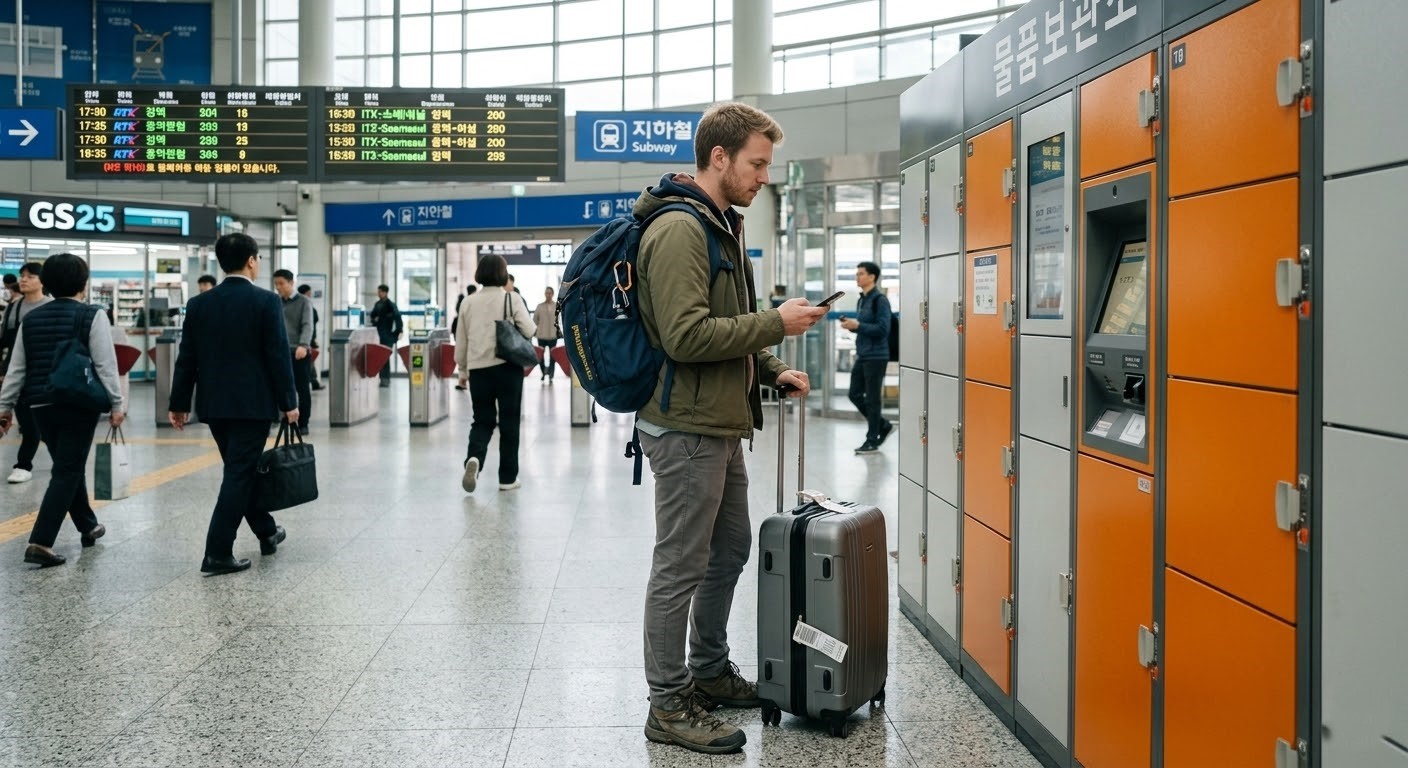
The awkward hours before check-in or after check-out are usually not about the bag alone. They are about whether your luggage still belongs to the route you are about to take.
Your day still circles back to the same neighborhood, the bag is large, or you want the most predictable option with the least public friction.
The hotel area is no longer part of the useful route and you want the suitcase closer to the station, terminal, or part of the city you will actually use later.
Check locally: locker sizes, payment methods, operating hours, item restrictions, and hotel luggage policies can vary by station, terminal, and property type.
The luggage problem in Korea rarely starts with the bag itself. It usually starts when your room and your route stop matching each other.
You arrive in the city in the morning, but your room is not ready. Or you check out at 11 a.m., but your train, trip to the airport, shopping plan, museum booking, or dinner reservation is still hours away. For a few hours, you are no longer moving through the day with a normal hotel rhythm. You are carrying your entire trip through a stretch of time that would be much easier without it.
That is when travelers start thinking about luggage storage in Korea, station lockers, leaving bags at the hotel, or anywhere to drop a suitcase before check-in or after check-out. Many people treat it like a side question. It is not. A weak storage decision can quietly waste the most usable part of the day, while a good one can make the city feel manageable again.
It helps to stop treating this as a locker question first. Most of the time, it is really a route question. Are you staying in roughly the same neighborhood until the room is ready? Are you leaving that area completely and only coming back late? Are you heading toward a rail station later? Are you carrying one small carry-on or a full-size suitcase that changes how you move through stairs, gates, and crowded sidewalks? Those details matter more than the basic idea of storage.
Ask the hotel before you build the day around a locker
A surprising number of travelers start searching for lockers before they ask the hotel the most useful question of the day.
If you have not checked in yet, ask whether the property can hold your luggage until the room is ready. If you have already checked out, ask whether you can leave your bags and collect them later. A staffed hotel will often be the simplest answer. That does not mean every property will do it, and the process is not identical everywhere. Smaller properties, self-check-in stays, some guesthouses, serviced apartment-style accommodations, and places with limited desk coverage can be less predictable. Still, when a front desk is staffed, one short question can save more time than fifteen minutes of locker-hunting inside a station.
- your day still revolves around the same neighborhood
- the suitcase is large enough that locker size uncertainty matters
- you are carrying shopping, laundry, skincare, or items you do not want to reorganize in public
- you were already going to return to the property before the evening really starts
- the hotel is easier to revisit than it first seems on the map
If you are staying in Myeongdong and most of the day will still happen around central Seoul before you head back, keeping the bag at the hotel often produces the cleanest day. You are not creating a second storage point. You are simply leaving the bag where you were already going to return.
Bag size matters here too. A backpack or small carry-on gives you flexibility. A large suitcase removes that flexibility quickly. Large lockers are often what travelers worry about most, and availability can shift by location and time. If the hotel is happy to hold the bag, the certainty is usually worth it.
There is also the question of what is inside. After a few days in Korea, luggage is rarely neat. You may have shopping, skincare purchases, extra shoes, wet laundry, snacks, breakable items, or tax-free goods you would rather not sort through in front of a locker machine while people queue behind you. Hotel luggage storage is usually calmer.
If the room will be ready later and you are already planning to come back to the same property before the evening starts, there is little point in pushing the storage problem into the station system. Travelers also tend to overestimate how inconvenient the hotel will be to return to. If it is close to a major subway line, or if you will already pass through the neighborhood again, leaving your bags there may be less disruptive than it first sounds.
Hotels also remove one layer of public friction. You are not interpreting a machine, judging bag size from a distance, or wondering whether you will find the same locker bank again six hours later. You are leaving the bag with a place that already has your reservation or knows your stay. The downside appears when hotel storage forces a return trip that no longer fits the day. Check out in Hongdae, spend the afternoon in another part of Seoul, then head straight to Seoul Station for a KTX, and the decision that sounded convenient at 11 a.m. can feel like the reason the final hours became awkward.
When station lockers make more sense
Public lockers in Korea are most useful when your plans and your accommodation have stopped belonging to the same map.
This is where travelers often get the biggest benefit from station lockers — not because lockers are inherently better, but because they can move the bag closer to where the day’s movement actually matters. A locker is usually worth considering when you have checked out and your next fixed point is a major station or terminal later that day, when your hotel is not near the area where you will spend the afternoon, or when you want several hours of walking, shopping, café stops, or museum time without dragging a suitcase behind you. If you arrived too early to check in but have no reason to stay near the hotel district until evening, or you are taking an intercity train later and want the luggage already near departure, the same logic applies.
In these situations, the bag has stopped being part of the accommodation problem. It has become part of the movement problem. Many travelers describe station lockers as somewhere to store luggage. In practice, they work more like a short-term reset. You drop the bag, and suddenly the city becomes usable again. Subway transfers feel easier. Crowded exits matter less. You can walk through a market without catching every curb with a suitcase wheel. You can sit down for a meal without managing a large bag in a tight aisle. You can enter a museum, department store, or palace without mentally dragging the suitcase through the whole afternoon.
Korea’s urban layout can make luggage more annoying than it first looks: long underground passages, big station halls, multiple exits, escalators that help but do not remove all the lifting, and sidewalks that are technically walkable but tiring with wheels. A suitcase does not have to be extremely heavy to become a problem. It only has to stay in the day longer than it should.
There is a trap here, though. Lockers only help when the station is actually part of your day. Travelers sometimes pick a locker location because a station looks central on the map. A central station is not automatically a useful one. If storing the bag there means you later have to detour back, re-enter a busy hall, find the same locker bank again, and then continue somewhere else, the locker may have shifted the inconvenience rather than removed it.
The right locker location is usually the station you will depart from later, a station area you will naturally pass through again, or the point that removes the biggest stretch of unnecessary suitcase movement from the day. The wrong locker location is usually the one that only felt convenient at the moment of drop-off.
Bag size changes the answer more than most travelers expect
A lot of luggage advice is too binary. Use a locker. Do not use a locker. Leave it at the hotel. Keep it with you. Real travel days are messier, and bag size changes the answer more than people often realize. A day with one backpack is not the same as a day with a medium suitcase. A day with a medium suitcase is not the same as a day with a large checked bag plus shopping. Yet many travelers think about storage as if all luggage behaves the same way.
If your main load is a backpack, you may not need storage at all unless the day is long, hot, heavily scheduled, or full of indoor stops where carrying the bag becomes a problem. A backpack still lets you switch subway lines, sit in cafés, browse shops, and walk into attractions with relatively little disruption.
A small wheeled case looks manageable, but over several hours it changes choices more than people realize. You hesitate over stairs. You take wider exits. You think twice about crowded lunchtime spots. You avoid older sidewalks or market streets. You put off detours that would feel easy without wheels. That does not mean you must store it. It means you should stop assuming it is neutral.
This is the most underestimated size. It is not large enough to feel dramatic, but it is large enough to interfere with a normal city day. It catches on café chairs, feels awkward in smaller shops, makes photo stops less spontaneous, and turns “let’s walk ten minutes” into a small negotiation. Travelers often keep carrying it for hours because it still feels technically manageable, then store it only after the suitcase has already shaped half the day.
Once the bag is a full-size checked suitcase, the question stops being whether you can carry it and becomes whether it should be part of the next six hours at all. Large luggage changes how you move through stations, how much you depend on elevators, where you can eat, and how relaxed you feel when plans shift. If you will not need anything from it until evening, early separation is usually the cleaner move.
What makes luggage storage waste time instead of saving it
Travel guides tend to focus on where to find storage. The actual time losses usually happen in the minutes before and after.
Drop-off feels easy, but retrieval is what hurts later
The easiest place to drop a bag is not always the easiest place to pick it up. A locker bank feels convenient when you are standing in front of it with fresh energy and a full phone battery. The same spot can feel much worse at the end of the day when your legs are tired, you are carrying shopping, the station is busier, and your train or airport timing has become more pressing. Always picture the return moment, not just the drop-off.
A storage point works better when it sits on the route, not beside it
A locker location becomes much stronger when retrieval happens on the way. If you will already be passing that station later, the storage choice is working with your route. If you need to make a special trip back, it may not be working at all. That is why one traveler loves a locker setup while another ends the day annoyed by it, even when both used the same type of facility. One stored the bag on the route. The other stored it off it.
Available lockers do not always mean usable lockers
Finding a locker area is not the same as finding a usable one. Size matters, and availability shifts with timing and location. Smaller compartments may be open when the larger ones are already gone. Travelers who only see empty locker doors from a distance sometimes assume the problem is solved before they are close enough to know whether their suitcase will fit.
Not recording the exact spot turns a simple task into a second errand
Larger stations and connected underground areas blur together fast. People remember the locker but forget the details: which passage, which side of the hall, which sign, which gate area, which level, which direction from the exit. The fix is simple. Take a photo of the locker bank, take a second photo of the nearby sign or hall marker, and note the station name. If it helps, write down the exit or platform context. That stops a ten-minute task from turning into a thirty-minute search.
Storing the bag too late still costs the afternoon
Some travelers only decide to store the suitcase after it has already damaged the day. They drag it through lunch, a museum, a shopping street, and a subway transfer before finally admitting it is a problem. By then they have already paid the price. If you know you will not need the contents again for hours, earlier separation is usually better than waiting for the inconvenience to become undeniable.
The most annoying forgotten items are usually small
Even when a locker or hotel hold is the right call, some things should not leave your hands — passport, wallet, medication, charger, travel documents, anything you might need before evening. People treat luggage storage as an all-or-nothing move, then realize the one thing they actually wanted was in the bag they deliberately made inaccessible.
A tight schedule makes storage feel worse than it should
Storage is a support step, not the centerpiece of the day. If your itinerary only works when the locker process is instant, the station is uncrowded, the bag fits on the first try, and retrieval is frictionless, the plan is too tight. Korea is easy to move through when the route has enough slack to absorb small delays. It gets much less forgiving when luggage, transfers, shopping, and a fixed departure are all competing inside the same narrow window.
Before check-in and after check-out are not the same problem
Hotel luggage storage and station lockers answer different questions. Hotel storage works better when you want to remove the bag but keep the day anchored to the accommodation side of Seoul or another Korean city. Station lockers work better when the hotel neighborhood is no longer part of the useful route and the bag needs to move toward transit or another district instead.
Real days are not always cleanly divided, so it helps to think about the whole arc of the day rather than the convenience of the drop-off moment alone. An early arrival where you plan to have lunch nearby, walk around, and come back for check-in is usually a hotel-shaped situation. An early arrival where your actual plans are nowhere near the hotel is different. A check-out day with a later KTX or terminal departure often pushes the decision toward lockers, but not every departure day does. If lunch, shopping, and pickup all happen near the same property, hotel storage can still be the easier option.
What should stay with you even when the main bag does not
Luggage storage is useful because it removes bulk. Travelers create a second problem when they store things they still need. Before closing a locker or handing over a suitcase, separate the day into what belongs in the stored bag and what belongs in the active hours ahead.
- passport and immigration documents
- wallet, cards, and cash
- phone, battery pack, and charging cable
- medication and anything time-sensitive
- hotel name, address, and reservation details
- train or flight details if needed that day
- one weather layer if rain or evening chill might matter
- fragile or high-value items you would rather not store
- clothes you will not need before the next room or departure
- heavy toiletries and extra shoes
- shopping that only adds weight during the day
- duplicate items you will not use until later
- anything that turns the daytime bag into unnecessary bulk
This sounds obvious, but it is one of the most common self-inflicted problems. People rush to store the bag and later realize the charger, medication, or evening outfit they wanted was in the one thing they deliberately made inaccessible. If you are using station lockers, going back because you forgot something is not a small inconvenience. It changes the route and undoes exactly what you were trying to set up.
When the first storage plan fails
Sometimes the hotel says no. Sometimes the locker is full. Sometimes only small compartments are available. Sometimes the location is more confusing than expected. Sometimes the bag does not fit. Sometimes you realize too late that the storage point was chosen for drop-off convenience rather than retrieval logic. This is normal.
Do not spend the next forty minutes forcing the same idea. Stop and decide what the real goal was: avoiding several hours of bag-carrying, getting the suitcase closer to a later departure point, removing a large bag before lunch or shopping, or avoiding a return trip to the hotel district.
Once that is clear, the next move gets easier. Sometimes it means trying another locker area in the same larger station. Sometimes it means going back to the hotel because the route cost is still acceptable. Sometimes it means keeping the bag because the storage options now cost more than they save.
The biggest time losses here do not come from the failed first attempt. They come from refusing to change the approach after it fails. Luggage storage is a support tool, not a principle. If the first method stops serving the day, switch methods.
Before you choose where the bag goes
The practical standard is not which option sounds smartest or looks most efficient on a map. It is which choice removes the most unnecessary bag-carrying from the hours that follow.
Think about the full route before you commit, not just the moment of drop-off. Think about where retrieval will happen, whether that storage point sits on your route or off it, and whether the size of the bag actually justifies the effort of storing it at all.
Hotel luggage storage and station lockers both work well when they are chosen for the right reasons. Both create problems when they are chosen for the wrong ones. The storage step itself usually takes only a few minutes. What shapes the rest of the day is the planning around it — or the lack of it.