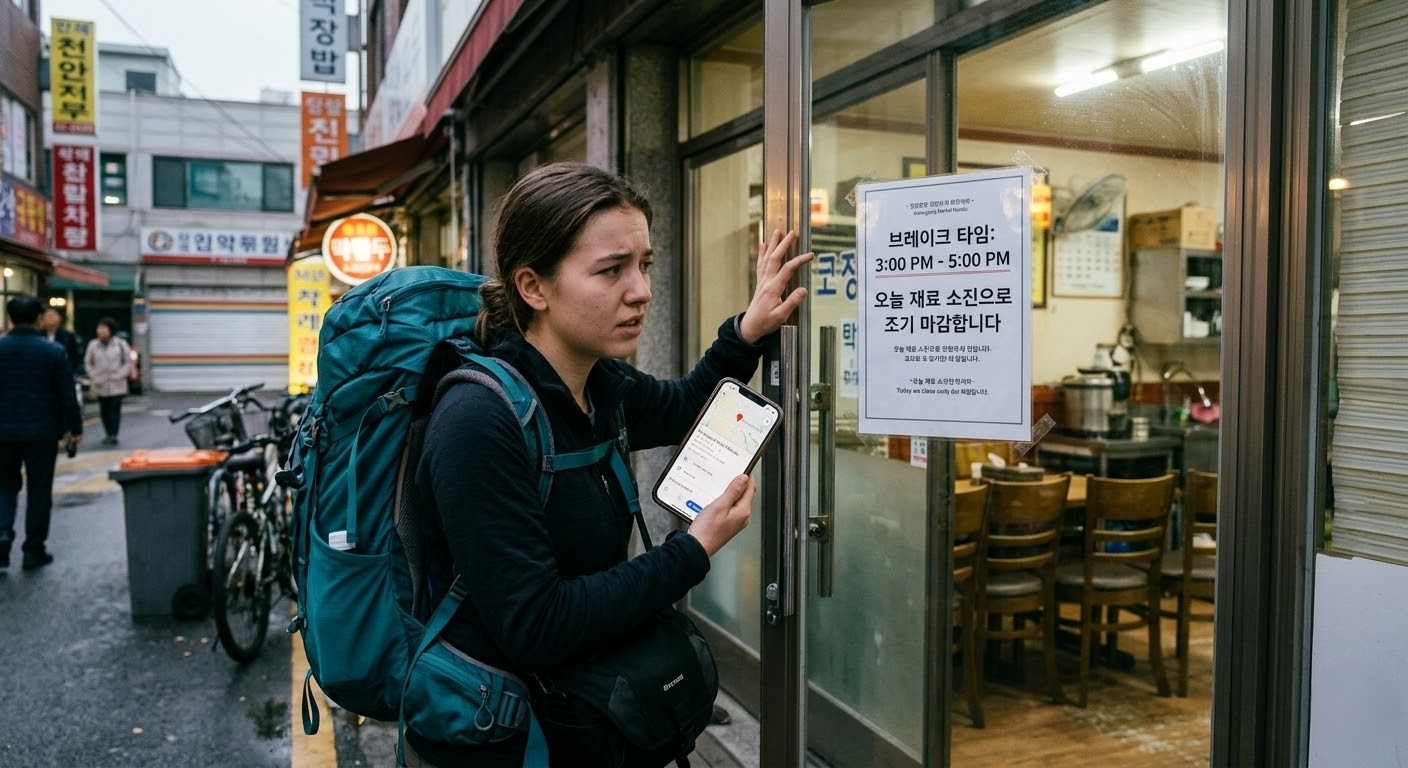
Field note for foreign travelers
In Korea, a restaurant can look ready from the outside and still be unavailable in the exact way you need.
The map says open. The lights are on. Staff are visible. People may even still be eating. And yet the answer for a new customer is still no. That gap is where a lot of foreign travelers lose time, energy, and confidence.
The issue is usually not the headline opening hour itself. It is everything wrapped around it: break time, last order, menu sell-outs, soft walk-in cutoffs, handwritten Korean notes on the door, and the difference between a business being open for the day and being ready to serve you right now.
This is why restaurant timing in Korea can feel strangely slippery to foreign visitors. On paper, the information looks simple. In practice, the business may be operating according to a more detailed rhythm than the app can show in one line. A visitor sees a clean status label and thinks the decision is finished. The restaurant is actually running on a more local logic that only becomes visible when you arrive.
That does not mean Korea is impossible to read. It means the usual travel question needs to change. Instead of asking only whether a place is open, it is more useful to ask whether the part of the business you need — the kitchen, the seating window, the ordering cutoff, or the specific menu you came for — is available now.
Once you start reading restaurant hours that way, a lot of situations that once felt random stop feeling random. Failed visits begin to look less like bad luck and more like missed timing signals. That shift matters because it turns the problem from something emotional into something manageable.
1) The app is broad, but the restaurant is operating on a narrower rhythm
A listing can be accurate in the broadest sense while still being unhelpful for the next fifteen minutes of your day. The restaurant may be open as a business, but the service window you need may already be closed, paused, or shrinking.
2) “Open” often describes the place, not your exact chance of eating there now
Lights on, staff inside, and customers at tables do not automatically mean a new walk-in can still sit down and order. Foreign visitors often read “visible activity” as “service available,” but restaurants do not always use those two ideas the same way.
3) Korea uses more timing layers than many visitors expect
Break time, last order, sold-out notices, early closing, day-specific changes, and reservation-heavy seating patterns can all matter more than the headline operating hours shown on the map.
4) The most current signal is often not the easiest signal to see
The best real-time information may be on the door, near the cashier, inside the reservation page, or available only through direct contact. Travelers often trust the easiest signal first and the freshest signal second, which is the reverse of what helps most in Korea.
Break time is not a side note
In Korea, break time usually means the restaurant is between service periods, most commonly between lunch and dinner. The staff have not gone home. The business is not closed for the day. But normal dining service is paused, and new walk-in customers may not be accepted until the next service period starts.
What makes this difficult for foreign travelers is how ordinary the place can still look from outside. The lights may stay on. Staff may be cleaning, cutting ingredients, restocking, or eating. The front door may not even be locked. That is exactly why the situation gets misread so often: it does not look closed in the dramatic sense, but it is still unavailable in the practical sense.
Another reason break time causes trouble is that it is not always communicated in the same way. Some places post it clearly. Some bury it in smaller text. Some rely on local customers already understanding the rhythm. Some seem to assume that if the staff are visible and the place is technically operating, the situation should be obvious. For a foreign visitor, it often is not obvious at all.
The most useful mental shift is to stop reading break time as a weak warning and start reading it as a hard service boundary. Once you do that, a lot of failed visits stop feeling mysterious.
Last order is often the real dinner deadline
If break time is the main daytime trap, last order is the main evening trap. Many visitors naturally use the full closing time as their reference point because it is the clearest number on the listing. In Korea, the more useful number is often the moment the kitchen stops taking new orders.
This is why a restaurant can still have diners inside, music playing, and staff moving around — and still say no to a new table. From your perspective, the restaurant is plainly still alive. From the restaurant’s perspective, the part that matters to a new customer has already crossed its operational cutoff.
This gap becomes even more important at places that are popular, highly rated, or famous for only a few dishes. When kitchens are under pressure, they become more conservative. When a place is busy, the useful window for a new customer can become narrower than the broad listing suggests. That is why the closing time can be technically correct while still being a poor guide for your actual arrival.
If dinner matters, build your movement around the order cutoff, not the full room shutdown. That one adjustment alone prevents a large share of evening frustration.
Timing rule that saves real time
The weakest parts of the restaurant day are usually:
- mid-afternoon, when many restaurants sit between lunch and dinner
- late evening, when the room still looks open but the order window is already closing
- busy days, when popular places quietly tighten the rules before the listing suggests they should
- days with special notices, private events, shortages, or unusual staffing conditions that only show up on the door or at the counter
The words on the door often beat the app
One of the fastest ways to get better at this in Korea is to stop treating the app as the final answer and start treating the entrance as a live information board. You do not need strong Korean for this. Recognizing a few short words is often enough to avoid a surprising number of failed attempts.
This matters because local restaurants often communicate very practical information in a very compressed way. A small printed line, a handwritten paper notice, or a short sign taped near the handle may tell you more about the next twenty minutes than the full app page does. For foreign visitors, the mistake is often not lack of effort but lack of signal hierarchy. They assume the richer-looking app page is automatically the better source.
The practical goal is not perfect translation. It is recognizing whether the door is telling you something more current than the app.
Why sold-out kitchens and quiet early wind-downs matter
A restaurant does not need to be fully closed to become the wrong destination for you. If the dish you came for is gone, if the kitchen has already narrowed what it is willing to make, or if the staff are quietly winding down walk-in service earlier than expected, the place may still look active while no longer functioning in the way you need.
This matters especially at popular restaurants with limited prep volume, tight kitchen capacity, or highly focused signature menus. Their broad listing stays stable. Their practical availability becomes narrower and more volatile as the day goes on. The place may still be “open,” but not meaningfully open for the experience you came for.
This is one of the reasons visitors sometimes say Korea feels inconsistent. In reality, the city is often more consistent than it looks; the traveler is just looking at the wrong layer. The broad business status stays stable. The usable service layer shifts underneath it.
The better question is not only “Is it open?” but also “Is it still worth entering for the specific meal I want right now?”
Before you walk over, use this order of checks
If the stop matters enough that a wasted trip will annoy you, check in layers instead of trusting one source. The whole point is to move from broad planning to real availability.
First: use the app for the broad frame
Use it for location, rough hours, neighborhood fit, and whether the business should be operating at all that day.
Second: look for anything that narrows the service window
Break time, last order, sold-out notes, same-day notices, menu exhaustion, and signs that the business is technically open but practically shrinking.
Third: ask the useful question
Not “Does this place show as open?” but “Will it actually serve me if I arrive when I plan to arrive?”
Fourth: protect yourself with a nearby backup
In dense food neighborhoods, the traveler who pivots quickly usually eats sooner than the traveler who keeps trying to rescue one bad target.
Fifth: if the stop matters, confirm timing — not just existence
A place can be easy to find and still be a bad timing target. Separating “I found it” from “I confirmed the right moment” prevents a lot of avoidable frustration.
Practical note
If the listing says “open” but you still do not trust it, a quick phone call can be a stronger real-time signal than the app.
You do not need a full Korean conversation for this to help. If someone answers, that already tells you the place is staffed, active, and reachable at that moment.
It is not perfect proof. A place may answer during break time, and an open place may miss the call because staff are too busy. But when the stop matters, the call can still reduce uncertainty faster than the listing alone.
For foreign visitors who do not speak much Korean, that can still be useful. The point is not perfect conversation. The point is getting a more live signal before you spend time getting there.
Restaurants and cafés create different kinds of timing risk
Cafés often feel safer because many of them run more continuously and depend less on a strict lunch-and-dinner rhythm. If all you want is a drink and somewhere to sit, they are often easier to approach without detailed timing planning.
But “easier” is not the same as “always safe.” Dessert cafés, specialty coffee spots, and smaller neighborhood cafés can still stop taking certain orders, close earlier than the broad listing suggests, or rely on small notices that matter more than the map app. They just tend to do so in quieter, less obvious ways.
Restaurants are where the bigger timing traps appear more consistently. Break time is more common, last order matters more, and kitchen limits affect the traveler’s experience more directly. That is why the frustrating sentence “it said open but I still could not eat there” usually points to a restaurant problem before it points to a café problem.
The useful rule is not “cafés are safe, restaurants are risky.” The more accurate rule is that restaurants demand more timing awareness, while cafés usually demand less — but never zero.
If you are already there and it is not serving, do this instead of forcing the plan
This is where many travel guides stop too early. They explain the terms but not the next move. If you are already standing outside and it turns out you cannot eat there right now, the first useful step is to read the door honestly before trying to rescue the original plan.
If it is break time
Check when service resumes. Waiting may make sense if the restart is soon and the place is worth it to you.
If it is last order
Waiting usually makes no sense. The more practical move is to pivot quickly.
If the key dish is sold out
If that dish is your main reason for being there, the original target is functionally gone even if the room is still active.
If the door suggests temporary closure or irregular holiday
Treat the place as unavailable for the day instead of waiting for the app to become correct.
Travelers lose the most time when they keep trying to save the original plan after the real-time signals have already said no. In many Korean food neighborhoods, the cleanest move is not emotional commitment to one destination. It is a fast pivot to the next workable option.
The more honestly you read the current signals, the less time you spend arguing with the situation in your own head.
The timing habit that prevents most wasted trips
The easiest way to waste time in Korea is to move based on a binary reading of restaurant status. The easiest way to avoid that is to think in timing windows instead.
Mid-afternoon is the biggest trap because it feels close enough to lunch to seem safe and close enough to dinner to feel promising. Late evening creates a different trap because the room may still look active while the kitchen cutoff has already passed. Those are the weak edges of the day, and foreign travelers often hit them because the listing never fully shows how close to the edge they really are.
If a meal matters, build buffer into it. Do not plan around the most generous interpretation of the listing. Plan around the fact that real service windows are often narrower and more fragile than the broad status label suggests.
This does more than save time. It makes the whole day feel smoother. A failed food stop hits much harder when you are tired, hungry, jet-lagged, or already far from your hotel. Reading restaurant timing well is not only a logistics skill. It is a comfort skill.
The rule worth remembering
If a listing says a place is open, do not stop there.
Check whether break time is in effect. Check whether last order has already passed or is close. Look for the most current and most local signal, not just the broadest one.
If the stop matters, verify before you walk. If the app feels uncertain, use a more direct route: the entrance, a recent signal, a reservation page, or a quick call.
Korea gets much easier once you stop reading restaurant hours as a simple promise and start reading them as a live operating situation.
That shift is what prevents wasted trips, awkward arrivals, and meals that fail for reasons the app never explained.