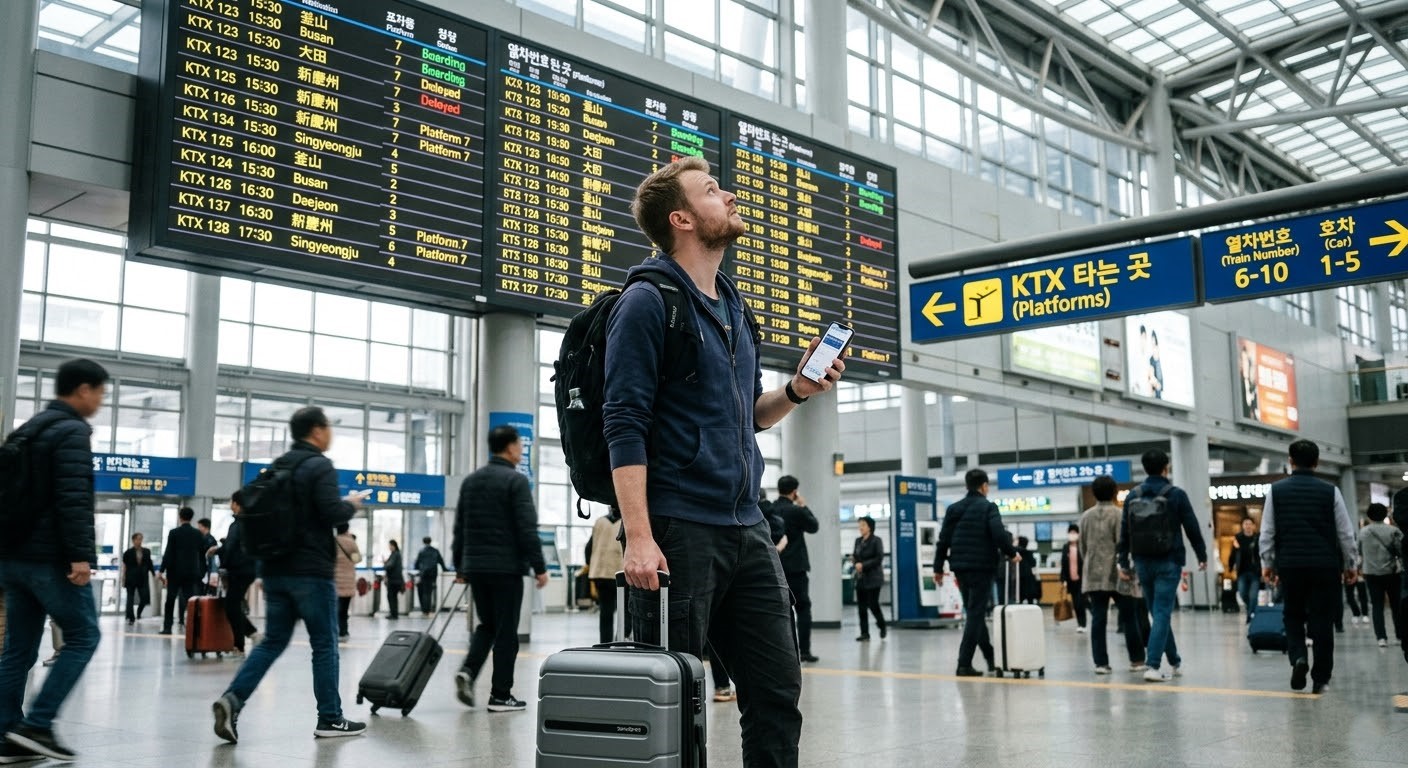
Inside a big KTX station, the stressful part usually begins before the ride does.
Check locally: departure board layout, ticket collection rules, platform access timing, train door positions, and luggage rack availability can vary by station, route, train set, and operating conditions.
For many first-time visitors, KTX looks straightforward right up until the moment the station starts moving fast.
You have a ticket. You know where you are going. The route seems clear. Then you walk into somewhere like Seoul Station or Yongsan Station and the experience stops being abstract. It gets specific quickly. Which board do you look at? Which line on the screen is yours? Is the platform posted yet? Where is your car? Is car 8 near the front or far down the platform? If you stand there thinking too long, are you now the slow person in the middle of everyone else’s commute?
The most stressful part of KTX for first-time travelers is often not the ride itself. It is the short stretch between entering the station and getting yourself, your bag, and your ticket to the right place without letting the station wreck your nerves in the process. That stretch is shorter than it feels, but it contains more decisions than most people expect, and those decisions stack on top of each other in a way that does not leave much room to pause.
A lot of basic travel advice collapses this into “buy the ticket and get on the train.” That is not wrong, but it is too thin to be useful when the board changes, people start walking with purpose, and you are still trying to figure out what exactly you are supposed to follow.
KTX usually gets easier once you understand the order of attention inside the station. Most first-time confusion starts with looking at the wrong thing first.
Start with the train number, not with the crowd
One of the easiest mistakes at a Korean rail station is letting other people’s movement shape your decisions before your own information is clear.
When travelers get nervous, they tend to reach for broad signals. They look for the busiest platform. They follow a crowd that seems to be heading somewhere important. They spot the destination name and assume the next train to that city must be theirs. That can work by luck. It is not a reliable way to board.
At a busy station, you want a tighter anchor than “people are going this way.” The safest anchor is your own booking information – specifically the train number and departure time. The destination matters, but it is not always enough on its own when multiple services are moving through the station close together.
This is the first mental shift that helps. Do not treat the station as a large room you need to decode all at once. Treat it as a sequence. First confirm the details that are uniquely yours. Then match them to the station board. Then follow the platform information. Then find the correct car. Once you break it into that order, the station usually stops feeling bigger than it is.
The board is not there to explain everything at once
Large departure boards can look intimidating because they contain more information than a first-time traveler wants to process in one glance.
The mistake is trying to read the whole thing like a poster. You usually do not need to. What you need is the line that matches your train, which means narrowing your attention quickly.
Most travelers do better when they use the board in that order: departure time, train number, destination, then platform if shown. The eye naturally wants to jump to the city name first. But searching by city name alone can slow you down, especially when you are scanning under pressure. A train number is tighter. A departure time narrows the search even further. Once those two match what you booked, the rest of the line becomes much easier to trust.
The board also tends to feel less foreign once you stop expecting it to behave like an airport departure screen. The logic is similar, but the pace feels different. Airports train people to think in terms of long waits, gate areas, and early positioning. KTX is more compact. You are working with a city station departure, not a drawn-out pre-flight process.
If you arrive and the board does not instantly calm you down, that does not mean you are doing something wrong. It usually means you are still trying to convert the whole screen into one answer. Narrow it down. Find your time. Find your train number. Then trust the line that belongs to you.
Your ticket matters twice: first at the board, then again at the platform
First-time travelers sometimes treat the ticket as something they only need once. In practice, it matters in two different moments.
The first use is confirmation. Your ticket tells you what to match on the main board. The second use comes later, when platform movement starts and the details become physical. Now you are no longer asking “Which train is mine?” You are asking “Where exactly do I need to stand, and what am I about to board?”
Keep the ticket mentally active rather than treating it as a document you have already finished with. The key fields are not just for getting into the system. They are the pieces that connect the board to the train door.
A printed ticket can feel easier for some travelers because it removes phone pressure in a busy station environment. A mobile ticket can feel easier for others because it is already in hand and harder to lose. Either way, the format matters less than whether you can see the train number, departure time, and car or seat information without fumbling when the station starts moving around you.
This sounds small until it is not. People usually do not get confused because KTX is inherently difficult. They get confused because they are looking up at a board, managing a bag, dealing with a phone brightness issue, and trying to restart their focus three times in a row.
The platform is only part of the problem
Many travelers assume that once the platform number appears, the hard part is over. Sometimes it is. Often it is only half over.
A platform tells you where the train will be. It does not tell you where you should be on that platform. That second question is where first-time visitors lose time, and it is the part that most general KTX advice skips too quickly.
KTX boarding gets easier when you stop thinking in terms of “my platform” and start thinking in terms of “my platform plus my car.” Those are not the same thing. Being on the right platform but in the wrong section can still leave you dragging a carry-on down the platform at the last minute while the train is already sitting there and everyone else seems to know exactly where their door will be.
The gap between “basically correct” and “actually convenient” becomes physical very quickly once luggage is involved. The wrong standing position does not only cost time. It creates a rushed boarding moment while the platform is filling up and the train is already in front of you.
Platform information gets you into the right zone. Car information gets you into the right boarding position. Both matter, and they are separate pieces of information you need to hold at the same time.
Car number is not a detail. It is the boarding problem.
The car number is what turns station information into a usable boarding plan.
Travelers often treat car information as something to sort out once they are already beside the train. That is possible, but it is a worse way to do it if the station is busy or if you are carrying more than a small day bag. Once you are on the platform with people moving around you and the train sitting right there, it is harder to think through the layout calmly. The pressure to just get on – any door, figure it out inside – becomes stronger than it should be.
The better move is to treat the car number as part of the pre-boarding step. Once you know the platform, the next question is not “Should I head over there now?” It is “Where along that platform do I need to be for my car?” That question is easier to answer while you are still inside the station, away from the platform motion, with the ticket already in hand.
First-time travelers tend to underestimate platform length. On a quiet day with a backpack, being several cars off may feel manageable. With a carry-on, shopping bag, or larger suitcase, the same mistake feels much more expensive. The train has not even left yet, and you have already turned the easiest part of the journey into a rushed walk with weight in your hands and people flowing around you.
It also changes how calm the station feels. When you know your platform but not your car, the whole area still feels unresolved. When you know both, the station becomes smaller. You are no longer dealing with a large system. You are dealing with one train, one platform, and one section of that platform.
Why first-time boarding feels rushed even when you are technically on time
This is one of the most common KTX surprises. A traveler arrives at the station with enough time on paper, but the last few minutes still feel compressed.
Usually the problem is not the timetable. It is the way station tasks stack together. You enter the building. You check the board. You confirm the train. You locate the platform. You move with your bag. You work out the car position. You second-guess yourself once. Only after all of that do you actually feel ready to board.
“I got here on time” and “I felt calm boarding” are not always the same thing. The gap is more obvious at larger stations. A big rail station creates friction that is not dramatic enough to look like a real problem from the outside. But each small delay takes attention. One wrong glance at the board, one extra stop to re-check the ticket, one unnecessary walk in the wrong direction, and the buffer you thought you had starts disappearing into station movement rather than the train journey itself.
Some travelers later decide the station itself was confusing. Often the station was not especially confusing. They just arrived with enough time for the train, but not enough time for their own first-time processing.
If you have luggage, the station changes shape
KTX is much easier to board when your hands and attention are free. Once luggage enters the picture, the station behaves differently.
Still gives you flexibility. Small errors in position usually cost less.
Changes the route more than you expect. Wrong placement starts to matter.
Changes almost every small decision – escalators, platform distance, stopping points, and how quickly you can recover from a mistake.
This is why rail advice that works for local commuters or light travelers often feels incomplete for visitors. A local rider with a small bag may not care much if they are standing two or three cars away at first. A traveler with luggage usually does.
The practical question is not just whether your bag can fit on the train. It is whether your bag makes the pre-boarding stage slower, less flexible, and more tiring than you expected.
That matters most in three moments:
- when you are scanning the board while holding everything
- when you are moving toward the correct platform
- when you realize you are not near the right car and need to adjust quickly
This is one reason KTX often feels easier on the second ride than the first, even when the route is longer. The train did not change. Your understanding of the station with your own bag did.
Seoul Station and Yongsan Station are not interchangeable in practice
For first-time foreign travelers, one avoidable source of confusion is treating major Seoul rail stations as functionally the same just because both are part of the wider rail network.
They are not the same in practice when you are the one holding the ticket. If your ticket is tied to one station, that station is your problem to solve. “I’m in Seoul” is not enough. “I’m at the correct Seoul station for this departure” is the version that matters.
This sounds obvious, but first-time visitors sometimes carry a vague mental picture of Korean rail travel. They remember “KTX from Seoul” without locking onto the actual departure station printed on their ticket. That becomes a real risk on a travel day when your hotel, subway route, taxi drop-off, and departure station all sit inside one city but do not point to the same door.
The station board can only help if you are already in the right station. If something looks off or the train you are expecting is not appearing where you think it should, check the departure station on your ticket before assuming the board is the problem.
What actually confuses people at the station
The phrase “first-time confusion” sounds vague until you break it into specific moments. In practice, most KTX confusion comes from a small set of recurring problems, and they tend to arrive quietly rather than all at once.
Reading the board too broadly and searching by destination alone. This slows down the scan and makes it easier to land on the wrong service, especially when multiple trains are heading to the same city within a short window.
Assuming platform information solves everything before car information is clear. Knowing where the train will be is not the same as knowing where you should be. Travelers who treat the platform number as the finish line often find themselves repositioning at the last minute.
Arriving with enough time for the train but not enough time for first-time processing. The timetable and the cognitive load are not the same clock. A traveler who needs two or three minutes more than expected to work through the board, platform, and car position may still technically board on time while feeling like they nearly did not.
Underestimating how much luggage changes the platform experience. What looks like a manageable walk on a quiet day becomes a different calculation with a suitcase and a shrinking time margin.
Checking the ticket too late, after already moving with the crowd. Once you are in motion, stopping to re-read the ticket feels like swimming against the current. The better time to read it carefully is before the current starts.
Letting the crowd become your guide instead of using your own train number as the anchor. Other people look purposeful in stations. That does not mean they are heading to your train.
These are not dramatic failures, which is exactly why they happen so often. They are quiet mistakes that create a rushed final few minutes rather than a fully broken trip. People usually still board. They just board with more stress than the train itself deserved.
A calmer way to move through the station
What helps most is not a long checklist. It is a cleaner order.
That order is simple, but it changes a lot. It prevents the common first-time pattern where travelers bounce between phone, board, crowd, and platform sign without ever feeling settled.
It also keeps the train ride separate from the station stress. KTX itself is often the easy part. The station is where the journey either tightens into unnecessary confusion or becomes manageable.
When to arrive if you are taking KTX for the first time
There is no single answer that fits every station, route, and traveler. The useful question is not how much time a confident local rider needs. It is how much time your own first-time processing needs.
If you are traveling light, already comfortable with rail systems, and not dealing with a complicated travel day, you may need less buffer than someone carrying luggage, navigating a large station for the first time, and managing several tasks at once.
Leave time for the station, not just for the timetable.
That means time to enter the building, settle your attention, read the board without rushing, confirm the platform, find the car, and walk there without turning the last few minutes into a recovery exercise. It also means time for the moment where you look at the board and are not immediately sure which line is yours, because that moment happens to a lot of first-time travelers and it takes a beat or two to work through.
The biggest mistake is thinking of arrival time only in relation to departure time. What matters is the relationship between departure time and your own likelihood of needing one extra check, one wrong-turn correction, or one slower walk than expected. Those small additions do not feel significant when you are planning the trip from a distance. They feel very significant when you are already inside the station.
A first-time traveler at a large station is doing something a frequent rider has long since automated. That automation has real time value. Giving yourself a few extra minutes is not excessive. It is the difference between making the station work for you and spending the last part of your buffer wondering if you missed something.
If something feels wrong, shrink the problem fast
When first-time travelers start feeling lost at a KTX station, the problem tends to balloon in their head. They stop asking one small question and start feeling like the entire station makes no sense. The board seems harder to read. The layout seems more complicated. Other people seem to know something they do not.
Usually none of that is true. The station has not changed. The information is still there. What happened is that too many unanswered questions piled up at once, and the mind started treating the whole thing as a single unsolvable problem instead of several smaller solvable ones.
- Am I in the correct station?
- What is my train number?
- What departure time am I matching?
- Which line on the board belongs to me?
- Do I know the platform?
- Do I know my car?
Work through those in order. Most of the time, you will find that you already know the answer to several of them, and only one or two are actually unresolved. That is a much smaller problem than “the station makes no sense.”
Calm in a rail station does not come from understanding everything around you. It comes from knowing which one thing you still need next.
The ride is rarely the hard part
Once you are in the right car and the bag is out of the way, KTX usually feels much simpler than the station that came before it. The seat is assigned. The train moves. The urgent decisions are already behind you.
If the pre-boarding minutes start feeling messy, focus on the station sequence instead of the whole trip at once. Read the right line on the board, match the platform, find the correct car, and get into boarding position before the last-minute rush begins.
For first-time foreign travelers in Korea, that is where the real effort pays off. Not in memorizing rail theory, but in handling the small station decisions in the right order.