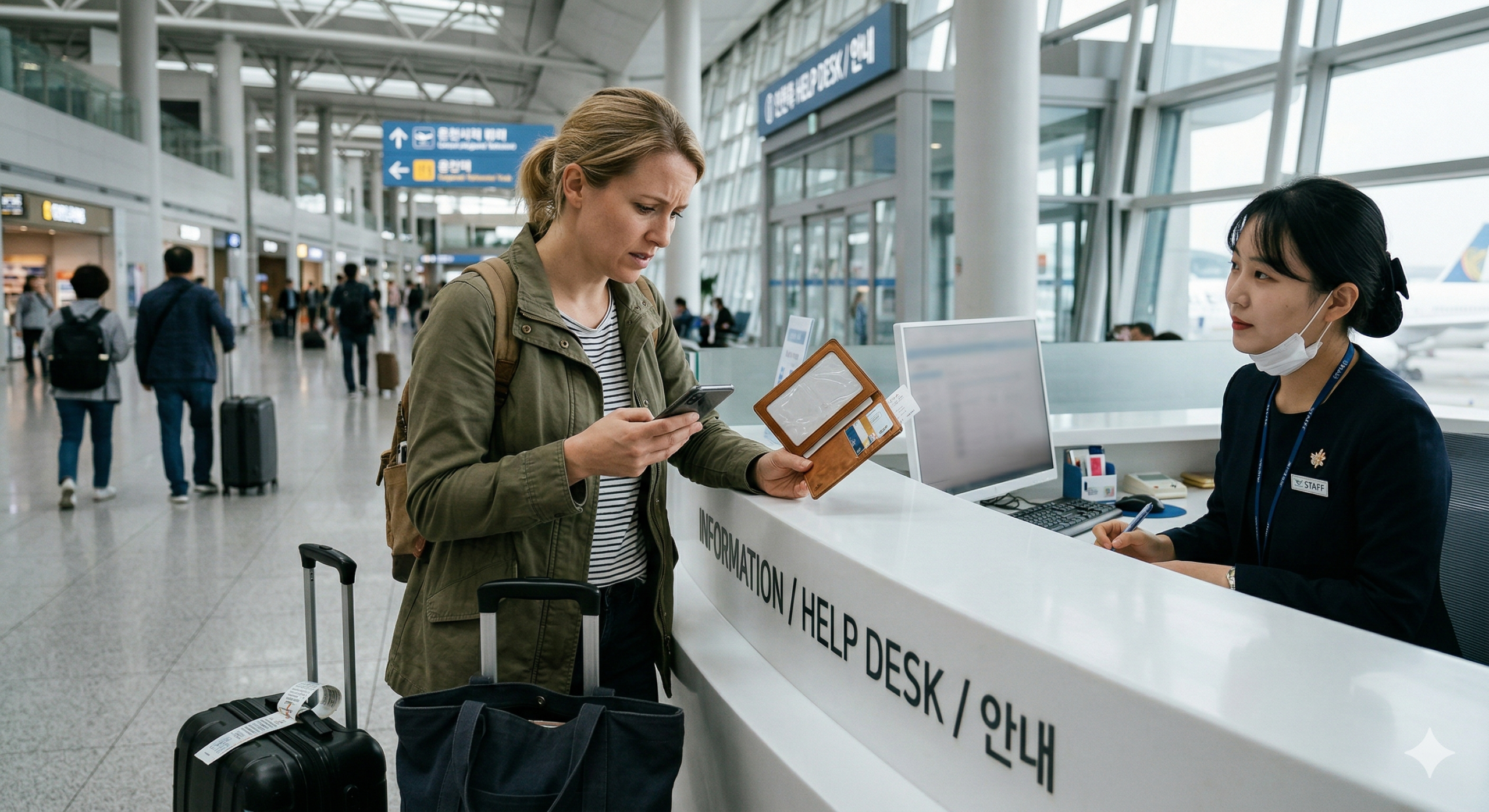
Losing your passport in Korea is not just a document problem. It becomes a timing problem almost immediately.
The moment you realize it’s gone, the damage starts spreading outward. Your next hotel check-in gets harder. A domestic flight or train journey gets awkward. Your international departure stops being routine and turns into a paperwork race. Even simple tasks feel heavier, because you’re no longer just moving through a trip — you’re trying to prove who you are while keeping everything else from falling apart around you.
That’s why the first few decisions matter so much. Most travelers don’t make the situation worse through carelessness after the loss. They make it worse by responding in the wrong order. They search too long. They call the wrong place first. They wait for certainty before starting the official process. Or they focus on saving the itinerary before securing the identity problem that’s about to disrupt everything else.
If your passport is missing in Korea, the goal isn’t to solve the whole trip at once. It’s to stop the problem from expanding. You do that by working out what kind of loss you’re dealing with, contacting the most likely holder quickly, getting into the formal reporting path early enough, and protecting the next 24 hours of travel before the passport issue drags everything else down with it.
First, work out what kind of passport loss you’re dealing with
Still in a hotel safe, travel wallet, inner zip compartment, backpack sleeve, or a jacket pocket you stopped checking too early.
Often a front desk, airport counter, security tray, exchange booth, clinic desk, tour desk, rental counter, or taxi.
You only noticed after multiple crowded stops, or you suspect the bag was open and other things shifted too.
Not every missing passport is the same situation, and treating them all the same way wastes time.
Sometimes the passport is misplaced, not lost. It’s in a hotel safe, a travel wallet, the inner zip pocket of a carry-on, a side sleeve of a backpack, or the jacket pocket you stopped checking because you were sure you’d already looked there. In that case, the right move isn’t panic — it’s one focused search.
Sometimes the passport was left behind somewhere specific. That usually happens at a front desk, an airport counter, a security tray, a currency exchange booth, a clinic registration desk, a tour desk, a car rental counter, or a taxi. In that case, your best move isn’t to search the whole city. It’s to contact the most likely holder before the item gets logged, moved, or transferred into a slower lost-property system.
Then there’s the third case: you don’t know where it disappeared, or theft is a real possibility. Maybe you only noticed it was gone after moving through a busy station, a crowded shopping area, multiple subway transfers, or an airport sequence involving too many trays and pockets. Maybe your bag had been open. Maybe other things had shifted. Once the situation looks like that, stop treating the passport like a delayed inconvenience and start treating it like an actual travel incident.
The reason this distinction is so important is straightforward. A passport left at a hotel front desk might be resolved in twenty minutes. A passport that disappeared somewhere between a train station, a café, a taxi, and a guesthouse is a completely different problem. The second one needs escalation sooner.
Do one hard search, not six weak ones
A lot of travelers burn the first useful hour by doing the same search over and over in different emotional states.
You do need to search — but it should be one serious, methodical effort, not a scattered loop. Stop moving around. Stand still, open your phone, and rebuild the day in order. When did the passport last come out? Not when do you remember seeing it. When did it actually have a job?
Was it at immigration? Hotel check-in? Currency exchange? Tax refund? SIM or eSIM registration? Clinic intake? Car rental? Ticket pickup? Duty-free purchase? The last confirmed functional use matters far more than a vague sense of where it “should” be.
Don’t ask, “Where do you think it is?” Ask, “What was the exact sequence after we last used it?”
That question gets much better answers. The critical part is knowing when to stop. If the passport doesn’t turn up after one proper search — especially if you’re moving soon or flying soon — continuing the same search pattern starts costing you more than it’s worth. The right time to escalate usually comes earlier than people want to admit.
Write down the details you’ll need before stress wipes them out
A surprisingly common mistake is trying to keep everything in your head.
The moment the passport looks truly missing, start a short notes file on your phone. You need a clean record of the practical facts, not a dramatic account of what happened.
This does two things. It stops you from fumbling through the same information badly every time you call someone. And it gives you a working file for the police, your embassy or consulate, your airline, and anyone else who may need the details later.
People consistently underestimate how quickly specifics blur once stress kicks in. The time of the taxi ride, the counter number, the name of the hotel desk clerk, the sequence of stops after the airport — all of it becomes harder to recall than it seems in the moment. Write it down before the story starts changing in your own memory.
Call the place most likely to be holding the passport, not the place that feels most official
Official reporting matters, but it isn’t always the first call to make.
If the passport may have been left at a hotel, call the front desk first. Ask them to check the safe, the drawer where documents are temporarily held, the lost-and-found log, and the exact spot where guests usually present passports. If it may have been left in a taxi, gather the pickup point, drop-off point, time, payment method, and route before calling. If it may have been left at a clinic, exchange booth, rental desk, or tour counter, contact that location directly while the trail is still local.
Don’t tell a long story. Keep the call clean. What you need to know isn’t “Can you help me?” It’s whether they physically have it, whether they passed it to another desk, whether it has already gone into a lost-property process, and who you should contact next if it hasn’t.
That’s the information that actually changes your situation. A local recovery is fast because the passport is still close to where it was last used. Once it’s been passed between staff, logged, transferred, or handed off to a centralized system, everything becomes slower and less personal. That’s why early direct calls matter.
Use the police and reporting route before the case becomes a departure problem
Once the passport is no longer tied to one likely holder, or if theft seems possible, move into the formal reporting path.
In Korea, the practical starting points are the nearest police station and the LOST112 system. LOST112 allows travelers to report lost items online, visit a nearby police station, and obtain a filing receipt for the report. That receipt can matter later, because the problem may shift from “finding the passport” to “documenting the loss properly so the replacement process can move forward.”
Use this when theft seems likely or the circumstances feel like a security issue rather than ordinary carelessness.
Useful when you need general travel support, office direction, or help explaining the situation in another language.
Useful when proof-of-entry, immigration records, or departure-side questions start appearing around the loss.
This is the stage where people often hesitate, still hoping the passport will reappear. That hesitation is understandable — and usually the wrong call. Reporting early doesn’t stop the passport from being found. It just prevents the administrative side from starting too late.
If the situation isn’t an emergency but you need help understanding which office to contact, what process to follow, or how to explain the problem in another language, 1330 can assist as a general travel support line, and 1345 can help with immigration-related guidance. These aren’t replacements for your embassy or consulate, but they can cut through a lot of confusion when you’re trying to figure out your next move.
If the passport may have been lost at Incheon Airport, don’t treat the whole airport as one desk
Airport losses follow their own logic, and this is where many travelers waste time unnecessarily.
If the passport may have been lost at Incheon Airport, use the airport lost-and-found route right away. But don’t assume the main airport desk automatically covers every part of the journey through the airport. Incheon Airport’s own guidance separates losses by where they occurred. An item lost in the passenger terminal isn’t always handled the same way as something lost on an aircraft, an airport bus, or the airport railroad. In those cases, you may need to contact the airline or transport operator directly rather than relying on the main terminal lost-and-found office.
A passport can disappear anywhere in that chain without the case staying within one operator’s system.
One more detail worth knowing: Incheon Airport’s official lost-and-found guidance states that foreign passports found at the airport are held for one month from the date of discovery before being transferred to the relevant embassies. That’s useful context — but it shouldn’t make you passive. It means there’s a formal custody chain in place. It doesn’t mean waiting is a smart plan.
If you’re still physically at the airport or close to it, use that advantage before leaving. Once you’re back in the city, every follow-up becomes slower: which terminal, which desk, which operator, which handoff, which timing window.
Contact your embassy or consulate earlier than feels necessary
A lot of travelers wait too long to make the embassy call because they want to avoid dealing with it unless the original passport is truly, definitively gone. In practice, that delay is often what turns a manageable situation into a departure crisis.
Your embassy or consulate is the part of the process that can turn a missing passport into something usable for travel again. Depending on your nationality, that might be an emergency passport, a temporary passport, an emergency travel document, or another limited-use document. The exact name, requirements, processing times, and appointment rules depend on your country — which is why guessing is a bad idea.
The key is to contact them while you still have time to respond to whatever they tell you.
- Your full name as shown in the passport
- Your nationality
- Your passport number if you have a copy or photo
- The issue and expiry dates if known
- Recent passport photos if required
- Your itinerary and departure timing
- Any police report or filing receipt
- Any other identification you’re still carrying
- What document can you issue in this situation?
- Do I need an appointment?
- What proof of identity will you accept if the passport is gone?
- Do you require a police report first?
- How many photos should I bring?
- Can this be handled same day or next day in urgent cases?
- Will the replacement document be accepted for my next flight or at my next destination?
Those are far more useful questions than “What should I do?” The more specific you are, the more actionable the answers will be.
Don’t overlook proof-of-entry and immigration-side questions
This is one of the details travelers most often miss until it’s almost too late.
LOST112’s guidance for lost passports specifically mentions that travelers should prepare passport details, photos, and — where relevant — proof related to entry and immigration status. In plain terms, your passport problem can sometimes become an immigration-record problem as well, particularly when you’re close to departure and need to prove lawful entry or current travel status after losing the document you used to enter the country.
That doesn’t mean every traveler will face the same paperwork requirements. It does mean you shouldn’t assume the replacement passport alone will automatically answer every question at the border.
This is where 1345 can be genuinely useful. The Immigration Contact Center provides multilingual guidance and can help clarify which immigration-related support line applies to your case and what office or process you need to follow. If your embassy or airline starts asking about proof of entry, immigration records, or what’s needed for departure after a passport loss, get guidance rather than guessing.
A lot of travel problems spiral because people solve one document issue and only then discover a second one attached to it.
Protect the next 24 hours of your trip before they become a second emergency
A lost passport rarely stays contained. It starts affecting nearby decisions fast.
If you’re close to hotel checkout, make sure you still have enough identification and booking confirmation to handle the next front desk. If you’re about to move cities, think carefully before doing it. Movement means more counters, more luggage, more handoffs, and more ways to make the problem harder to manage. If you’re flying soon, don’t assume your airline will automatically accept whatever replacement document your embassy issues — confirm that once the replacement path becomes clear.
You also need to protect the practical parts of the trip that now matter more than usual.
Passport problems get messier when nobody is clearly owning the process. The goal here isn’t comfort. It’s containment. You’re trying to stop one missing document from creating three more failures around it.
Know when to stay put instead of forcing the itinerary forward
This is where a lot of otherwise capable travelers make the wrong call.
They try to “keep the trip normal” while working on the passport issue in the background. So they check out, move to the next hotel, take the KTX to another city, or push forward because they don’t want the trip to feel ruined.
Sometimes that works. Often it doesn’t.
The more you move before the passport situation is stabilized, the more the problem spreads. You now have more hotel desks to deal with, more luggage to manage, less time, more booking changes, and more ways for the situation to become difficult to explain. If you’re within a day or two of needing embassy assistance, police paperwork, airport follow-up, or airline confirmation, staying put is usually the stronger move.
Useful test: will moving today make the passport problem easier to solve tomorrow?
If the answer is no, movement is probably serving your emotions more than your logistics.
A passport photo helps, but it’s not a fix
Many travelers assume that having a photo of their passport means they’re essentially covered. That’s too optimistic.
A copy or photo can absolutely help. It can speed up identification, make embassy conversations easier, help you provide the passport number and issue details, and reduce uncertainty when filling in forms or speaking to police or consular staff.
But a copy is not a substitute for the actual passport. It doesn’t automatically restore your ability to travel. It doesn’t override airline or border-control requirements. It doesn’t eliminate the need for a proper replacement document.
If you do have a photo or scan, treat it as supporting material — not the solution itself. Helpful, yes. Sufficient, no.
What to do if the passport is found after you’ve already started reporting it
This happens more than people expect, and it creates real confusion because nobody’s sure whether to stop the process or see it through.
If the original passport is found quickly and is physically back in your hands, the next step depends on how far the reporting or replacement process has already gone and what your embassy or consulate tells you. Don’t assume you can simply ignore the paperwork already in motion. If you filed reports, booked an emergency document appointment, or were told the original passport could be invalidated once reported lost, verify its status before attempting to travel on it.
This varies by country, which is why you shouldn’t guess. The safe move is to confirm directly with the issuing authority or consular office handling your case.
The broader point is simple: finding the passport later doesn’t always reset the situation to zero. Sometimes it does. Sometimes it changes what the next step needs to be. That’s why keeping a clear record throughout matters.
The most common mistakes travelers make after losing a passport in Korea
Treating it like any other lost item. It isn’t. A charger can be replaced at the nearest convenience store. A scarf can wait. A missing passport changes your ability to identify yourself and move through the rest of the trip.
Searching indefinitely before reporting. One solid search is rational. A prolonged search that delays the official path almost never is.
Assuming one phone call covers the whole problem. It usually doesn’t. A hotel, a police station, LOST112, an airport lost-and-found office, an airline, and an embassy or consulate all do different jobs. Most passport situations involve more than one of them.
Waiting until departure day is close before calling the embassy or consulate. That’s how a manageable situation turns into a genuine panic.
Trying to keep the itinerary alive at any cost. Sometimes the smarter move is to pause the trip, stabilize the identity problem, and restart from a more solid position.
Letting embarrassment slow you down. People delay reporting because they feel foolish. That feeling is understandable and completely unhelpful. The situation improves when you start moving — not when you spend time being hard on yourself.
A clear action order if you’re dealing with this right now
If you’re reading this while stressed and short on time, keep the sequence simple.
That order won’t make the situation pleasant. It will make it manageable.
What matters most
Losing your passport in Korea can derail a trip fast, but it doesn’t automatically end one. Most bad outcomes come from delay, blurred timelines, and the right steps taken in the wrong order.
The solution isn’t to stay perfectly calm. It’s to be systematic before the situation gets more expensive to fix. Work out what kind of loss you’re dealing with. Do one proper search. Contact the most likely holder. Start the formal path early. Use the correct airport route if the loss may have happened at Incheon. Bring your embassy or consulate in before time gets tight. Clarify immigration-side questions rather than assuming they’ll sort themselves out. And protect the next 24 hours so one missing document doesn’t trigger a chain of avoidable failures.
A passport loss feels like the trip has suddenly slipped out of your control. The way back isn’t luck. It’s sequence.