Quick take
- T-money is mainly for public transportation.
- Buy it early if you plan to use the subway or buses on arrival day.
- Do not assume every taxi or store will accept it in the same way.
- If you’re traveling with children or teenagers, ask about fare discount registration.
If this is your first trip to Korea, there’s a good chance you’ll hear about the T-money card before you’ve even left the airport. The reason it comes up so often is simple: it makes getting around noticeably easier.
Instead of buying a separate ticket every time you take the subway or a bus, you load money onto one card and use it throughout your trip. That matters more than most first-time visitors expect. On arrival day, you’re already dealing with immigration, luggage, airport signs, map apps, and a stream of small decisions. A T-money card removes one of those decisions and makes transportation feel more predictable from the start.
What a T-money card actually does
A T-money card is a rechargeable transportation card used widely across Korea. For most travelers, its job is simple: it lets you pay for public transportation without buying a new ticket every time.
In practical terms, that means subways and buses. Depending on the taxi and how that vehicle is set up for payment, it may also work in cabs. It’s accepted at some affiliated convenience stores and partner merchants too, but that’s a secondary benefit, not the main reason to get one. The real value is transportation.
That distinction matters. A lot of first-time visitors read that T-money works in many places and start treating it like a general payment card. That’s not the most useful way to think about it. The simpler mindset is this: buy it for getting around, and treat any store use as a bonus when it happens to work.
Why first-time visitors usually end up getting one
A lot of travel advice sounds useful in theory but doesn’t change much on the ground. A T-money card usually does.
When you first arrive in Korea, public transportation can feel straightforward in some ways and unfamiliar in others. The network is large, signs are often in English, and maps are easy to find, but you’re still dealing with a new system, a new language environment, and an unfamiliar payment routine. Small friction adds up fast. You reach a subway station, stop at the ticket machine, figure out which option to buy, wonder about transfers, and then repeat the whole thing on the next ride.
A T-money card cuts most of that out. It tends to be especially useful for:
- first-time visitors planning to use the subway regularly
- travelers moving between the airport, hotel, and different neighborhoods
- anyone staying several days rather than taking only one or two rides
- people arriving tired who want the first 24 hours to involve fewer decisions
- travelers who prefer a simple system they don’t have to rethink every time they board
If your trip includes Seoul, Busan, or anywhere else where you’ll rely on public transportation day to day, having one card that works across those routines makes the whole trip feel less fragmented.
Is it mandatory?
No, and it’s worth being clear about that.
You can travel in Korea without one. Some subway lines still sell single-use tickets, and taxis take cash and credit cards. But for a first-time visitor who expects to use local transportation more than once or twice, a T-money card is usually the more practical choice. It saves time, reduces guesswork, and makes transfers easier to handle.
The honest framing isn’t “you absolutely need this.” It’s this: if you want public transportation in Korea to feel easier from the start, this is one of the most straightforward tools you can carry.
Where to buy a T-money card
For most travelers, buying one isn’t complicated. The most common places to look are:
- convenience stores
- subway stations
- airport transportation areas
- station service desks in some locations
If you want the path of least resistance, a convenience store is usually the safest first stop. The process is simple: ask for a T-money card, pay for it, then ask to add value to it.
Some travelers assume they need to find a special transportation office or a tourist counter. That’s usually not necessary. A regular convenience store handles it in most cases.
Best time to buy it
Early, ideally before you start taking multiple rides.
That doesn’t mean the moment you land. But the sooner you have it, the less time you’ll spend figuring out single tickets or alternative payment options while you’re already in transit. If you know you’re taking the AREX, the subway, or city buses on arrival day, getting the card before you start moving is usually the cleanest option.
How much to load at the start
This is one of the most practical questions, and it’s also where many guides get vague. A reasonable starting balance should cover:
- your first airport transfer or first major city ride
- a few subway or bus trips
- a little extra margin in case your plans change that day
That gives you a working balance without putting too much money on a card you’re still getting used to.
A lot of first-time visitors worry about choosing the perfect amount. That’s usually the wrong concern. What matters more is having enough to avoid a problem on day one. Once you see how you’re actually moving around, you’ll have a much clearer sense of whether you need a larger reload.
Think practically rather than mathematically. The goal isn’t to optimize every won on arrival day. The goal is to avoid being stuck at a gate or a bus stop because your balance ran out.
How to top it up
- Hand the card to the cashier
- Say how much you want to add
- Pay for the reload
- Check the updated balance if you want to confirm
The mechanics are easy. The more useful habit is timing. Top up before the card becomes a problem, not while you’re rushing to catch a train with luggage and almost nothing left. If you know you’ve got a full day of movement ahead, reload a little earlier than you think you need to. That one habit prevents a surprising amount of friction.
Using it on the subway
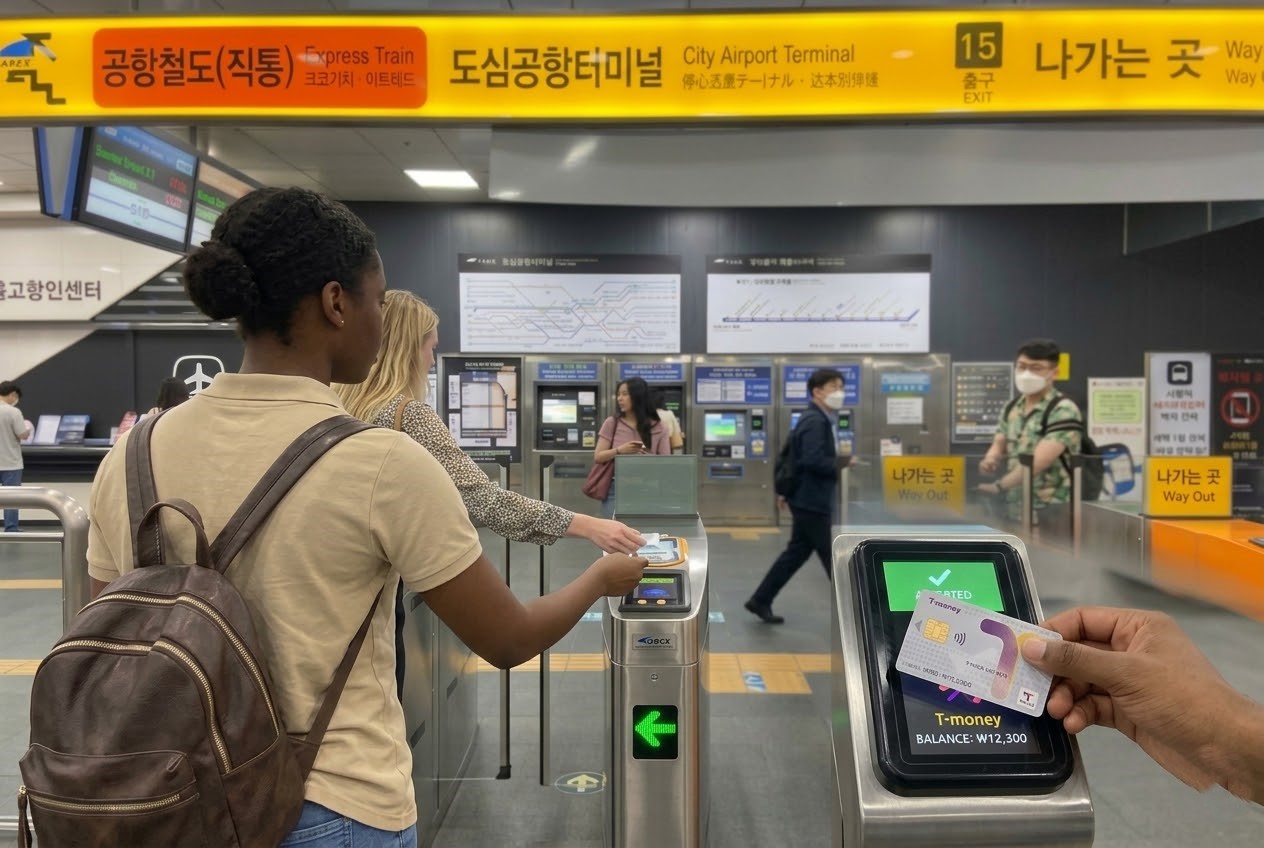
The subway is where most visitors get comfortable with the card quickly. Tap in at the gate when you enter. Tap out when you exit. After one or two rides, it becomes automatic.
What slows people down isn’t usually the card itself. It’s the hesitation: Am I at the right gate? Do I need a different ticket? Does this line work the same way? Do I tap again when I leave? Once you have a T-money card, the payment part of that uncertainty disappears. You’re left with the route question, not the payment question.
Using it on buses
Buses are where first-time travelers need to pay a bit more attention.
Important: Tap when you board, and in many cases tap again when you get off, especially when distance-based fares or transfer rules apply.
This is one of those details that separates useful guidance from a vague summary. A lot of low-effort guides just say “use the card on buses” and stop there. The second tap matters. If you skip it when you should have done it, it can affect your fare or your transfer.
If you’re unsure on a specific route, watch what other riders do and follow any posted instructions. Don’t assume every region or bus type works in exactly the same way.
Choosing airport transportation based on your actual destination
One mistake first-time visitors make is picking airport transportation before thinking clearly about where they’re actually going.
The best option from Incheon International Airport depends less on what sounds fastest in general and more on your specific endpoint.
- Seoul Station: AREX Express is often a strong option.
- Other parts of Seoul: An airport limousine bus may be easier if it cuts down on transfers.
- Incheon destination: A bus can often feel more practical than the subway depending on the neighborhood.
- Heavy luggage or late arrival: The easiest route may be better than the technically fastest one.
The useful rule is simple: don’t choose transportation based only on the name of the service. Choose it based on your actual endpoint, how many transfers you’ll need, and how much you’re carrying.
Using T-money in taxis
Sometimes it works, but don’t build your plan around that assumption.
- expect T-money to work best with public transportation
- treat taxi acceptance as possible, not guaranteed in every situation
- if you want to pay by card in a taxi, confirm before the ride rather than at the end
That keeps expectations realistic and avoids the kind of confusion that happens when travelers assume it worked once, so it must work everywhere.
A practical note on taxis from the airport
Not every taxi at the airport is the same. Deluxe taxis, sometimes called black taxis or premium taxis, cost more than regular taxis. They can be more comfortable and spacious, but they’re not the obvious default for most travelers who just want to reach their hotel without overpaying.
If keeping costs in check matters to you, a regular taxi is usually the more practical choice. A deluxe taxi makes sense if you specifically want more comfort, extra luggage space, or a premium experience and you’re willing to pay for it. For most first-time visitors, the better default is to compare train, bus, and taxi based on where you’re going, how much you’re carrying, what time you’re arriving, and how many transfers you want to deal with.
Using it at convenience stores and other shops
Yes, it works at affiliated stores, but stay disciplined about how you use it. Don’t turn T-money into your main shopping payment tool just because it occasionally works at a convenience store. That’s not what the card is for, and it’s not how most travelers get the most out of it. If it helps you pick up something small at a convenience store, fine. If it doesn’t work at a particular shop, your trip is unaffected because the card’s real job is transportation.
Child and youth discounts: what families should know
Do not assume child or youth discounts apply automatically. Ask about registration when you buy the card.
This is one of the most practically useful details in this guide, especially for anyone traveling with kids.
Children and youth can receive discounted fares if the card is registered with their date of birth. Registration is typically done at a convenience store or subway information center, and you may need to show proof of birth date. A passport usually works.
If you’re traveling with a child or teenager, ask about registration when you buy the card. That’s much easier than finding out later that the card has been charging adult fares the entire time.
Common mistakes first-time visitors make
1. Buying the card but not loading enough balance for the first day
The card itself does nothing without money on it. If you buy it and forget to load it properly, you haven’t actually solved your transportation problem.
2. Treating it like a universal payment card
T-money can be used outside of transportation in some situations, but it shouldn’t be your primary payment solution for shopping and meals.
3. Assuming every station, bus, taxi, and store works identically
Korea’s transportation system is traveler-friendly, but details still vary. Don’t generalize too quickly from one experience.
4. Skipping the exit tap on buses when it matters
This is a small mistake that can affect your fare and transfer credits. When the local routine calls for a tap-out, do it.
5. Assuming child or youth discounts are automatic
They may require registration. Families should check upfront rather than guess.
6. Choosing airport transportation without thinking about the final destination
Thinking in broad categories such as “train is faster” or “bus is easier” isn’t enough. The better choice depends on where you’re actually headed, how much luggage you have, and how many transfers you’re willing to make after a long flight.
A simple decision framework for arrival day
- Going directly to Seoul Station? The AREX Express is often one of the cleanest and most straightforward options.
- Going somewhere else in Seoul? Check whether an airport bus gets you closer to your hotel with fewer transfers.
- Going to Incheon? Don’t assume the train is best. A bus may be simpler depending on the neighborhood.
- Arriving tired, carrying heavy luggage, or landing late? The easiest route is often more valuable than the technically fastest one.
That’s also where T-money fits in. Even when it’s not the only payment method you use that day, it makes the first stage of local transportation more manageable once you’re out of the airport.
Situations where a T-money card helps the most
Arrival day in Seoul
You’ve just cleared immigration, collected your bags, and need to get into the city. You’re not trying to become an expert in Korean public transportation. You just want one payment method that gets you moving without unnecessary decisions.
A full day of subway rides
You’re going from your hotel to one neighborhood, then another, then back at night. Buying a separate ticket each time is unnecessary friction.
A mixed subway-and-bus day
You take the subway for the longer stretch, then a bus for the last part. This is where a transportation card feels far more natural than managing separate payments.
Traveling with family
When you’re moving as a group, any repeated friction gets amplified. A tap-and-go system becomes more useful, not less.
Visiting more than one city
If your trip includes multiple cities and regular use of public transportation, the convenience accumulates. The benefit isn’t just one ride. It’s fewer repeated decisions spread across several days.
Who gets the most out of it
A T-money card is most useful for:
- travelers staying several days rather than passing through briefly
- visitors using buses and subways regularly
- first-time travelers who want fewer moving parts to manage
- people who’d rather tap and go than think through each fare
- families and anyone with a full day-to-day itinerary
It’s less relevant if you’re barely using local transportation, mostly relying on private transfers, or only taking a handful of rides. But that’s not how most independent first-time travelers move around Korea.
A simple rule for deciding whether to bother
Ask yourself one question: Will I use Korean public transportation more than once or twice?
If the answer is yes, a T-money card is worth getting early. Not because it’s mandatory, and not because it’s a travel hack, but because it removes a repeating layer of friction from one of the most common parts of the trip.
That’s what a good travel tool does. It doesn’t make the trip exciting. It makes it smoother.
Final thoughts
A lot of first-time Korea travel advice focuses on the bigger decisions, such as where to stay, which apps to download, and what to book before you arrive. Those things matter. But small operational details often shape the actual experience more than people expect.
A T-money card is one of those details.
It doesn’t answer every transportation question. You still need to know where you’re going, which line to take, and whether a bus or train makes more sense for a given trip. But it removes one repeating layer of friction, and that alone earns its place in your wallet.