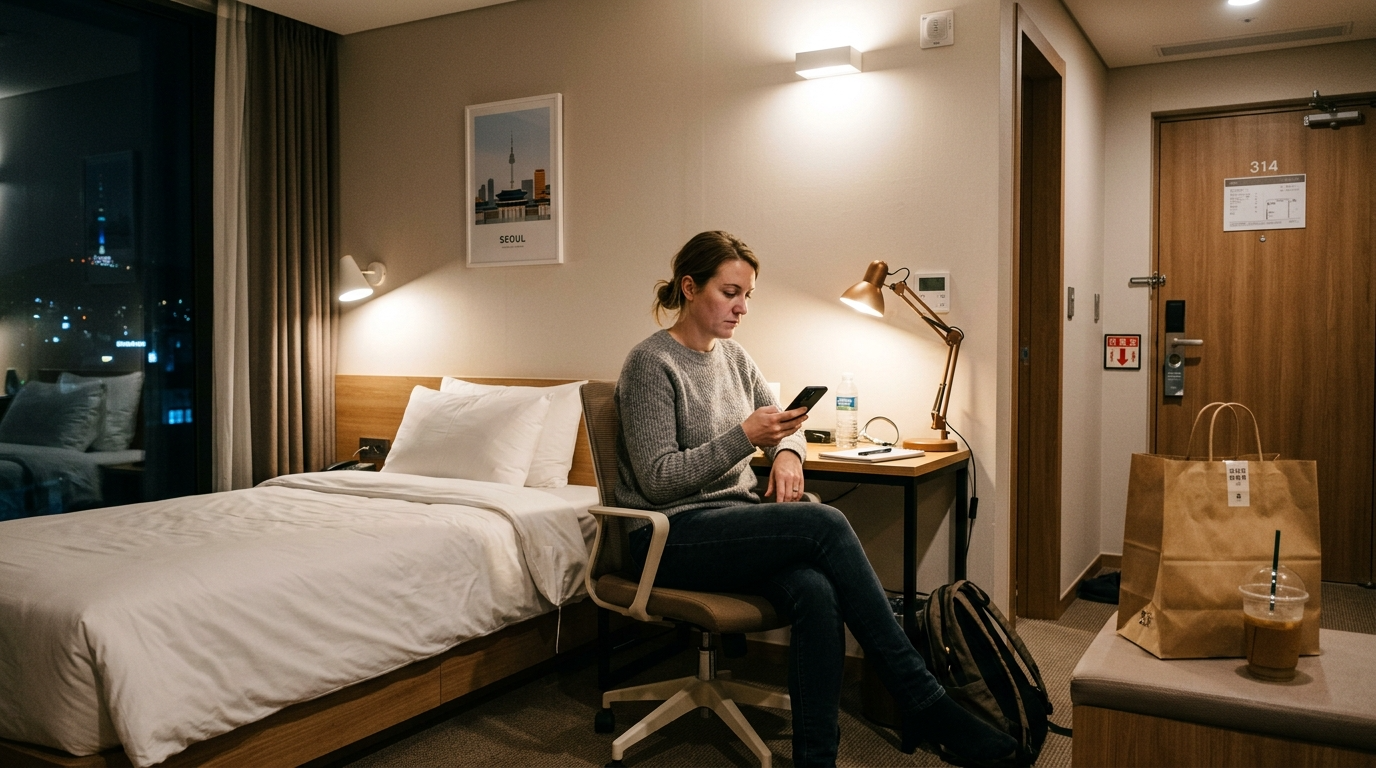
Can Tourists Order Food Delivery in Korea? What Works, What Fails, and Why Hotels Complicate It

Travel Utility Editorial

Can Tourists Order Food Delivery in Korea? What Works, What Fails, and Why Hotels Complicate It

A practical, search-intent guide for foreign travelers trying to order food delivery in Korea while staying in a hotel.

Ordering food delivery in Korea as a tourist is possible. The problem is that many visitors imagine the easy part and miss the fragile part.

From the outside, Korea looks like one of the most delivery-friendly places in the world. Food can reach homes, hotels, parks, and other pickup points with surprising speed, and that convenience is visible everywhere in Korean daily life. That creates a strong expectation among foreign travelers: if delivery is this normal in Korea, then ordering dinner from a hotel should be easy. In practice, that is exactly where people get tripped up. The food is not the hard part. The handoff is. The app setup is. The building is. The last ten minutes are.

That is why the better question is not simply, “Can tourists order food delivery in Korea?” The better question is: “Under what conditions does delivery actually work for a short-term visitor staying in a hotel, and what usually breaks before the food reaches them?” Once you frame it that way, the whole system starts to make more sense.

“The food is not the hard part. The handoff is. The app setup is. The building is. The last ten minutes are.”

What usually works What usually fails Why it matters
A service that a foreign traveler can actually use from signup to payment Local verification friction, payment rejection, unclear interface The order can fail before the restaurant even matters
Precise address plus a realistic pickup point Using only the hotel name or assuming room-door delivery Hotel delivery depends on the final approach, not just the map pin
Being ready when the rider arrives Mentally checking out after payment In hotel settings, the handoff is often the whole game

Korea has a powerful delivery culture, but tourists do not enter it on local terms

A lot of travelers arrive in Korea expecting food delivery to behave like a global default. Open an app, choose a restaurant, pay with a card, drop a pin, and wait by the door. That logic works in plenty of cities around the world. In Korea, it can work too, but only when several local assumptions happen to line up at the same time.

The delivery ecosystem in Korea grew around people who already understand the local setup. They know how addresses are structured. They know how delivery apps behave. They know what happens when a driver calls instead of messaging. They know whether a building expects a handoff at the lobby, outside the entrance, or somewhere less obvious. They also know that “delivery” in Korea is not always the same thing as “a driver comes all the way to my room.”

A tourist staying in a hotel is entering that ecosystem from the outside. They may be fluent in ordering food back home, but that does not automatically translate into success here. The friction points are different. A visitor can have mobile data, a valid hotel booking, a working credit card, and still get stuck because the local app expects Korean phone verification, the payment flow rejects the card, the address is interpreted differently, or the hotel does not want riders moving beyond the lobby. So the system can feel effortless to watch and awkward to use.

That mismatch is the core issue. Korea’s delivery culture is strong. Tourist access to that culture is conditional.

The first failure point is often the app, not the hotel

Many tourists assume the hardest part of hotel delivery will be the hotel itself. Very often, the first problem shows up much earlier.

A lot of Korean delivery apps were not built with short-term foreign visitors as the default user. Some are Korean-first in language design. Some expect local phone number verification. Some create payment friction for travelers who are using foreign-issued cards. Even when the app is technically usable, the process can still feel shaky if a visitor is trying to order late at night, switch between translation tools, and guess whether the final checkout screen is actually reliable.

That is why “just download a delivery app” is weak advice. Downloading the app is the smallest part of the problem. The real question is whether the entire path works for a tourist from beginning to end. Can you create an account without local friction? Can you trust the payment method to go through? Can you understand enough of the interface to know what kind of delivery you are setting up? Can you react if the driver or the service contacts you after the order is placed?

This is also why tourists describe food delivery in Korea as inconsistent rather than impossible. One person succeeds and thinks it is simple. Another gets blocked at verification. Another gets through payment but fails at the handoff. Another successfully orders once and assumes that all future orders will work the same way, only to find that a different hotel or different district changes the outcome completely.

The difference between “easy” and “confusing” is often not the restaurant. It is the stack of small requirements sitting between the app and the building.

Practical frame: In Korea, a tourist order usually has two separate failure zones: first the ordering flow, then the hotel handoff. People often focus on the first and underestimate the second.

Hotel delivery sounds simple, but hotels are one of the least straightforward delivery destinations

The idea of ordering food to a hotel feels intuitive. You are tired, the weather may be bad, you do not want to go back out, and delivery seems like the most natural answer. But a hotel is not the same kind of destination as an apartment, and that difference matters more than many travelers expect.

Hotels have front desks, access controls, guest privacy rules, elevator restrictions, late-night staffing patterns, and internal preferences about outside visitors. In many properties, the food handoff is treated as something that should happen in the lobby or at the entrance rather than at the room door. Some hotels are more flexible. Some are stricter. Some do not explain the policy clearly until the delivery is already in motion.

This matters because travelers often imagine hotel delivery as if it were room service without the hotel. That is the wrong mental model. A rider delivering fried chicken, tteokbokki, or burgers is not operating under the same rules as hotel staff. The delivery task is simply to complete the drop-off. Whether that means the entrance, the lobby desk, or the room corridor depends on a mix of app design, driver behavior, and hotel policy.

That is where the confusion starts. Travelers think they are ordering food. In reality, they are arranging a three-way handoff between the app, the rider, and a building they do not control.

What a successful hotel delivery actually looks like

A successful order for a tourist in Korea usually depends on two separate things going right.

First, the order has to be placed in a way that works for a non-resident. That means the app or service must be realistically usable without the usual local friction swallowing the process. The language cannot be a complete barrier. Payment cannot collapse at the last step. The account setup cannot become a dead end.

Second, the handoff has to make sense inside the actual hotel environment. That means the delivery point has to be clear, the hotel has to tolerate the handoff, and the traveler has to be available when the food arrives. This second part is where many visitors lose control of the situation, because they focus on the menu and forget that the building still has the final say.

If you separate those two parts early, hotel delivery in Korea becomes much easier to judge. Some hotels are not bad for delivery because the app is weak. Some delivery attempts fail even when the app works because the building is awkward. Some cases look like “payment failure” when the real issue is that the traveler wanted room-door delivery in a property that quietly expects lobby pickup.

In other words, a successful order is not just an order that goes through. It is an order that reaches a pickup point you can actually use without confusion.

Why hotel addresses are more complicated than they look

A surprisingly common mistake is assuming the hotel name is enough.

For many tourists, the hotel name feels like the address. They booked the room, the taxi found it, the maps app recognizes it, so the delivery should also find it. But delivery works best when the destination is clear both to the platform and to the rider making the handoff. A hotel can have multiple entrances, a side driveway, a lobby on a different level, a tower name that differs from the brand name, or a Korean name that locals recognize more easily than the English version shown on a booking site.

This creates a gap between being “generally locatable” and being “easy to deliver to.” A delivery can fail even when the hotel itself is not difficult to find. The problem is often the final approach. Which entrance matters? Where is the rider supposed to stop? Is the lobby on the street level or upstairs? Does the hotel have a separate residence wing? Does the front desk want outside food delivery riders using the main elevator? None of this feels important while browsing menus, but it becomes critical when the food is five minutes away.

That is why exact address handling matters so much more than tourists expect. The cleanest version is usually to use the hotel’s precise street address and pair it with the most practical pickup point you can actually reach quickly. If the hotel has a business card, printed address slip, or front desk direction in Korean, that can be more useful than relying on memory or an English-only hotel label.

The destination needs to make sense to the system, to the rider, and to you. If it only makes sense to one of those three, the order becomes vulnerable.

The destination needs to make sense to the system, to the rider, and to you.

The handoff is where most hotel delivery attempts succeed or fall apart

For tourists, the most important shift is to stop thinking about “delivery” as the same thing as “doorstep convenience.”

In Korea, especially in hotel settings, the cleaner mindset is often: delivery means the food reaches a workable pickup point. That might be the lobby. It might be the main entrance. It might be a place the front desk tells you to wait. The more you insist on a room-door fantasy without confirming the building setup, the more likely you are to create avoidable friction.

This is not just about policy. It is also about timing. When the rider is close, the traveler may need to move quickly. A front desk staff member may call the room. The app may show arrival before the traveler is fully ready. If the guest is showering, charging the phone across the room, or assuming the rider will keep waiting indefinitely, the handoff becomes messy fast.

Late-night orders make this worse. At the end of a long day, tired travelers are more likely to place the order and mentally switch off. But late-night building conditions can be tighter, staff coverage can be thinner, and communication friction becomes more noticeable when everyone expects the exchange to be quick.

So the real rule is simple: do not judge hotel delivery by whether the payment went through. Judge it by whether you can complete the handoff cleanly.

Foreigner-friendly delivery services work better because they remove the first layer of friction

If the local delivery route feels awkward, the smartest move is not to force it harder. It is to use the part of the ecosystem that already expects foreign travelers to exist.

That is why tourist-oriented or multilingual delivery services matter. They do not magically remove every problem, but they reduce the first layer of failure. If a service lets you sign up without a Korean phone number, supports international card payment, uses English or other languages cleanly, and provides a support path that a short-term visitor can actually use, you start the process on much firmer ground.

Korea Tourism Organization has highlighted Shuttle Delivery in exactly this context: as a service designed specifically for foreigners, with multilingual access, signup without a Korean phone number, and support for international credit cards. That does not mean every tourist must use one named service forever, and it does not mean every hotel handoff becomes automatic. What it does mean is that the tourist problem is real enough for official travel guidance to point to a workaround built around foreign-user friction.

That matters because it changes how travelers should think. The goal is not to prove that you can survive the most local possible ordering flow. The goal is to get food with the least friction. If a foreigner-friendly delivery platform makes that easier, then that is not a shortcut. It is simply the better tool for the job.

Important distinction: A foreigner-friendly app can solve ordering friction. It cannot erase the physical logic of the hotel.

Even with a better app, hotel delivery can still get awkward

Using a more accessible app solves one class of problem, not all of them.

A tourist-friendly ordering flow can still run into trouble if the hotel expects lobby pickup and the traveler never checked. The order can still get messy if the address is too loose, if the rider is directed to the wrong entrance, or if the guest is not paying attention when the food arrives. A multilingual app helps with ordering clarity, but it does not eliminate the physical logic of the building.

This is exactly why some travelers feel misled after a seemingly successful first experience. They use a foreigner-friendly service once in a simple hotel, assume the system is now solved, then run into problems in a larger hotel, a late-night order, or a property with stricter access rules. The app did not fail. The context changed.

That is why hotel delivery in Korea should be treated as building logistics as much as food ordering. The food may be the reason you open the app, but the final success depends on whether the app, the rider, the address, the hotel, and your own timing all line up.

What usually works best in real travel situations

For most tourists, the most reliable version of delivery in Korea is less glamorous than they expect.

It usually looks like this: use a service that is realistically usable as a foreigner, order to a hotel that can handle the handoff without drama, assume lobby pickup unless the hotel clearly says otherwise, keep the phone nearby, and be ready to move when the food is close.

That approach works because it reduces the number of things that need to go right all at once. You are no longer depending on room-door access, perfect app translation, guesswork about the building, and blind faith that the hotel will sort everything out for you. You are treating the order like a controlled pickup, just one that starts through a delivery service.

Another practical improvement is to confirm the hotel side before you order. You do not need a long explanation. A short front desk question is enough: “If I order food delivery, do I pick it up in the lobby or can it come to the room?” That one question can prevent most of the confusion that shows up later.

The other high-value habit is to simplify the destination. If the hotel is large or oddly designed, focus on the easiest handoff point rather than the most comfortable one in theory. The smoothest delivery is often the one that asks the least from the building.

When pickup is smarter than delivery

One of the most useful travel judgments in Korea is recognizing when delivery is no longer the best answer.

If the hotel policy feels unclear, if the building is awkward, if you are ordering very late, or if you already know the app is going to be a fight, pickup may simply be the better plan. A platform that offers pickup can solve the hardest part of the process by removing the building handoff entirely. In some cases, walking to a nearby restaurant or grabbing something from a convenience store is the smarter move, especially when your real priority is eating with minimal stress rather than proving that hotel delivery can be made to work.

That is not a downgrade. It is good decision-making.

The wrong mindset is: “Locals do this every day, so I should be able to do it exactly the same way.” The better mindset is: “What is the lowest-friction way for a short-term visitor in this exact building to get dinner tonight?” Sometimes the answer is delivery. Sometimes it is pickup. Sometimes it is not worth spending twenty minutes fighting a checkout flow when a better option is five minutes away.

Travelers who adjust quickly usually have a better experience than travelers who keep trying to force the perfect version of convenience.

A practical checklist before you place the order

Before ordering food delivery to a hotel in Korea, it helps to pause and run a quick reality check.

Can I use this app or service comfortably without local verification problems or payment friction?
Do I have the exact hotel address, not just the hotel name?
Do I know the simplest and most realistic pickup point at this property?
Has the hotel made it clear whether outside food goes to the lobby or can reach the room?
Will I actually notice and respond quickly if the rider or hotel contacts me?
If this gets messy, is pickup a cleaner backup than trying to force full delivery?

These questions matter because most failed orders are not random. They are usually the result of one weak assumption that was never tested before checkout.

The cleanest delivery experiences in Korea usually look almost boring from the outside. The traveler uses a service that fits their situation, knows where the handoff will happen, keeps the phone nearby, and treats the building as part of the order rather than background scenery.

What tourists should remember most

Yes, tourists can order food delivery in Korea.

But the version that works well is usually not the version people imagine before they arrive.

It works best when the ordering method is realistic for a foreign visitor, the address is precise, the hotel handoff point is understood, and the traveler is ready to receive the order in the way the building actually allows. It fails when the traveler assumes that Korea’s fast delivery culture automatically means hotel delivery will be effortless for a short-term guest.

That is the key distinction. Korea is excellent at delivery. That does not mean every hotel delivery setup is naturally easy for foreigners.

If you want the process to feel smooth, do not focus only on the menu, the price, or the app screenshots. Focus on the handoff. In real travel situations, that is where the order usually succeeds or falls apart.