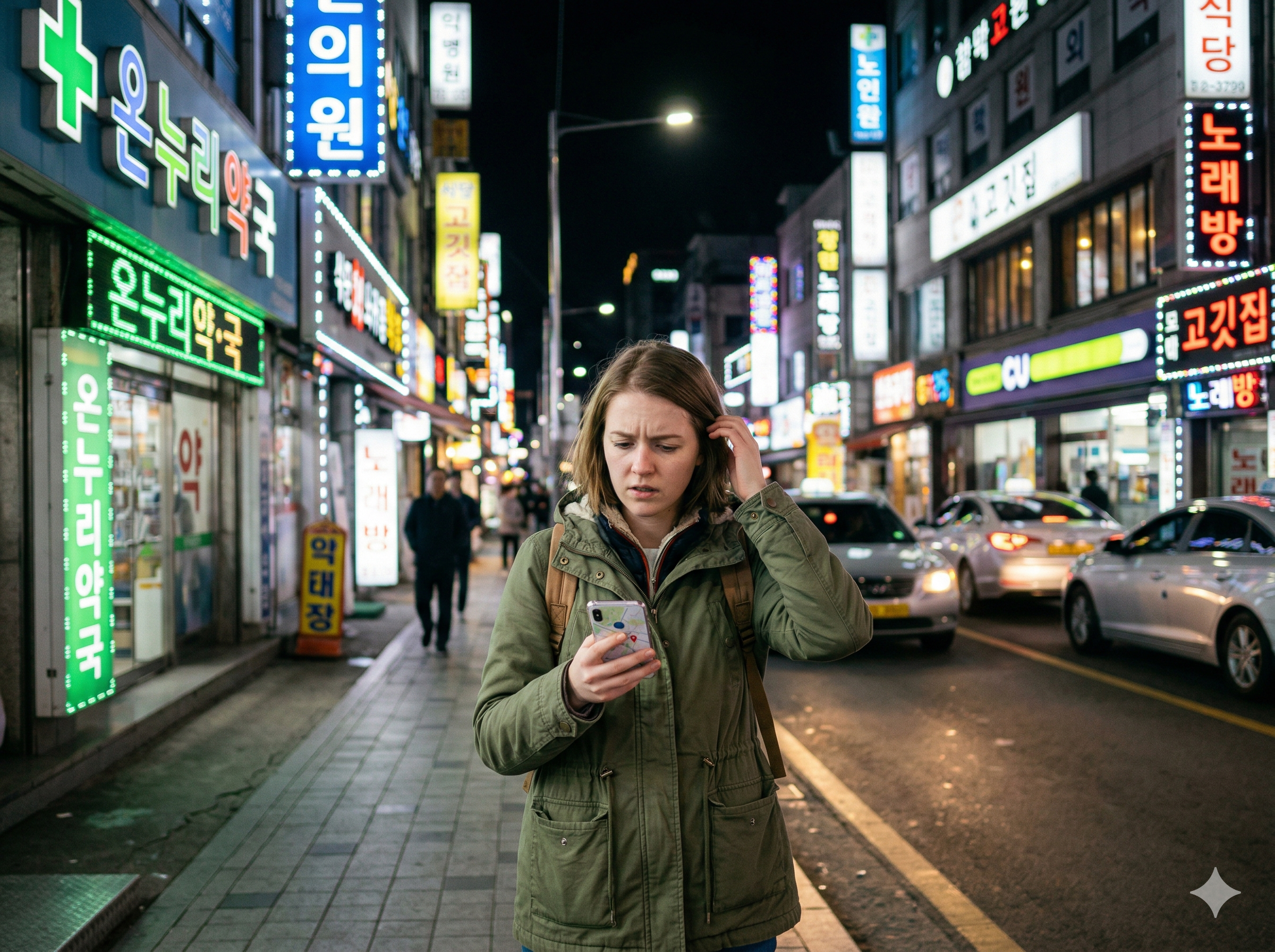
Sick in Korea Right Now? How to Find a Late-Night Pharmacy, an Open Clinic, or Emergency Help Fast

Travel Essentials

Sick in Korea Right Now? How to Find a Late-Night Pharmacy, an Open Clinic, or Emergency Help Fast

When you suddenly feel sick in Korea, the hardest part is often not explaining the symptom. It is figuring out what is actually open, what level of care fits the situation, and how to move before you get worse.

Real bottleneck Not translation first. Availability first.
Best search mindset Find what is open now, not what looks best in general.
Most expensive mistake Staying in the wrong lane for too long.
Core action path Choose the lane. Confirm. Move.
Use this article like a decision tool, not a theory page. If you are feeling weak, feverish, nauseated, dehydrated, or simply too tired to compare ten options, focus on what is open, what matches the seriousness of the problem, and what you can actually reach now.

When you get sick in Korea, the hardest part is often not describing the symptom. It is finding something that is actually open right now.

That is the real pressure point, especially late at night, on Sundays, or during a holiday. In that moment, the question is usually not “What medicine should I buy?” It is “Where can I go right now without wasting time?” This is why people lose time in the wrong order. They start thinking about medicine brands, translation, or which hospital has the best reputation, when the first job is much more basic: figure out what is still operating, then move fast enough for that answer to matter.

This guide is for that exact moment. It is built for the traveler who is already feeling sick and does not want a broad explanation of the Korean medical system. It is built for the person who needs to know what to search, where to look first, what not to waste time on, and when to stop browsing and treat the situation as urgent. If you suddenly feel sick in Korea, this guide is meant to help you do three things quickly: sort the problem into the right lane, find a late-night pharmacy or an open clinic faster, and recognize when emergency help should come before any more searching.

When you feel sick in Korea, the first question is not “What medicine?” but “What is still open right now?”

A lot of travelers start in the wrong place mentally. They think about medicine names, symptom translation, or whether they will be understood. But if you are sick at 11 PM, on a Sunday evening, or during a holiday period, the first bottleneck is usually not communication. It is availability.

That is why this problem becomes more stressful than people expect. A clinic you saved on your map earlier in the trip may not be open now. A pharmacy with strong reviews may still be useless if it is already closed. A hospital that looks excellent in a daytime search may not be the place you can realistically use at night. The mistake is not just lacking information. The mistake is searching for the wrong kind of information first.

When you feel weak, feverish, nauseated, or dehydrated, the right goal is narrower than most people assume. You do not need the best option in the city. You need the correct level of care that is actually operating now and reachable from where you are.

That is the order that works. First decide whether this still looks like a pharmacy problem, a clinic problem, or an emergency problem. Then check what is actually open. Then confirm before moving, because posted hours and real-life availability do not always match perfectly, especially at night and on holidays. If you remember only one line from this article, make it this: when you suddenly get sick in Korea, operating status matters before almost everything else.

The pressure gets worse because a normal search habit becomes a bad search habit once you are sick. On a healthy day, broad comparison feels smart. You have time to look at reviews, compare locations, and think about whether one place looks cleaner, more popular, or more trustworthy than another. But when you are already feeling weak, that same behavior becomes dead weight. The comparison itself starts costing you energy. Every extra minute spent reading is a minute you are still not moving.

That is why the first job is not to become well-informed in a general sense. The first job is to reduce uncertainty enough to act. If your body already feels like it is sliding in the wrong direction, the difference between “open now” and “probably good” matters a lot more than people expect.

This is also why the night factor changes everything. At 2 PM, a bad search may only waste twenty minutes. At 11 PM, the same bad search can send you toward a closed place, a mismatched place, or a level of care that was wrong from the beginning. The later it gets, the more dangerous vague searching becomes.

First, decide whether this is pharmacy, clinic, or emergency territory

Pharmacy

Best when what you need is symptom relief and the situation still feels manageable enough to stay in a short, contained story.

Clinic

Best when the problem clearly needs evaluation rather than more guessing, more waiting, or another round of symptom relief.

Emergency

Best when the situation looks unstable, dangerous, or unsafe to keep treating as a nearby-place-and-see problem.

You do not need a long medical essay when you feel awful. You need a clean split.

A pharmacy is usually the first move when what you mainly need is symptom relief and the situation still feels manageable. That can include mild cold symptoms, a sore throat, a routine headache, motion sickness, mild digestive trouble, mild diarrhea, a bug bite, minor skin irritation, or something that feels unpleasant but still contained.

A clinic becomes the better move when the problem clearly needs evaluation rather than just relief. This is the lane for symptoms that are stronger, more persistent, more medically unclear, or more disruptive than they should be. Fever that keeps climbing instead of fading. Pain that feels stronger than “just buy medicine” pain. Vomiting or diarrhea that is not settling down. Symptoms that are making it hard to eat, drink, move normally, or think clearly enough to trust your own judgment. At that point, the problem is no longer “What should I take?” It becomes “I need someone to actually look at this.”

Then there is emergency territory. That is where comparing pharmacies and clinics stops being useful altogether. Trouble breathing. Severe chest pain. Fainting. Confusion. Sudden weakness. Serious allergic reaction. Heavy bleeding. Major injury. Repeated vomiting that feels out of control. At that point, the smart move is not more browsing. It is urgent help.

A simple way to think about it is this. Pharmacy is for relief. Clinic is for evaluation. Emergency is for unstable or dangerous situations. You do not need to classify every symptom perfectly. You just need to avoid wasting time in the wrong lane.

What matters here is not perfect diagnosis. What matters is whether you are under-reacting or over-searching. Many travelers do not make a bad decision because they are reckless. They make it because they are trying too hard to be reasonable in a situation that has already changed categories.

That is why the split has to stay simple.

If the question in your head is still “Can I get through the night if I get the right symptom relief?” you are probably still in pharmacy territory.

If the question has changed to “I do not think symptom relief is enough anymore,” you are probably in clinic territory.

If the question has changed to “This feels unsafe to manage by trial and error,” stop treating it like a normal search problem and move into emergency logic.

The value of this split is not that it is elegant. The value is that it prevents the most expensive mistake of all: searching like a pharmacy case when you are already a clinic case, or searching like a clinic case when the situation is already urgent.

Which Korea tools actually help you find an open pharmacy or clinic fast

When people panic, they often search too broadly. That is exactly the wrong instinct.

If you are sick in Korea and trying to find something open right now, the most useful tools are the ones built around current availability, not the ones built around general popularity or aggregate reviews.

Official route

E-GEN

Korea’s emergency medical portal. It is useful because it is designed around real medical access rather than travel-style browsing. When time matters, it is a much better fit for “What is open now?” than a broad general search.

Pharmacy route

Pharm114

Widely used for finding on-duty and holiday pharmacies. If your problem still looks like a pharmacy-level issue, this narrows the search around actual pharmacy availability instead of generic map results.

Emergency line

119

If the situation looks urgent, this is the emergency number. Use it when the problem has clearly moved beyond “find a nearby place and see.”

Medical guidance

1339

If you need medical guidance rather than travel help, this is the line to remember. It matters when you need directional help but are not yet in simple pharmacy territory.

Travel support

1330

If you need Korea travel support while navigating the problem, this is the travel helpline. It is not the same as medical guidance, and using the right tool matters.

Seoul late-night layer

Seoul public late-night pharmacies

If you are in Seoul, the city runs a public late-night pharmacy system. That adds another specific route for people still in the pharmacy lane but suddenly needing help after normal hours.

The key point is this: when you are sick, do not treat all search tools as equivalent. Use availability-first tools first.

The easiest way to misunderstand these tools is to treat them like optional extras. They are not. When timing matters, they are often more useful than a standard search engine results page because they start from the question you actually need answered: what is operating right now?

That is a fundamentally different starting point from ordinary travel planning. Ordinary travel planning starts with quality, popularity, or personal preference. Sick-and-moving-now planning starts with access.

Another thing that matters is mental load. When you feel sick, your tolerance for friction drops fast. A tool that already narrows the search to open medical resources saves energy in a way that normal browsing simply does not. That energy matters because your body is already spending it elsewhere.

So the value of these tools is not just accuracy. It is compression. They shorten the distance between “I need help” and “I have a real next step.”

How to find a late-night pharmacy in Korea when you need help now

If the situation still looks like a pharmacy problem, your real task is not “find a pharmacy.” It is “find a pharmacy that is actually open right now.”

That sounds simple, but it fundamentally changes the search mindset. A regular map search for nearby pharmacies can still send you in circles if the hours are outdated, if the place has already closed, or if the listing does not clearly reflect holiday or late-night operation. When time matters, you need a search path built around current availability, not just existence.

The fastest practical path for a pharmacy-level problem

  1. Start with an availability-first source.Use a route built around open pharmacies rather than a broad map search that may still leave you guessing.
  2. Check whether the place is close enough to matter.A decent pharmacy that is open and near you is often more useful than a better-known one far away.
  3. Confirm before moving if anything feels uncertain.At night, on Sundays, and during holidays, “looks open” and “is operating right now” can quietly become different things.

If you are in Seoul, the public late-night pharmacy system can be very useful. But even here, the safest mindset is not “it’s on the list, so I’ll just go.” The safer mindset is “it’s on the list, now I confirm before moving.” That one extra step prevents a lot of wasted trips.

What should you prioritize if you feel weak and want to keep the search simple?

First, prioritize current operating status over everything else. Not ratings. Not how polished the reviews look. Not whether it appeared in a travel blog earlier that week. Second, prioritize proximity when the situation still looks mild enough for a pharmacy run. A decent pharmacy that is open and close to you is more valuable than a better-known one across the city. Third, prioritize confirmation over optimism. If there is any doubt, check first rather than assuming.

A lot of travelers compare pharmacies the way they compare restaurants. That is the wrong mindset when you are sick. The real question is not “Which one seems best?” It is “Which one is real, open, and reachable from where I am right now?”

There is also a limit to what a pharmacy can solve, and that limit matters more late at night because tired people tend to stretch the pharmacy option too far. A late-night pharmacy is useful if what you need is fast symptom relief and the problem still looks contained. It is not the place to keep negotiating with a situation that is clearly moving into clinic or emergency territory.

A useful shift is to stop imagining the late-night pharmacy as a mini clinic. It is not there to solve every medical uncertainty. It is there to be the fastest realistic first stop when the problem still looks like symptom management.

That means it works best when the story is still short. Your throat hurts. Your stomach is unsettled. You have a headache. You feel nauseated. You need basic relief, not medical evaluation.

Once the explanation in your head starts getting longer, the fit gets weaker. If you are stacking up fever, weakness, repeated vomiting, difficulty eating, or signs that the symptom is intensifying rather than stabilizing, that is usually a signal that the pharmacy lane is getting thin.

Late at night, the temptation is to force that lane anyway because it feels easier and less complicated. That is exactly where travelers lose time. A pharmacy is useful when it is the correct first stop. It becomes inefficient the moment it turns into a delay before the real next step.

What to search when the pharmacy route still makes sense

When people are tired and unwell, they tend to make their searches too broad. The better move is to search in a way that reflects the actual decision in front of you.

That means searches built around three things: your current condition, current opening status, and your location. In practice, that kind of targeted search thinking is far more useful than broad browsing when you are already sick.

If your situation still looks like a pharmacy issue, the useful search mindset is not “medicine Korea” or “best pharmacy Seoul.” It is much closer to “late-night pharmacy near me,” “open pharmacy now,” “holiday pharmacy near me,” or “pharmacy open right now in Seoul,” depending on where you are and what time it is. If you are already using official pharmacy lookup routes like Pharm114, those broader searches may become less necessary, but the underlying logic remains the same.

This also helps you avoid a common mistake: searching for medicine before you have solved the access problem. A lot of sick travelers start looking up cold medicine, diarrhea medicine, or flu treatments when they have not yet confirmed whether they can physically walk into a pharmacy that is actually operating. The better sequence is access first, product second.

Another useful rule: if the symptom is still mild enough for pharmacy territory, do not let the search become too ambitious. You are not trying to diagnose and solve the entire illness from your phone. You are trying to reach a real place that can help you with the next step.

The reason this matters is that product-first searching creates a false feeling of progress. You feel like you are already solving the problem because you are reading medicine names, ingredients, and possible matches. But if you still do not know where you can actually go, you have not solved the hard part.

That is why symptom-specific product searching should come after access, not before it.

The search becomes stronger the moment it reflects the real-world sequence:

FirstWhere can I physically go?
SecondIs it actually open right now?
ThirdDoes this still fit the pharmacy level of care?
Only after thatThink more narrowly about the type of symptom relief you are likely to ask for.

That order protects you from spending twenty minutes researching medicines you cannot even access yet.

How to find an open clinic or hospital when regular places are closed

This is where foreign travelers often waste time in a more costly way.

They recognize that the situation has moved beyond the pharmacy stage, but instead of searching for something that is currently operating, they start hunting for the “best” hospital, the “top-rated” clinic, or the most popular place in the area. That approach feels responsible, but when you are sick right now and the clock is moving, it is usually the wrong goal.

The first goal is not reputation. It is actual access.

That means your search mindset needs to shift. You are not looking for a famous name or a five-star rating. You are looking for a clinic or hospital that is currently open and realistically reachable from where you are. This is exactly why availability-first routes matter more than generic map browsing when the situation is time-sensitive.

Another important distinction: do not treat “open clinic” and “emergency room” as interchangeable just because everything feels urgent to you in the moment. They are not the same thing. If the problem needs evaluation but does not look unstable or dangerous, your task is to find a place that is actually seeing patients right now. If the situation looks serious enough for emergency care, stop trying to optimize through clinic searches and move directly.

When you are sick in Korea, finding a good place matters less than finding a real open place at the correct level of care.

That is the shift that actually saves time.

So if the pharmacy route no longer makes sense, do not get stuck in prestige-searching mode. Search for what is open, what matches the seriousness of the problem, and what you can realistically reach without burning another hour while you are getting worse.

There is also a hidden cost to prestige searching when you are unwell: it makes you feel productive while keeping you stationary. The search looks thorough, so it feels responsible. But if the result is a well-reviewed listing for a place that is closed, far away, or calibrated for a different level of care, that effort has not moved you forward at all.

This is why “open and usable” beats “impressive” in a sick-travel situation.

A clinic or hospital that is operating, near enough, and appropriate for the actual problem is more valuable than a better-known place that requires longer travel, more comparison time, or assumptions about hours you have not confirmed.

The later it gets, the more true that becomes.

How to search when you need a clinic, not just symptom relief

The moment you move into clinic territory, the search logic has to tighten considerably.

At that point, chasing broad quality signals can actually slow you down in a meaningful way. What matters more is whether the place is open, reachable, and capable of seeing you now. This is why “best hospital Seoul” can be a genuinely bad search when you are sick tonight. It sounds useful and specific, but it usually returns information built for planned future visits, not urgent same-night or holiday movement.

The stronger search behavior is much narrower. Search with current timing in mind. Search with your actual location as the starting point. Let availability be the first filter, not the last one. If you are already feeling weak and are near your hotel, the right clinic is often the one you can get to safely right now, not the one you might choose after an hour of leisurely comparison on a normal day.

There is also a mental trap that catches a lot of travelers at this stage. Some assume that moving from pharmacy to clinic automatically means they now need a “serious” or major hospital, which sends them into over-searching and over-escalation mode. That is not always true. The practical question is not “What sounds impressive or thorough?” It is “What actually matches the level of care this problem now requires?”

If the problem still does not look unstable, the real win is getting evaluated without wasting more time. If it does look unstable, the logic changes again and you move directly into emergency thinking.

Another mistake at this stage is letting the search become emotionally driven. The symptom feels worse, so the search gets bigger and more dramatic. That often leads people into searching by anxiety rather than by need.

A calmer, narrower search approach works better:

Check oneWhat is open right now?
Check twoWhat is close enough to reach safely?
Check threeDoes this look like ordinary clinic-level evaluation or something more urgent?
Check fourAm I still prioritizing access, or have I drifted back into reputation scrolling?

That last question matters because it is surprisingly easy to slip back into comparison mode once fear starts rising. But comparison mode is rarely what helps most when the real issue is that you need evaluation now.

The more immediate the problem feels, the less the search should look like research.

When to stop searching and treat it as urgent emergency help

Some situations are not “search longer and compare more” problems.

If there is breathing trouble, severe chest pain, fainting, a serious allergic reaction, heavy bleeding, severe dehydration, repeated vomiting that will not stop, or a major injury, the entire search process should simplify immediately. You are no longer trying to compare late-night pharmacies or locate a convenient open clinic. You are dealing with something that may need urgent emergency help, and the faster you accept that, the better.

Hard stop examples

  • Trouble breathing or breathing that feels unsafe to manage by waiting
  • Severe chest pain or a symptom pattern that feels alarming rather than routine
  • Fainting, confusion, or sudden weakness
  • Serious allergic reaction
  • Heavy bleeding or major injury
  • Severe dehydration or repeated vomiting that will not stop

This is where travelers sometimes lose critical time because they are still trying to behave like careful, responsible researchers. They keep comparing nearby options. They keep reading ratings. They keep hoping that one more search will reveal an easier answer. But if the situation already looks unstable or clearly serious, that continued optimization is not care. It is delay.

You do not need to prove to yourself that this is the worst thing that has ever happened. You only need to decide honestly whether it still looks safe to treat as a “find a nearby place and see how it goes” problem. If the answer is no, simplify immediately.

Not every unpleasant symptom is an emergency. But some situations are clearly no longer mild, and in those moments, fear and urgency should not be confused with each other. Panic is not useful. Speed is.

A useful mental line here is this: once the situation looks unstable, the search should get shorter, not longer.

That is where many people go wrong. They believe seriousness demands more research, more verification, more comparison. In reality, seriousness often demands less research and more direct movement.

If the condition looks dangerous, your job is not to produce the smartest possible search result. Your job is to stop wasting time on lower-level options that no longer match what the situation has become.

This is also why the emergency threshold should be treated as a practical threshold, not a dramatic one. You do not need theatrical certainty before acting. You need enough clarity to recognize that browsing is now the wrong activity.

Once you know that, simplify immediately.

The fastest search path that actually works when you are sick and tired

When you feel weak, the best system is the shortest one you can still trust.

The shortest usable decision path

  1. Choose the lane.Decide whether this still looks like pharmacy, clinic, or emergency territory.
  2. Use the correct availability-first route.Pharmacy route for pharmacy-level problems. Open clinic or hospital route for evaluation-level problems. Emergency route if the situation looks unstable.
  3. Confirm.Do not assume listed hours are enough when it is late, a Sunday, or a holiday.
  4. Move.Once the level of care is clear, stop over-comparing and go.

Start by asking one question: does this look like pharmacy, clinic, or emergency territory? Once you have answered that, do not open ten tabs and start comparing everything at once. Pick the correct lane first.

If it looks urgent or unstable, stop there and move to emergency action. If not, commit to either the pharmacy lane or the clinic lane based on what you actually need: basic symptom relief or real medical evaluation.

Then search through the availability-first route rather than broad browsing. For pharmacies, use the official on-duty search path. For clinics and hospitals, search for what is actually open rather than what seems best in general. If you are in Seoul late at night, late-night pharmacy information may be directly applicable, but still confirm before moving because listed hours can shift in practice, especially around holidays.

Then confirm.

Then move.

That is the full flow.

Do not spread your energy across too many decisions simultaneously. Do not chase the highest-rated option if it is farther away and your main problem is that you need help now, not later. Do not carry over morning information into a nighttime problem. And do not keep researching after you already know what level of care you need.

A useful rule here is brutally simple: when you are sick, the best option is often not the objectively “best” place. It is the first correct place that is actually open and reachable from where you are standing.

The value of this sequence is that it still holds together when you are not thinking at full speed. That matters more than people realize in advance. A search system is only useful if it survives contact with a tired, uncomfortable, impatient version of yourself.

That is why the sequence needs to stay short enough to actually use.

Choose the lane.

Use the correct availability-first route.

Confirm.

Move.

Everything else is secondary unless the situation itself forces you upward into emergency logic.

If your search flow is more complicated than that while you are already sick and your body is demanding attention, it is probably too complicated for this moment.

What foreign travelers usually waste time on

Most wasted time comes from behavior that feels rational in a normal situation but turns harmful when you are sick and the window is closing.

One common mistake is searching for the best-reviewed place instead of the closest open place. Another is relying on somewhere you bookmarked earlier in the trip, only to discover it is closed now. Another is assuming that a map listing is reliable without confirming late-night or holiday operating status. Another is staying in pharmacy mode because it feels simpler and less disruptive, even though the symptom has already moved past the point where basic symptom relief is the real answer.

There is also the opposite mistake: jumping straight into major hospital searches for something that is still very likely a pharmacy-level problem, and losing time because the search is now far broader, heavier, and more complicated than it ever needed to be.

Then there is the most costly one: continuing to search and compare after the situation has clearly become urgent.

This is why the order of decisions matters so much. If you get the care level wrong, the search slows down. If you get the search goal wrong, the movement slows down. If you get both wrong at the same time, you can lose a surprising amount of time while feeling worse with every passing minute.

When you are sick in Korea, the correction principle is simple. Compare less. Confirm faster. Move sooner.

It also helps to catch how these mistakes sound inside your own head, because they arrive in quiet, reasonable-sounding voices.

“I saw a better-rated place a little earlier.”

“This one looks nicer on the listing.”

“I think it should still be open at this hour.”

“Maybe I can just manage with pharmacy medicine a bit longer.”

“Maybe I should look around a little more before committing.”

Those thoughts sound reasonable because they are constructed from normal decision-making habits. But normal decision-making habits were built for situations where your body is not the thing setting the deadline.

That is why the correction principle matters. It interrupts the instinct to browse as if you are healthy.

Compare less.

Confirm faster.

Move sooner.

That is the version of decision-making that actually works when you are sick and time is not neutral.

What to do once you arrive

Once you reach the pharmacy, clinic, or hospital, do not make the next step harder than it needs to be.

The goal is not to explain your entire travel story or give a full medical history from memory. The goal is to communicate the symptom clearly enough for the next action to happen.

That means short, symptom-first language is more effective than long background narrative. Fever. Sore throat. Vomiting. Diarrhea. Headache. Strong stomach pain. Rash. Trouble breathing. Started this morning. Getting worse. Cannot eat. Cannot keep water down. Pain is strong. Those kinds of short, direct building blocks are usually more useful than a long explanation of where you have been and what you did yesterday.

If you are at a pharmacy, the purpose is usually fast symptom relief combined with a quick judgment about whether the problem still belongs in the pharmacy lane or needs to move further. If you are at a clinic, move into the registration-wait-consultation flow as directly as you can. If the situation is urgent, speed matters more than polished explanation or careful phrasing.

This is also where translation tools can earn their keep, in the right role. Not as the main solution to every communication challenge, but as support for getting one key message across when you need it. You do not need a perfectly worded speech. You need to make the next step possible.

If you have made it to the right door, the hardest part is largely behind you. At that point, your job is not to sound thorough or impressive. It is to make the symptom legible, stay inside the correct care lane, and let the system take over from there.

Another useful rule: resist the pull toward over-explaining. People tend to believe that more detail will always help, especially in an unfamiliar system. But when you feel genuinely unwell, more detail often turns into noise for both sides. What typically helps most is the cleanest, most direct version of the problem.

What is happening.

When it started.

Whether it is getting worse.

Whether you can still eat, drink, move, or breathe normally.

That focused version is usually more valuable than walking through the full story of the day.

Once you arrive, your job is not to narrate everything perfectly. Your job is to make the next action easier for everyone involved.

One more practical rule: do not wait until you are much worse to make the move

This is one of the most expensive mistakes travelers make, and it is also one of the most human ones.

They already know the situation is moving beyond mild discomfort, but they wait because they hope a short rest will turn things around, because they do not want the hassle of navigating an unfamiliar system while feeling bad, or because the whole search process feels exhausting before it has even started. By the time they finally move, they are weaker, more dehydrated, more anxious, and significantly less capable of making clean decisions quickly.

The best time to make the next move is almost always earlier than your tired brain wants it to be.

If you are in your hotel room and already know this is no longer a simple discomfort problem, make the decision while you still have enough energy to search clearly, confirm clearly, and travel to the right place without it becoming an ordeal. A process that feels entirely manageable at 8 PM can feel substantially harder later if you have spent three more hours getting worse while hoping the situation would resolve on its own.

This matters in Korea for the same reason it matters anywhere: systems feel more confusing and more intimidating when your body is failing. The earlier you sort the problem into the correct lane, the less mental energy the whole process costs you. That is not a small thing when you are already running low.

Waiting also creates a false economy that feels obvious in hindsight but is easy to miss in the moment. It feels as though you are saving effort by delaying the decision, but what you are often actually doing is choosing to make the same decision later with less energy, worse symptoms, and fewer good options.

That trade is almost always bad.

A mild problem that warrants action at 8 PM may turn into a more disruptive and harder-to-manage problem by 11 PM. A clinic search that feels entirely workable while you are still reasonably functional can feel overwhelming later when you are shaking, nauseated, exhausted, or too dehydrated to think straight. The system itself has not necessarily become harder during those hours. Your ability to navigate it has become smaller.

That is why moving early matters. Not because every symptom is dangerous or worth escalating, but because every hour of worsening reduces your decision-making margin in ways that are difficult to recover quickly.

If you already know this is not just mild discomfort anymore, treat that recognition as useful, actionable information rather than something to debate with yourself for three more hours while lying in bed hoping it passes.

The biggest time-saver is not knowing every medical detail. It is finding the right open door before you get weaker.

That is the real travel lesson here.

When you suddenly get sick in Korea, the system can feel unfamiliar fast. But the thing that usually costs the most time is not a lack of medical knowledge. It is searching in the wrong order, with the wrong goal, at the wrong level of care. If the situation is minor, an open pharmacy can solve the immediate problem. If it needs real evaluation, an open clinic or hospital matters far more than a famous or highly rated one. If it looks unstable or dangerous, the right move is urgent help, not better browsing or one more round of comparison.

So do not make the goal too complicated. You do not need to understand the entire Korean medical system tonight. You need to sort the problem into the right lane, confirm what is actually open, and move before you feel noticeably worse.

That is the difference between getting stuck in search mode and actually getting help.

And that is also what makes this kind of situation more survivable than it first feels. You do not need total system mastery. You need one correct next action, taken early enough to still matter.

If you remember the order, the situation becomes much easier to manage.

Choose the lane
Find what is really open
Confirm
Move

That sequence is worth far more in the moment than knowing every detail about how the system works in theory. It keeps the decision short enough to use when you are tired, scared, or already fading. And in that state, short enough to use is the only kind of useful that actually counts.