Running Out of Clean Clothes in Korea: How Hotel Laundry Rooms, Guesthouses, and Coin Laundromats Actually Work

You usually realize the laundry problem when the day is already over.

You get back to the room, kick off your shoes, and start sorting through what you still have left to wear. One T-shirt is damp from sweat. Another picked up rain on the way back. Underwear is running low. Socks are no longer negotiable. Tomorrow starts early, and suddenly the question is no longer whether you feel like doing laundry in Korea. The question is how to solve it tonight without losing the rest of your evening.

Many first-time visitors discover at exactly this point that laundry in Korea is not confusing because the machines are hard. It feels confusing because the decision is never only about the machine. You need to know where to search, which words to use, whether the place is still open, whether the hotel laundry room is worth waiting for, and whether the dryer is part of the same job or a second job with a second payment.

A hotel laundry room, a guesthouse washing area, and a neighborhood coin laundromat can all fix the same problem. In real travel, though, they do not feel interchangeable. They ask for different amounts of walking, waiting, attention, and energy. Once you understand that, the whole topic gets easier. You stop asking where a washing machine exists and start asking which kind of laundry setup matches the night you are actually having.

Tonight’s most useful map searches

코인세탁방 코인빨래방 셀프빨래방 24시 코인세탁방 크린토피아 코인워시 워시엔조이

If you are searching late at night, put the neighborhood, station area, or hotel area in front of the term. “Hongdae 코인세탁방” is usually far more useful than a broad citywide search, because late-night laundry is mostly a proximity problem.

When laundry stops being a small side task

A lot of travelers pack as if laundry will stay optional. On a short trip, that can work. On a longer trip — or one shaped by humid weather, long walking days, rain, gym use, family travel, or frequent city changes — laundry stops being a background chore much faster than people expect.

Korea makes this more noticeable because daily movement can be easy while clothing turnover is not. You might spend the day moving efficiently between the subway, convenience stores, cafés, neighborhoods, and the hotel, and still end up with more dirty clothes than you planned for. In summer, that is obvious. A single afternoon of walking in Seoul humidity can soak through a shirt faster than a full day of hiking somewhere cooler. In rainy weather, it happens just as fast — wet cuffs, damp jacket linings, socks that never fully dried from yesterday. In winter, the issue often shifts from sweat to bulk: thick layers, pajamas, heavy socks, base layers, anything that needs longer drying time and takes up more machine space.

Laundry rarely becomes urgent on your most relaxed day. It becomes urgent on the night when you are already tired, the next morning matters, you have a full bag of clothes that smell like the day, and hanging wet items around the room stopped being a realistic option about two hours ago.

How to search for a laundromat in Korea without wasting time

If it is already late and you need laundry now, searching in broad English is usually too slow and too unreliable. Results drift toward tourist-facing listings, places that rank well in English but are not necessarily close to you, and general location pages that do not tell you what you actually need to know at eleven at night.

What works better in Korea is local map searching with the words local businesses actually use. Most coin laundromats in Korea are not listed in English at all, or they appear under a Korean name with minimal English tags. If you search only in English, you may be seeing just a fraction of what is actually within walking distance.

What usually works best

Open Naver Map or KakaoMap.

Search in Korean, not just English.

Add your area: hotel name area, station area, or neighborhood.

Then check the listing hours before you walk over.

The last part matters more than people expect. Many travelers waste time not because the search tools are bad, but because they search too broadly and start comparing places that were never realistic. They find a highly rated laundromat in another neighborhood, read the reviews, check the photos, and only then realize they have spent fifteen minutes researching a place thirty minutes away by transit. Laundry at night is almost always a proximity problem before it becomes a quality problem. A decent laundromat ten minutes on foot beats a great one that requires getting back on the subway.

One more step is worth doing before you leave: check whether the specific branch you plan to visit is actually open. Hours listed on map apps are not always perfectly current, and some locations keep shorter hours than the chain’s general reputation suggests. A quick look at the listed hours — and, if possible, a glance at recent reviews mentioning hours — can save you a cold walk to a closed door.

Before you walk outside

If you are standing at the front desk anyway, ask there first. Two minutes of asking can save twenty minutes of searching when you are already tired and low on battery.

The three places travelers usually end up using

Most visitors in Korea handle laundry in one of three places, and they work very differently in practice.

Option Best when Main weakness
Hotel laundry room Your load is small, the machines are free, and you want to stay inside the building. Too few machines, long waits, weak dryers, or hotel pricing that feels high for what you get.
Guesthouse or residence machine The machine is free and the setup is calm enough that you can finish without informal waiting. Drying is often weaker, less clear, or more improvised than travelers expect.
Outside coin laundromat You need a real wash-and-dry solution tonight, with bigger machines and less waiting. You have to walk out, read the room fast, and understand the payment flow.

The hotel laundry room is the easiest choice emotionally because it asks the least from you. You are already in the building. You do not need to pack a bag and walk back outside. You do not need to figure out a new room, a local payment system, or where anything is. If the machines are free, your load is small, and the dryer is part of the same setup, this can absolutely be the right answer.

The catch is that hotel laundry rooms are often limited in ways that only become clear once you actually check. A single washer and a single dryer shared across multiple floors of guests is not unusual. If both are occupied when you arrive, you are now waiting in a building that was not designed around your laundry schedule. Some hotels also charge per load in ways that can add up faster than a coin laundromat would. Others have machines that are technically available but old enough that the dryer takes much longer than you expected.

Guesthouse, hostel, and residence-style setups feel more informal. The washer may be in a common room, beside a shared kitchen, or tucked into a hallway used by several guests. Availability is unpredictable. One machine may technically exist, yet the real issue becomes whether other guests are already using it, whether there is a functional dryer at all, and whether the drying setup is strong enough to finish the job before you need to sleep.

The neighborhood coin laundromat is where many travelers end up once the hotel option turns out to be smaller than the actual problem. The hotel has one washer and one dryer and both are occupied. The guesthouse has no dryer. The wait is already longer than you want it to be. At that point, going to a local laundromat is not an extra errand. It is just the most direct way to solve the problem before it gets later.

What a Korean coin laundromat usually feels like late at night

If you have never used one in Korea before, the room may feel more local and less familiar than a hotel laundry room, but it usually becomes readable within a few minutes of walking in.

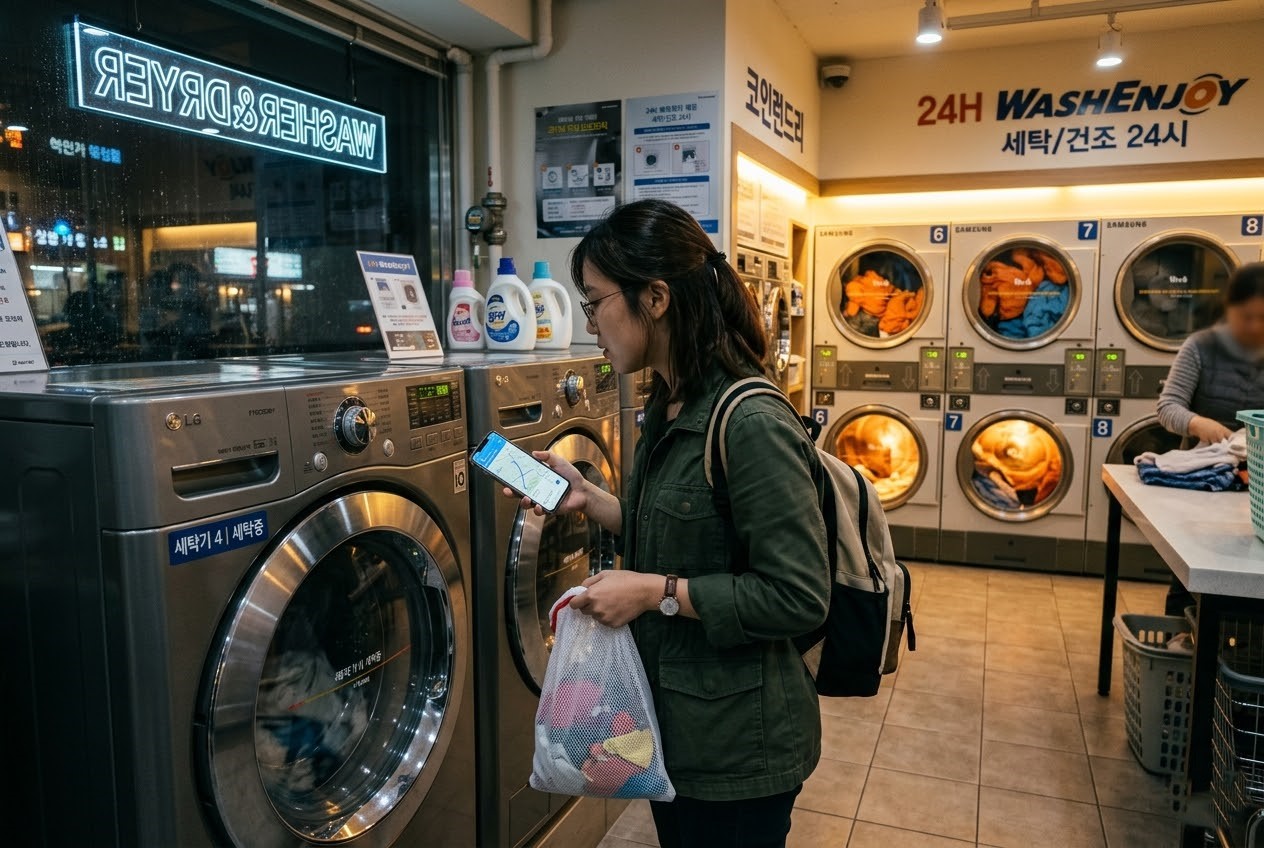
The first thing you notice is often the lighting. These places are lit hard — brighter than most small businesses at that hour — which makes them feel open and usable even when it is late and everything around them has closed. The machines are usually larger than hotel machines. Dryers may be stacked in rows. There is typically a folding counter, a few chairs, printed instructions on the machines or the wall, a payment kiosk of some kind, and either a coin changer or a bill exchange machine near the entrance or along one wall.

Some shops look very simple — functional, slightly worn, clearly just a room with machines. Others look polished enough to feel almost like a small unmanned service space, with newer machines, digital displays, and a kiosk system that handles everything from payment to cycle selection. Either version usually tells you how it wants to be used if you spend one quiet minute looking around before you start anything.

These places also tend to feel less tourist-facing than most of the trip. There may be no English explanations on the wall. The machine labels may be entirely in Korean. The payment kiosk may not have an English option. That can make the room feel harder than it is, especially on a night when you are already short on patience. In practice, once you locate where payment happens and understand the basic cycle selection, the rest falls into place pretty quickly.

Many chain laundromats in Korea keep very long hours, and some operate around the clock. That makes them especially useful on nights when you are finishing dinner late, the hotel facility is already occupied, and you do not want to risk damp clothes in the room. Even so, check the specific branch before you walk over. A chain that is known for 24-hour operation does not guarantee that every individual branch follows that schedule.

What the price usually looks like, and why the dryer changes the math

Rough branch-level guide only

Prices vary by branch, machine size, and cycle type. The dollar figures below are only quick visual conversions for travelers and not fixed nationwide rates.

Typical item KRW Approx. USD What changes the cost
Standard wash ₩4,000–₩6,000 about US$2.70–$4.00 Branch pricing, machine size, and cycle type.
Larger wash ₩6,000–₩8,000 about US$4.00–$5.40 Bigger drum, bulkier load, heavier items.
Dryer ₩3,000–₩5,000 about US$2.00–$3.40 Dry time, branch setup, load thickness, and whether one cycle is enough.
Fabric softener ₩500–₩1,000 about US$0.35–$0.70 Usually a separate add-on purchase.
Laundry bag ₩500–₩1,000 about US$0.35–$0.70 Size and branch stock.

Most travelers look at the wash price first and mentally treat it as the full cost of doing laundry. In Korean self-service setups, washing and drying are usually separate steps with separate charges. You pay to wash. Then you pay to dry. The two costs are not bundled, and the drying cost is not a small footnote — it is often a meaningful part of what you actually spend.

A light load — a few shirts, underwear, and socks — is one kind of problem. A mixed load with jeans, a hoodie, a towel, children’s clothes, or anything that came in wet from rain is another. The second kind costs more to wash, takes longer to dry, and is much more likely to need a second drying round.

That second drying cycle is where many tired travelers get caught. You open the dryer expecting finished clothes, and the jeans are still damp at the waistband, the hoodie is warm but not dry through the thick parts, and the towel needs more time. You are now either paying again and waiting longer than you budgeted for, or walking back with clothes that are not quite done and hoping the hotel room can finish what the dryer did not.

If you want to manage this realistically, separate the load before you go. Decide whether the heavy items truly need to be done tonight. Do not overload the machine to save one wash. And do not plan the night around the wash only. In Korea, the dryer matters just as much as the washer, and on some nights it matters more.

Detergent, fabric softener, laundry bags, and payment flow

Detergent

In the Korean coin laundromat setups most travelers use, detergent is generally already built into the washing process. You do not need to bring your own and pour it in by hand.

Fabric softener

Fabric softener is usually a separate purchase. If it matters to you, look near the kiosk or payment area instead of assuming it is already included.

Laundry bags

Laundry bags and basic carry bags are commonly sold on site. That helps more than it sounds, especially when the whole laundry trip was unplanned.

Payment is the part that shifts from simple to annoying if you walk in with the wrong expectation. Some shops still run on coins in a fairly traditional way. You exchange bills for coins, then feed the machines directly. Other shops use a kiosk-centered flow where you select the machine, choose the cycle, and pay at the kiosk instead of at the washer or dryer itself. Some kiosks take cards. Some branches mix coins, bill exchange, and card payment in the same room.

The practical move is to read the room before touching anything. If there is a kiosk that clearly looks like the payment center, start there. If there is a bill exchange machine by the entrance, that usually tells you the branch still expects part of the process to run on coins. If the machines themselves have readers or payment pads, the branch may be set up for direct machine payment.

Most of the confusion disappears once you stop staring at the washer first and look for where the branch expects you to begin.

When staying inside the hotel is still the better move

It would be a mistake to read all of this and assume that going to a coin laundromat is always smarter. It is not.

Stay in the hotel when…

you only need a small load, the machine is free now, the weather is bad, your battery is low, or you simply need a shirt, underwear, and socks ready by morning without adding another walk to the night.

Go to a laundromat when…

the hotel setup is full, the dryer is weak, the load is bulky, drying really matters tonight, or the hotel option starts looking smaller than the actual problem you need to finish.

The key question is not “hotel or laundromat” in the abstract. It is whether the hotel setup can realistically finish the whole job tonight — wash and dry — within a timeline that still works for you. If the answer is yes, stay. If the answer involves waiting, hoping the dryer is good enough, or coming back twice, the calculation changes.

Guesthouse and residence-style machines sit in the middle. Sometimes they are the easiest answer because they are right there and nobody else is using them. Sometimes they are the most frustrating because the drying situation is weak, the machine is old, or there is no clear system and you end up waiting informally while another guest finishes.

What happens if you leave your laundry in the machine too long

Most travelers who use a Korean coin laundromat for the first time are not expecting this, but it is common enough that it is worth knowing in advance.

When a wash or dry cycle finishes and you do not come back promptly, the next person who needs the machine will often move your finished laundry to a holding cart or basket. This is not hostility. It is just the practical reality of shared machines in a busy shop. In a quiet shop at an off-peak hour, nobody may touch anything for a while. In a busier location at nine or ten at night, your clothes may be in a holding basket much sooner than you expected.

The holding cart is usually in plain sight near the machines or beside the folding counter. Your clothes are typically just placed there loosely so the machine can keep moving. Nothing is usually taken or damaged, but finding your load moved by a stranger can still feel unpleasant if you were not expecting it.

Use the alert system if the branch offers it

Many modern laundromat systems in Korea can send phone alerts when the wash or dry cycle ends. Depending on the branch, that may happen through a kiosk flow, an app, or a membership-linked system. Not every location works the same way, but it is common enough that it is worth using whenever the option appears.

If the shop does not offer alerts, set your own phone timer the moment you start the machine. Not later, and not after you sit down somewhere else. Most awkward laundry moments come from timing, not from the machines themselves.

Useful English questions to ask at the front desk before you head out

Do you have a laundry room in the building?

Are there both washers and dryers?

Is the laundry room open right now?

Is it busy at the moment?

Is there a coin laundromat near the hotel?

Which would you suggest at this time of night?

The last question is often the most useful one because it gets the staff to factor in time and availability rather than just pointing to what exists. A front desk person who already knows the hotel machine has been running continuously for the last two hours, or knows there is a 24-hour branch two blocks away, can save you a lot of unnecessary trial and error.

The mistakes that quietly turn a simple wash into a tiring night

  • Searching only in English and missing the nearest Korean listings.
  • Comparing branches that were never realistic walking options.
  • Checking the map but not checking whether the branch is open tonight.
  • Counting the wash price but forgetting that drying is usually separate.
  • Bringing a heavy mixed load and assuming one drying round will be enough.
  • Walking straight to the washer and missing the kiosk or bill exchange flow.
  • Leaving without setting a timer and coming back to find the load already moved.
  • Heading outside without first checking whether the hotel already has a workable setup.

Not one of these is a big disaster on its own. The problem is timing. Laundry almost always surfaces at exactly the point when you are already tired, slightly hungry, low on battery, and not in the mood to navigate a new system. That is when a simple job starts feeling larger than it is, and that is when small avoidable mistakes stretch the night out much longer than necessary.

If the hotel machine is free, use it. If it is not, search near where you are standing, check the hours, budget for the dryer as seriously as the wash, and set a timer before you step away. On nights like this, that usually matters more than finding the perfect laundromat.