Korea Local Guides
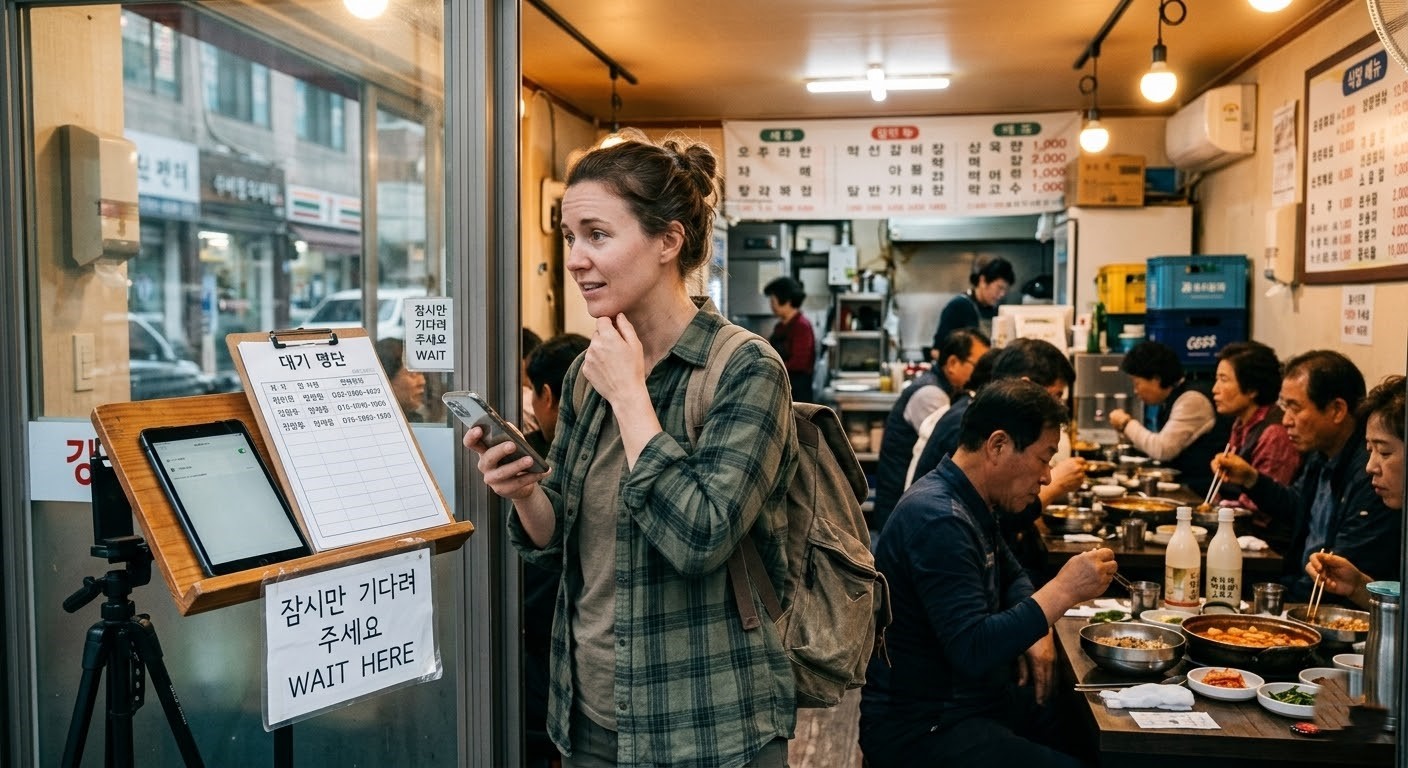
You walk into a Korean restaurant, stop near the entrance, and immediately realize that nobody is explaining the next step. No one is clearly lining up. A table looks empty. A server sees you but keeps moving. A tablet is glowing near the door. If this is your first trip to Korea, that first half-minute can feel much more confusing than it should.
What this guide helps with
This is not a guide to Korean food etiquette in general. It is a practical guide to what happens from the moment you enter a casual restaurant in Korea: waiting, seating, ordering, self-service, and paying.
Best fit for this article
Casual neighborhood restaurants, small Korean meal spots, noodle shops, rice bowl places, and other everyday dining places that foreign travelers are likely to enter without a reservation.
In most cases, nothing is actually wrong. The restaurant is working the way it normally works. The problem is that local customers already understand the flow, while first-time visitors do not. That gap creates a surprising amount of stress. You do not know whether to wait, sit, speak first, find a machine, or stay where you are. You start scanning the entrance, the tables, the walls, and the other customers, hoping that one of those things will tell you what to do next.
A lot of travel advice about Korean food focuses on what to eat. That is useful once you are ready to order. Before that point, many travelers need something more basic: how to understand the room they have just walked into.
The line is not always a clear line
Many travelers expect either a host stand or a visible queue. In a lot of casual Korean restaurants, especially neighborhood places, you may get neither.
People may be waiting near the entrance without forming a tidy single-file line. One person may be looking at a phone. Another may be leaning against the wall. A couple may look as if they are still deciding where to eat, even though they have already committed to this restaurant and are waiting for their turn. If you are searching for the shape of a line you already know, you can miss the fact that there is already an order.
In other restaurants, the waiting system is written down or handled by a device. You may see a clipboard, a handwritten list, a small tablet near the door, or a number screen that shows the next party to enter. If you do not read Korean, those things can be easy to misread. A waiting tablet can look like a payment machine. A list can look like something for reservations only. A number display can seem unrelated to dining if you have never seen that system before.
Another complication is that the people near the entrance are not always waiting for that restaurant. On busy streets, especially in Seoul, the space in front of one shop can overlap with the next. Customers from another store, people checking directions, delivery pickups, smokers, and friends meeting up can all be standing in the same narrow area. From a few steps away, it can look like one queue even when it is not.
If nothing is clear, one of the most useful things you can do is watch the next local customer who walks in. Very often, that one person will explain the entire entrance system without saying a word.
A free table may still be part of the wait
One of the easiest mistakes to make is to spot an open table and assume it belongs to whoever moves first.
Sometimes that is exactly how the restaurant works. There may be no waiting list, no assigned seating, and no staff member who needs to guide you. If there is a free table, you take it. In many other places, though, an open table is not actually available yet. It may still need to be cleaned. It may be held for the next party already on the waiting list. It may belong to a section the staff have not reopened yet. From the doorway, those differences are not always obvious.
This is where many foreign visitors begin to feel awkward. You do not want to block the entrance. You do not want to stand there so long that you feel conspicuous. But you also do not want to sit down and realize that the table was not truly open in the way you thought.
Larger restaurants do not always solve this problem. A bigger dining room can look more organized, but it can also give you more things to misread. Several tables may appear empty while staff are still clearing one area, resetting another, and moving parties in order from a waiting list. What looks available from a distance may still be out of use for a few more minutes.
Smaller restaurants can be difficult for the opposite reason. The place is compact, the system is informal, and the regular customers seem to understand it immediately. Nobody pauses to explain anything because, to the people who come there all the time, there is nothing to explain. A traveler sees the same room and gets far less information from it.
A practical entrance rule
If you are unsure, do not rush toward the table. Stand just inside the entrance or off to the side where you are not blocking staff. Then watch what happens when a table becomes free or when the next customer enters. That usually tells you whether the restaurant is seat-yourself, wait-to-be-seated, or wait-until-called.
Staff may see you and still not come over
This is one of the moments that can feel the most uncomfortable to first-time visitors. A staff member has clearly seen you, but nobody comes to the door.
In many casual Korean restaurants, that is normal. Staff are often handling several things at once: carrying soup, clearing dishes, entering an order, checking a payment, responding to a call bell, or bringing side dishes to another table. The fact that someone noticed you does not always mean they will stop what they are doing to greet you immediately.
If you come from a place where restaurant staff usually guide the first steps of the experience, this can feel cold. It can also trigger self-doubt very quickly. Did they miss you? Are you supposed to say something first? Have you entered the wrong way? Did you overlook some sign near the door?
Sometimes the answer is simple. The restaurant is busy, and someone will come over in a moment. Sometimes the silence means something slightly different. You may be expected to put your name on a waiting list, choose a seat yourself, use a kiosk, or wait while staff finish a rush. The same quiet moment can mean different things in different restaurants.
Many casual restaurants in Korea are built around speed and efficiency rather than verbal guidance. A staff member may point, nod, hold up fingers for the number of seats, or say something brief once they are ready. If you expect a fuller explanation, that can feel abrupt. It does not necessarily mean the place is unfriendly.
Sitting down does not tell you what happens next
Getting a seat feels like the hardest part is over. Very often, it is only the start of the next question.
In some restaurants, the sequence is familiar. You sit down, receive a menu, place your order, eat, and pay at the end. In many casual Korean restaurants, sitting down does not tell you enough by itself. You still have to figure out where the menu is, how to get someone’s attention, whether the order happens at the table or somewhere else, and when payment is expected.
Some tables are easy to read. There may be a call button, a built-in tablet, utensils stored in a drawer, a paper menu under the glass, or a small stand with a QR code. In other places, the table seems to tell you almost nothing. You sit down, look around, and realize that everyone nearby appears to understand the next step much better than you do.
Timing is where a lot of travelers get stuck. They wait for a menu that is already hanging on the wall. They sit quietly even though the restaurant expects them to go to the counter. They start walking toward the register and then notice that every other table is using a call button instead.
Even restaurants that look similar from the outside can handle this differently. A noodle shop, a rice bowl place, and a casual Korean meal spot may all seem relaxed and informal from the street while using completely different ordering sequences once you are seated.
Ordering can happen in several different ways
This is one reason restaurant visits can feel inconsistent at first: the order itself may happen in a completely different way from one place to the next.
You may order directly from a server at the table. You may sit down first and then walk to the counter. You may order and pay before sitting. You may use a kiosk near the entrance. You may use a tablet attached to the table. Some restaurants even combine systems, especially if drinks, side items, or takeaway orders are handled separately.
None of these systems is hard once you know which one the restaurant uses. The problem is that visitors often assume the current restaurant will work like the last one they visited. That assumption can last a little too long.
Kiosks are a good example. Many travelers feel relieved when they see one because it looks easier than speaking. Sometimes it is. Sometimes it is not. The language setting may be limited or incomplete. Menu categories may be less clear than expected. The photos may not help much. The payment screen may move quickly, and if other people are waiting behind you, even a simple choice can suddenly feel stressful.
Table tablets can be confusing in the opposite direction. If there is a device right in front of you, it feels natural to assume the whole order should happen there. In some restaurants, that is correct. In others, the device is only part of the process, the screen is mostly in Korean, or staff still need to confirm something. Some visitors end up waiting far too long for a server because they do not realize the table already gives them the basic ordering function.
Counter ordering creates another common misunderstanding. In some places, customers are expected to walk up, order, and pay with very little discussion. That is simply how the restaurant works. A first-time visitor may sit for several minutes expecting full table service that is never meant to happen.
Look for these clues before you decide the restaurant is slow
- A counter with a menu board behind it
- Other customers walking up to order and pay
- A kiosk near the entrance with food photos
- Signs containing words such as 주문, 계산, 선불, or 후불
Small self-service habits start earlier than many visitors expect
A lot of the friction in Korean restaurants comes from small self-service details rather than one large confusing rule.
Water is one of the most common examples. In some restaurants, it appears automatically at the table. In others, customers are expected to get it themselves from a dispenser, a metal kettle, or a shelf with cups. If you do not notice that setup, you can spend half the meal wondering whether your table has been forgotten.
Utensils work the same way. Some places put spoons, chopsticks, napkins, and small dishes directly on the table. Others keep them in a drawer underneath. Others store them near a self-service corner by the wall. None of this is difficult once you know where to look, but it can feel surprisingly unclear if you are still expecting staff to bring everything.
Call buttons are another detail many visitors miss the first time. In some restaurants the button is large and easy to spot. In others, it sits along the table edge, next to a tablet, or beneath a small label in Korean. If the restaurant expects customers to use the button, simply waiting can create a delay that feels confusing even though the system is working exactly as intended.
Side dishes and refills can vary as well. Some restaurants place everything on the table at the beginning. Some keep extra portions at a self-service bar. Some allow refills for certain items but not others. The important point is not that every restaurant follows the same rule. It is that many places expect you to notice what is self-service instead of explaining it aloud.
You may also notice signs that include words such as 셀프, 물, 추가, or 반납. You do not need to memorize those before your trip, but if you spot them in the moment, they can be useful clues. A shelf full of cups, a water machine, a drawer built into the table, or customers getting something for themselves usually tells you that the restaurant expects a more hands-on style of dining.
What to search on your phone when you are stuck
Sometimes watching the room is enough. Sometimes you still need a faster answer while you are standing there. That is when a quick search on your phone can help.
The most useful searches are short and specific. Do not search something broad like “Korean restaurant culture” while standing in a doorway. Search the problem you have in front of you.
If you do not know whether you need to register first
- “Korean restaurant waiting tablet”
- “how to join waiting list at restaurant in Korea”
- “restaurant queue tablet Korea”
If you are seated but unsure whether to order at the table or counter
- “order at counter or table Korea restaurant”
- “Korean restaurant call button”
- “how to order in casual restaurant Korea”
If the kiosk is stressful
- “how to use restaurant kiosk in Korea”
- “Korean restaurant kiosk English”
- “주문 kiosk Korea meaning”
If you are unsure whether water, utensils, or side dishes are self-service, search:
- “water self service Korean restaurant”
- “where are utensils in Korean restaurant”
- “side dish refill Korea restaurant self service”
If you are at the end of the meal and not sure whether to leave dishes or return them, search:
- “tray return restaurant Korea”
- “pay at counter Korean restaurant”
- “how to finish meal in Korean self service restaurant”
The point of these searches is not to turn dinner into homework. It is to help you solve the exact problem in front of you within thirty seconds. A precise search is much more useful than a broad cultural explanation when you are already inside the restaurant and need to act.
Paying and leaving can be the final confusing step
By the end of the meal, most travelers feel more comfortable. Then one final question appears: how do you finish properly?
In many casual Korean restaurants, customers pay at the front counter when they leave. In others, the order is already tied to the table, tablet, or order number. Sometimes there is no printed bill placed on the table at all. If you are used to receiving a check and settling it at your own pace, this can feel unfinished until you understand how the restaurant closes out the meal.
Some places make the ending obvious. You stand up, walk to the counter, and pay. Other places are less clear. You may wonder whether you need to bring anything with you, mention the table number, wait for the staff to recognize your table, or simply go to the register and let them pull up the order. Usually the process becomes clear once you move toward the front, but the first moment can still feel uncertain.
More self-service places sometimes add one more step. You may be expected to return a tray, stack dishes, or place cups in a return area. In other restaurants, you should leave everything on the table. Again, watching one local customer near the end of their meal can answer that question faster than overthinking it.
The front area can also feel more chaotic than the rest of the meal because so many things happen there at once. Customers waiting to enter, people paying, delivery pickups, staff moving in and out, and diners leaving can all be using the same small space. That is one reason the final minute can feel more hectic than the meal itself even if nothing unusual is happening.
If you are unsure at the end, you can look for one of the same practical clues you used at the start. Is there a register at the front? Are people standing there with table numbers or receipts? Is there a tray return shelf near the exit? Is there a sign containing 계산 or 반납? The restaurant usually tells you how the meal ends if you know where to look.
What changes after a few meals in Korea
After a few restaurant visits, these patterns become much easier to read. You stop looking for one universal rule and start noticing practical signals instead: where people wait, whether customers seat themselves, how other tables order, where water and utensils are kept, whether anyone is using a bell, and what people do when they leave.
You still will not know everything the moment you open the door. One restaurant will want you to sign in. Another will expect you to sit right away. One will use a kiosk. Another will send you to the counter. One will have full table service for the basics but self-service for water. Another will do the opposite. But once you stop expecting every step to be announced aloud, the experience changes. You walk in, look around, and let the restaurant show you its pattern. In Korea, that is often the fastest way to understand what to do next.