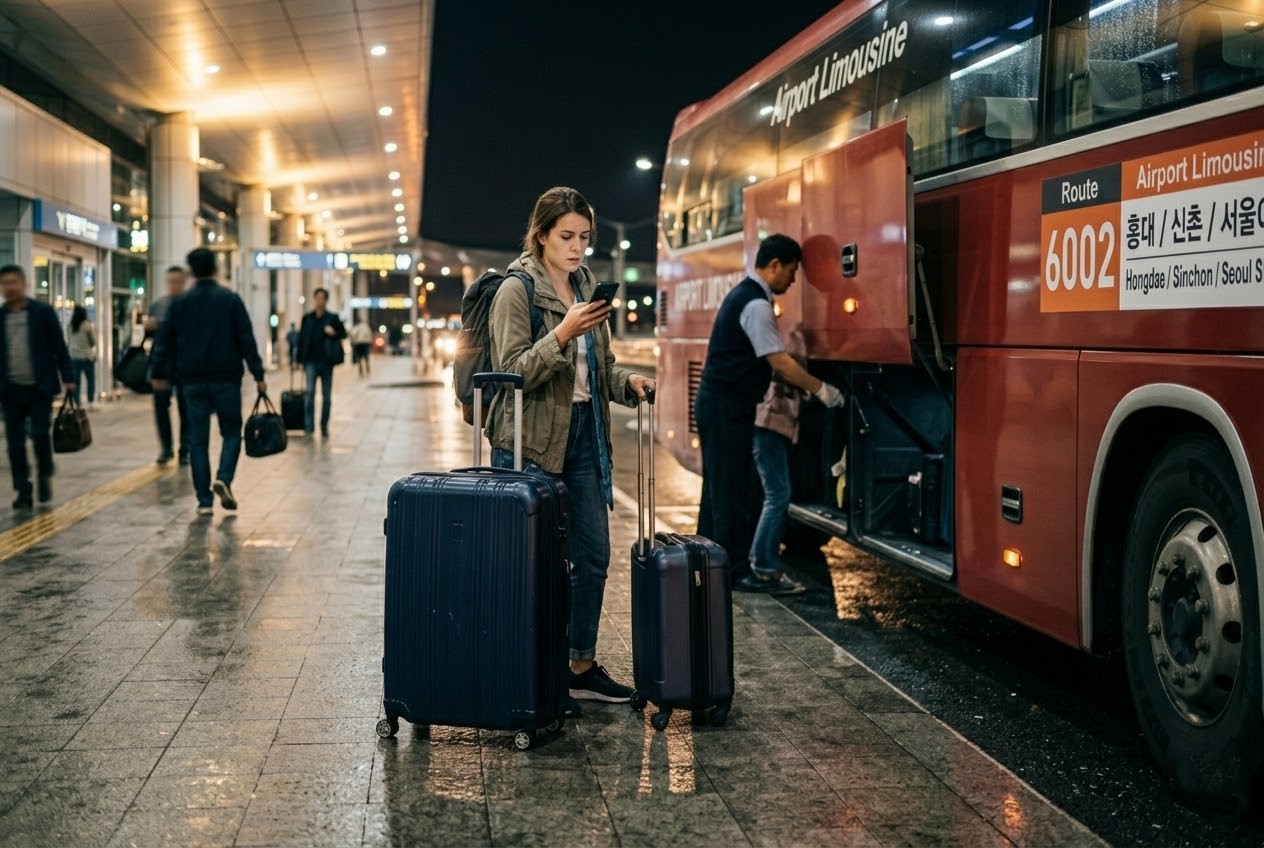
INCHEON AIRPORT TO SEOUL AT NIGHT
Updated October 20, 2026. All times are Korea Standard Time.
After a late arrival at Incheon Airport, check the next usable departure from your terminal before buying a ticket. A train or bus is useful only if it gets you to a stop from which you can still reach your accommodation.
Start with the time you are ready to leave the arrivals hall, not the aircraft’s landing time. Immigration, baggage collection and the walk to transport come between those two moments. This guide covers travel from Incheon Airport to Seoul; for the return journey, use our departure-day airport guide.
Make these three checks in the arrivals hall
- Confirm your terminal. Use the Terminal 1 or Terminal 2 timetable that matches where you are standing.
- Find the next service that reaches a useful stop. Check its destination and departure time, then include the final walk or taxi ride to your hotel.
- Confirm late check-in with your accommodation. Have the entrance instructions and a contact number saved before leaving the airport.
A route search made before your flight is a starting point. Run it again after collecting your bags, using the current local time. If your arrival crosses midnight, check that a dated ticket or reservation uses the correct calendar date.
Check the Express and all-stop trains separately
The AREX Express timetable checked for this guide lists the last airport-to-Seoul service at 22:40 from Terminal 2 and 22:48 from Terminal 1, arriving at Seoul Station at 23:31. The displayed weekday and holiday tables show the same final Express departure. These are Express times, not a statement that all airport trains stop then. Recheck the official AREX Express timetable for your travel date.
If you miss the Express, check the all-stop service separately with AREX or station staff. Ask which station the next train actually reaches. Before committing to a transfer, also check the final departure of the connecting line. Reaching Seoul Station does not establish that a particular onward subway connection is still available.
Both terminals have airport-rail access at the transportation center’s basement level. See the airport’s rail location guide. For all-stop schedules, use the AREX website; this guide does not substitute an unverified all-stop cutoff for the Express timetable.
Illustrative planning example: suppose your flight is scheduled to land at Terminal 1 at 22:30. The 18 minutes until the listed last Express departure are not an available transfer allowance: you still need to leave the aircraft and complete arrival formalities. Prepare a night-bus or taxi alternative before flying.
Night buses: match the stop to your accommodation
Incheon Airport lists the following Seoul night routes. This is a selection of stops to help you shortlist a route, not a complete stop list. Check the full route before purchasing.
| Route | Selected stops / destination | Listed adult fare |
|---|---|---|
| N6000 | Songjeong, Yeomchang, Gangnam Express Bus Terminal | ₩17,000* |
| N6002 | Hongdae, Four Seasons Hotel, Dongdaemun, Cheongnyangni | ₩17,000 |
| N6701 | Mapo, Seoul Station, Euljiro, Dongdaemun Design Plaza | ₩18,000 |
| N6703 | Seorae Village, COEX, Jamsil, Gangbyeon, Gwangnaru area | ₩18,000 |
*The airport lists a separate ₩10,000 adult fare to Songjeong. Source: Incheon Airport’s Terminal 1 night-bus guide. Confirm the fare for your exact stop.
Use the hotel’s full address to compare the bus stop with its entrance. “Gangnam” covers more than one possible destination; a bus to Gangnam Express Bus Terminal is not a promise of a stop outside your hotel. Likewise, check the specific Dongdaemun stop rather than treating every stop with that district name as interchangeable.
Read the timetable for your terminal and direction
The airport publishes separate Terminal 1 and Terminal 2 night-bus tables. Each also includes journeys back to the airport. Read the columns whose departure location is your airport terminal.
For example, the published N6701 timetable pairs a 00:20 Terminal 2 departure with 00:40 at Terminal 1. Its later departures include 01:20 and 03:25 from Terminal 2, compared with 01:40 and 03:45 from Terminal 1. The gap matters: do not assume another bus will follow within a few minutes. Verify the next departure and ticket availability at the airport.
The airport shows the night-bus area on Terminal 1’s first floor and Terminal 2’s basement level. Confirm the exact bay on your ticket or current terminal signage. The listed ticket channels include airport ticket counters and machines; the N6701/N6703 listing also names Tmoney GO.
Source: Incheon Airport’s terminal-specific night-bus guides linked above. Timetables can change; the airport advises confirming with the operator.
Compare the complete trip cost
Write down two totals before choosing between a bus and taxi:
- Bus: tickets for everyone travelling, plus any taxi needed from the stop to the hotel.
- Taxi: the quoted or estimated fare for the vehicle, with the treatment of tolls, night charges and other fees clarified.
Illustrative calculation: three adults using an ₩18,000 service spend ₩54,000 on bus tickets before any final transfer. Compare that total with a current taxi estimate for all three passengers and their actual bags. A taxi is not automatically cheaper, and a car that cannot hold the luggage is not a usable comparison.
Include the wait for the next departure in your decision. If your hotel has a check-in deadline, tell the property your revised arrival estimate and ask how to enter after that time. Do not pay for a faster transfer on the assumption that someone will be at reception.
If you need a taxi after the trains
Use a designated taxi stand. Incheon Airport warns about solicitation and call vans presenting themselves as taxis. Its official taxi guide identifies pickup areas by terminal and vehicle type.
For a Seoul standard taxi, that guide lists a 20% night surcharge from 22:00–23:00 and 02:00–04:00, and 40% from 23:00–02:00. Vehicle classes and taxi jurisdictions have different rules. The base fare shown in a table is not the total cost to your hotel.
Show the driver the hotel’s Korean address and confirm the destination before loading. Ask whether the trip uses a meter or a quoted fare, how tolls are handled, and whether your payment method is accepted. Keep the receipt and booking record, if any.
Save a plan you can use with a low phone battery
Before travelling, save one note with the following fields. Fill in the departure details again after landing.
| Field | What to save |
|---|---|
| Accommodation | Full address, entrance instructions and late check-in contact |
| Arrival terminal | T1 or T2 |
| First workable route | Train or bus, departure time, destination and final transfer |
| Fallback | Next night bus or designated taxi stand |
| Cost comparison | Total party cost, including the stop-to-hotel leg |
If your flight is delayed, update the transport plan and notify the accommodation while you still have a connection. Keep the address available offline so the hotel remains identifiable even if your mobile data fails.
Sources and scope
Official AREX and Incheon Airport pages were checked on October 20, 2026 and are linked beside the relevant information. The route table is a planning shortlist, not a live departure board or seat guarantee. The examples are illustrative calculations, not reported travel experiences. This article covers late arrivals at Incheon Airport heading to Seoul.
1 thought on “Arriving Late at Incheon Airport: Last Trains, Night Buses and Hotel Transfers”
Comments are closed.