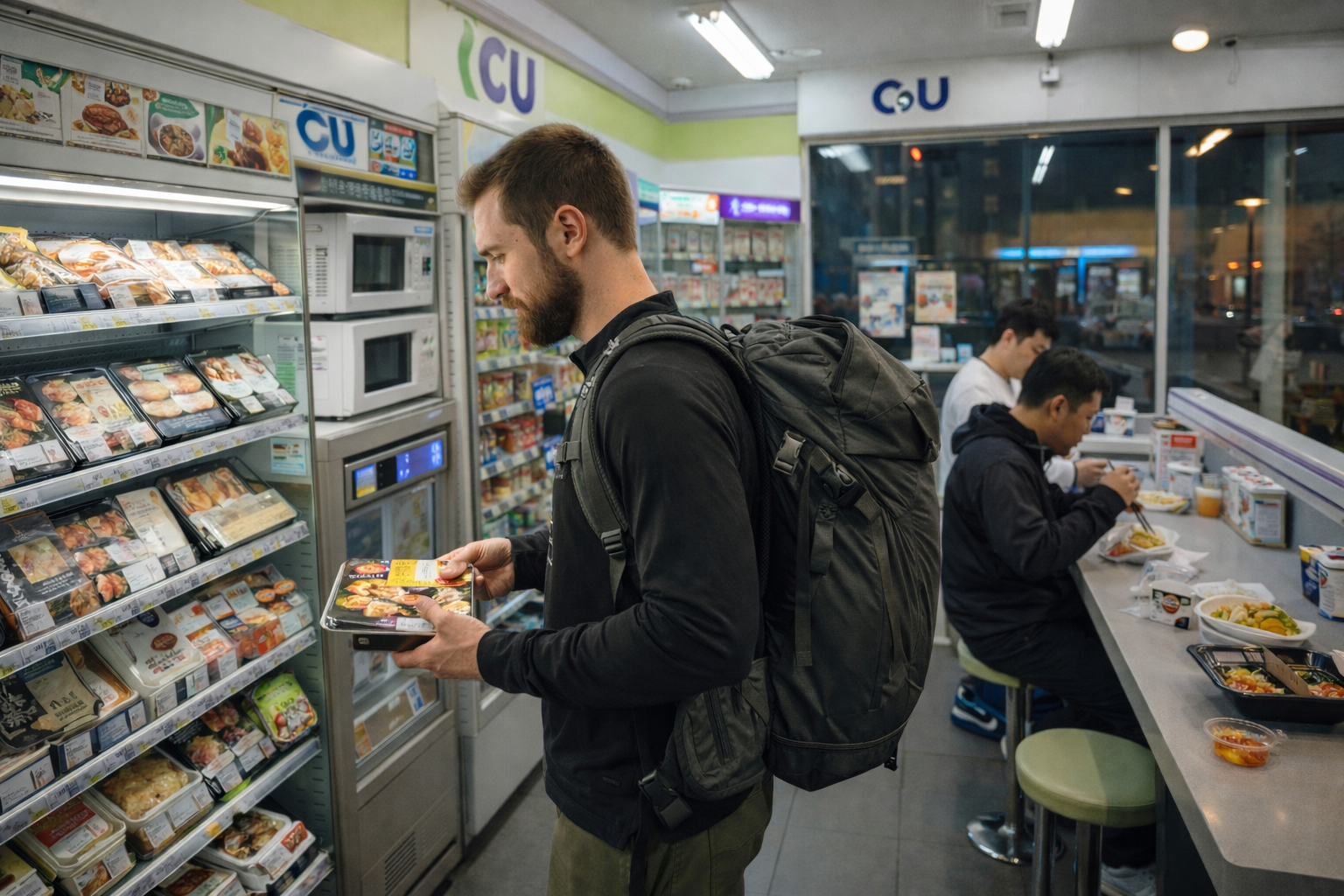
Why Korean Convenience Stores Feel Different: What Foreign Travelers Should Actually Know Before Buying Anything

Late-night Korea travel reality

What surprises many travelers is not that Korean convenience stores sell food. It is that they often solve the exact part of the day that has started to fall apart.

You may walk in thinking you only need water, tissues, or painkillers. Then you realize the store can give you a hot meal, a place to sit for a few minutes, a microwave, a ramen machine, coffee, chargers, cash access, and a much easier answer to the question of what to do next when restaurants feel too far, too late, too crowded, or simply too much effort.

That is why convenience stores in Korea feel different from the ones many foreign visitors are used to. The difference is not only product range. It is the role they play. A Korean convenience store is often less like a small emergency shop and more like a compact everyday service point that helps people keep moving. It covers food, timing gaps, low-energy decisions, small practical failures, and the kind of minor travel problems that do not justify a full detour but still need a solution.

This matters more on a trip than people expect. A lot of travel friction does not come from one dramatic mistake. It comes from repeated small interruptions. You arrive late and do not know what is still open. You have an early departure and need food before dawn. You are between neighborhoods and want something hot in ten minutes, not a full sit-down lunch. It starts raining. You are tired. Your battery is low. The idea of decoding another restaurant menu feels disproportionate to how hungry you actually are. Korean convenience stores are useful precisely because they step into those moments.

First-time visitors still hesitate because the system is rarely explained. They are not sure whether they are meant to use the microwave themselves, whether the ramen machine costs extra, whether they can eat inside, or whether the refrigerated food is actually designed to become a full meal rather than just a backup snack. They watch local customers move quickly and confidently through the store without yet understanding the operating logic behind what they are seeing. Once that logic becomes clear, the whole category becomes much more useful.

What this guide covers

How Korean convenience stores actually function for travelers, not just what they sell.

How the self-service meal setup, microwaves, ramen machines, and seating usually work.

Which food combinations are actually worth trying if you want more than a plain cup noodle.

Why convenience stores matter more in Korea than many travelers expect

In many countries, convenience stores are mostly built around drinks, candy, chips, cigarettes, and a small number of ready-made sandwiches. Korea uses the format more broadly. Convenience stores operate as part of ordinary daily life, which is why the food setup, self-service stations, and practical utility feel noticeably more developed than what many visitors expect to find in a corner shop.

That broader role is easy to miss until you notice how many different kinds of problems a single store can solve. Need a fast hot meal after midnight? It can do that. Need coffee and a quiet five-minute reset before getting back on the subway? It can often do that too. Need a charger, napkins, cold medicine, cash access, or a cheap breakfast before the city is properly awake? Again, that is exactly where Korean convenience stores become useful. Korea Tourism Organization materials also describe convenience-store food as a visible and normal part of everyday Korean eating culture, especially for quick, affordable meals.

This is the important shift for foreign travelers: once food stops being a minor side shelf and becomes a real meal option, the convenience store stops being a backup and starts becoming part of the travel plan. You may not intend to rely on it when you first land. But the moment you realize that dinner can be solved in ten minutes without a reservation, without waiting, and without much language confidence, the whole store becomes more valuable.

Travel problem Why the convenience store helps What travelers usually underestimate
Late-night hunger Hot food, ramen, coffee, and ready meals are often still available. The best meal may be inside the refrigerated section, not only on the noodle shelf.
Early departure Fast breakfast and drinks before restaurants open. A simple meal bought the night before can make departure morning much easier.
Low-energy sightseeing day Quick, low-friction food without choosing a full restaurant. The store often saves more time and mental energy than the money itself.
Rain, heat, or fatigue A brief indoor stop with food, water, and a seat can reset the day. The store functions as a short practical recovery point, not just a retail stop.

What foreign travelers usually notice first

The unfamiliar part is usually not the food itself. It is the self-service environment around the food. Many Korean convenience stores have microwaves, hot water dispensers, ramen cooking machines, utensils, napkins, divided trash bins, and some kind of small eating area. These are not decorative. They are there because customers are expected to use them.

That is exactly where hesitation tends to begin. Travelers are not sure whether the microwave is public, whether the ramen machine is free, whether they need to ask the cashier for help, or whether the seats are reserved for some other kind of purchase. In practice, the system is usually simpler than it looks. If you bought the food there, you can generally heat it there, prepare it there, and eat it there if the branch has seating.

The reason this feels awkward at first is that Korean convenience stores rarely explain themselves. The setup is treated as ordinary. Local customers already know the logic, so the store does not stop to teach it. That can leave first-time visitors slightly out of sync for the first few minutes. The important point is that the system is learnable very quickly once you understand that you are supposed to read the environment rather than wait for formal instructions.

A useful mental model

Do not think of the store as only a snack shop. Think of it as a small self-service meal station built inside a retail space. Once you make that shift, the refrigerator, microwave, ramen machine, utensils, and seating all start to make sense together instead of feeling like disconnected pieces.

How the meal setup usually works

The basic workflow is straightforward, but first-time visitors often benefit from seeing it written out clearly. A typical convenience-store meal in Korea usually follows this order: choose food from the refrigerated section or noodle shelf, pay at the counter, move to the microwave or ramen station, heat or cook the food, pick up utensils, then eat there if seating exists or take the meal with you.

What confuses people is not the sequence itself but the lack of formal separation between the shopping part and the food-prep part. In some countries, if hot food is involved, staff handle it. In many Korean convenience stores, the customer handles that part. So a traveler stands at the refrigerator holding a lunch box and wonders whether the cashier will heat it. Usually, no. The store is arranged for self-service, which is why so much of the useful equipment is located off to the side rather than behind the counter.

Once you have done this one time, the whole store becomes much easier to read. Before that first attempt, though, the environment can feel more ambiguous than it really is.

The refrigerated section is more important than it looks

One of the most common first-visit mistakes is judging the store too quickly. Travelers notice drinks, chips, desserts, and cup noodles, assume that is the main offering, and miss the section that matters more. In many Korean convenience stores, the refrigerated shelves are where the practical meals live.

This is usually where you find triangle kimbap, full kimbap rolls, lunch boxes, rice bowls, pasta dishes, sandwiches, salads, and packaged side dishes. These are not random extras. They are a major part of how the store functions as a real meal stop. Many tourists do not fully register this until several days into the trip and then realize the store would have solved multiple earlier late-night or low-energy food problems much more cleanly.

The best habit is simple: scan the refrigerated section first. Then decide whether you want a ready meal, a quick snack, or something more playful built around ramen and add-ons. That one change usually improves the whole convenience-store experience.

Understanding the instant ramen machine

For many visitors, the ramen machine becomes the most memorable part of the Korean convenience-store experience. Many branches have a countertop machine specifically designed for instant noodles. The exact setup varies by location, but the overall rhythm is consistent enough that travelers can learn it quickly.

A typical ramen flow looks like this: choose a ramen packet or cup ramen, pay at the register, get a paper bowl if needed, open the noodles, add the seasoning, place the bowl in the machine, press start, wait while the machine adds water and cooks, then remove the bowl carefully when finished. In many stores, the machine handles the water and the timing automatically. In others, the process is slightly more manual. Either way, it is designed for customers to use themselves, not for staff to operate on their behalf.

The part that feels confusing is usually not the device itself. It is the surrounding uncertainty. Travelers often do not know whether the bowl is included, whether seasoning goes in before or after cooking, whether they can add items from elsewhere in the store, whether the machine costs extra, or where to sit once the ramen is ready. In practice, most of those questions answer themselves once you watch the area for thirty seconds. The first attempt feels awkward because you are interpreting an unfamiliar social system, not because the machine is technically difficult.

That distinction matters. Once you stop treating the ramen machine as a novelty that requires permission and start treating it as part of the normal food setup, the hesitation drops quickly.

What travelers often overthink

Whether they are allowed to use the ramen machine and microwave themselves.

What usually matters more

Finding the bowl, understanding the order of steps, and noticing where utensils and seating are.

Best first move

Watch the area for half a minute before starting. The store usually teaches itself through observation.

The small self-service details people miss

Near the microwave or ramen station, there is usually a small rack or container with utensils — chopsticks, spoons, forks, napkins, and sometimes straws. These are generally free for paying customers. Visitors sometimes ask the cashier for utensils while the same items are already sitting in a self-service holder nearby.

Trash is worth paying attention to as well. If you eat inside, you are usually expected to throw away your own waste and tidy up after yourself. The bins may be divided for cups, food waste, and general trash. You do not need to approach this nervously, but it helps to notice how other customers are using the space rather than treating it like a table-service restaurant.

These details sound small, but they are part of why Korean convenience stores feel smooth once you understand them and slightly awkward before you do. Nothing is especially difficult. The friction comes from not yet knowing where the invisible assumptions are.

Can you eat inside the store?

That depends on the branch. Some locations have seating, some do not, and some have only two or three window seats while others have a small eating counter. Stores near universities, office districts, or major stations are more likely to have people sitting inside.

Where seating exists, it is generally intended for customers using the food setup. People eat ramen, drink coffee, wait for transport, take a short break, or have a quick solo meal. The informal rules are simple: do not hold seats for too long during busy periods, clean up after yourself, and do not treat the space like a café for long laptop sessions unless that specific location clearly supports that kind of use.

The most useful way to think about it is proportional use. This is a quick-use eating area attached to a convenience store, not a lounge.

How heating works for ready meals

Most Korean convenience-store meals are designed to be heated. The packaging usually makes this clear even if you cannot read every Korean word. You will often see timing guidance, microwave icons, or other clear hints that the food is meant to be warmed.

The usual flow is straightforward: buy the meal, bring it to the heating area, loosen or remove the film according to the packaging, microwave it for the indicated time, then eat there or take it away. These meals are practical rather than elegant. They are not trying to replace a proper restaurant dinner. They exist to solve a very specific problem: wanting something fast, hot, affordable, and low-friction. That is why they work so well for travelers.

Once you understand that design logic, convenience-store food stops feeling like a compromise and starts feeling like a tool.

Why convenience-store food keeps being useful across a trip

Convenience-store meals solve a problem that keeps repeating during travel. Late at night, restaurants may already be closed. Early in the morning, you may not want a formal breakfast. Between neighborhoods, you may want something faster than a sit-down lunch. On a heavy sightseeing day, spending around 5,000 won and moving on in fifteen minutes may simply be the correct choice.

That is why convenience stores are not only a budget option. They solve timing problems and energy problems, not just money problems. A traveler with money can still prefer the convenience store because what they are short on is not budget but patience, time, and decision-making energy.

This is also why some travelers end up using convenience stores more as the trip goes on, not less. The longer you are in motion, the more you begin to appreciate spaces that solve practical needs quickly and reliably.

Three real convenience-store food combos worth trying

One reason Korean convenience stores developed such a visible presence online is that people rarely just buy one item and leave. They build combinations. Some are practical. Some are student-style comfort food. Some spread through Korean YouTube and social media. Coverage of Korean “modisumer” culture describes this broader habit of modifying and combining ready-made convenience-store food rather than eating everything exactly as packaged.

The combinations below are not random internet tricks. They reflect real ways people use Korean convenience-store meal stations and they work because the store is designed for light assembly rather than passive shopping.

Combo 1

Ramen + triangle kimbap + cheese

This is one of the most recognizable and easiest first combinations for travelers.

Buy one spicy ramen, one triangle kimbap — tuna mayo and bulgogi both work well — and one cheese item such as a single cheese slice or string cheese.

Cook the ramen first, open the kimbap, then either eat the kimbap on the side or drop part of it into the soup. Add the cheese so it softens into the broth.

Why it works: the ramen provides heat and salt, the kimbap makes the meal more filling, and the cheese takes the edge off the spice while making the broth feel heavier and more comforting.

Combo 2

Cup tteokbokki + pasta or noodles + sausage + cheese

This is the kind of combination that spread through Korean YouTube and convenience-store food culture, including the well-known “Mark Jeongsik” style of building one heavier, cheesier meal from several ready-made spicy items.

A common version uses cup tteokbokki or spicy rice-cake cup, cup pasta or noodles, sausage, and shredded or sliced cheese.

Heat the cup items first, combine them into one larger bowl, add the sausage, then melt cheese over the top in the microwave.

Why it works: the result tastes much bigger and more indulgent than any of the individual items alone — salty, spicy, messy, and very much in the spirit of Korean convenience-store experimentation. It is not the cleanest first attempt for a tired traveler, but it is one of the most culturally specific combinations you can try.

Combo 3

Triangle kimbap + curry or a rice-meal add-on

This one is less flashy online but often more useful in real life.

Buy one triangle kimbap or plain rice item, one curry pouch or simple sauce if available, and optionally a boiled egg or sausage.

Heat the curry or sauce, add it over the rice, and use the egg or sausage to make the meal feel more complete.

Why it works: it converts a small snack into something that feels much closer to a full meal. It is practical, cheap, and easy to assemble without making a mess, which makes it especially good when you are hungry enough to want more than a single triangle kimbap but still do not want restaurant effort or restaurant spending.

Why these combos caught on

Korean convenience stores are built for modification. They give you microwaves, hot water, ramen cooking machines, cheap add-on items, and enough variety to construct small meals rather than only consume sealed products one by one. Once that kind of infrastructure exists, experimentation follows naturally.

Over time, this became part of a broader Korean consumer habit often described as modisumer culture — customers adjusting and combining products into something slightly different from the original packaged idea. In convenience stores, that usually means building simple custom meals rather than eating each item separately.

For travelers, the value is not that every combination is brilliant. The value is that the store is not a passive retail space. It quietly invites a little assembly, and that changes the eating experience.

When convenience stores are the smartest option

There are situations where a convenience store is not a compromise. It is simply the right call. Late-night arrivals are the clearest example. A traveler reaches the hotel after restaurants have closed, is too tired to search further, and still needs food. The convenience store solves that immediately.

Early departures work the same way. If you are leaving for the airport before the city feels awake, the convenience store may be the easiest food option nearby. The same is true for short breaks between neighborhoods, rainy or low-energy afternoons, and days when you want to keep food spending under control without skipping meals.

The useful point is not that convenience stores are always better than restaurants. It is that they are often better matched to the kind of travel problem you are actually trying to solve.

The cultural side that visitors often remember

Korean convenience stores tend to feel more relaxed and more socially used than many visitors expect. You may see people eating ramen by the window, drinking iced coffee while studying, charging a phone, waiting for a friend, or buying one quick meal after midnight and eating it quietly before going home.

That is part of why convenience stores become memorable to foreign travelers. They are not glamorous, but they offer a fast glimpse of ordinary Korean daily life. You see how the city actually moves when people are not performing for tourists.

The brands you will see most often

Most travelers repeatedly encounter GS25, CU, 7-Eleven, and Emart24. For practical travel purposes, the differences between chains usually matter less than people expect. Product lines vary slightly and specific branches vary slightly, but the nearest well-stocked location is usually the right answer.

The more useful question is not which chain is best. It is which branch is in the right place right now and has the meal setup you need.

Common first-time mistakes

Buying only snacks and missing the meal section

Travelers overlook the refrigerated meals and assume the store is mostly drinks and chips. It is not.

Feeling uncertain about using the microwave or ramen station

These are there for customers. If you bought the food there, you are usually meant to use them.

Not understanding how seating works

Where seating exists, use it briefly and clean up after yourself.

Jumping straight to the most complicated combo

Start simple. Ramen plus kimbap is a better first attempt than a heavier multi-item cheese build if you are tired and unfamiliar with the setup.

Assuming convenience-store food is only for budget travel

It is also for timing, fatigue, weather, and situations where low-friction decision-making matters more than dining atmosphere.

When convenience stores are not the right choice

Even with all of these strengths, convenience stores are not the answer to everything. A restaurant makes more sense when you want a proper Korean dining experience, when you are meeting people, when you want freshly cooked food rather than practical ready meals, or when atmosphere matters as much as the food itself.

The useful framing is not that convenience stores are better than restaurants. It is that they solve a different kind of problem, and they solve that problem extremely well.

The simplest way to use them well

Check the refrigerated meal section first. Decide whether you want a simple ready meal or a small combo. Pay before moving to the food station. Heat or cook the food, pick up utensils, eat quickly if there is seating, clean up, and move on.

Do this once and the whole system becomes easy.

That is also why people remember Korean convenience stores longer than they expect to. They are not attractions, but they keep showing up at exactly the right moments — late at night, on tired days, between neighborhoods, before early departures, or when the trip needs something warm and uncomplicated rather than impressive.

After a long day, a hot bowl of ramen, a triangle kimbap, and ten quiet minutes by the window can feel more satisfying than a much more expensive meal somewhere else. That is the real reason these stores matter in Korea. They are not just where you buy things. They are where a surprising number of small travel problems get solved quickly, quietly, and with almost no fuss.