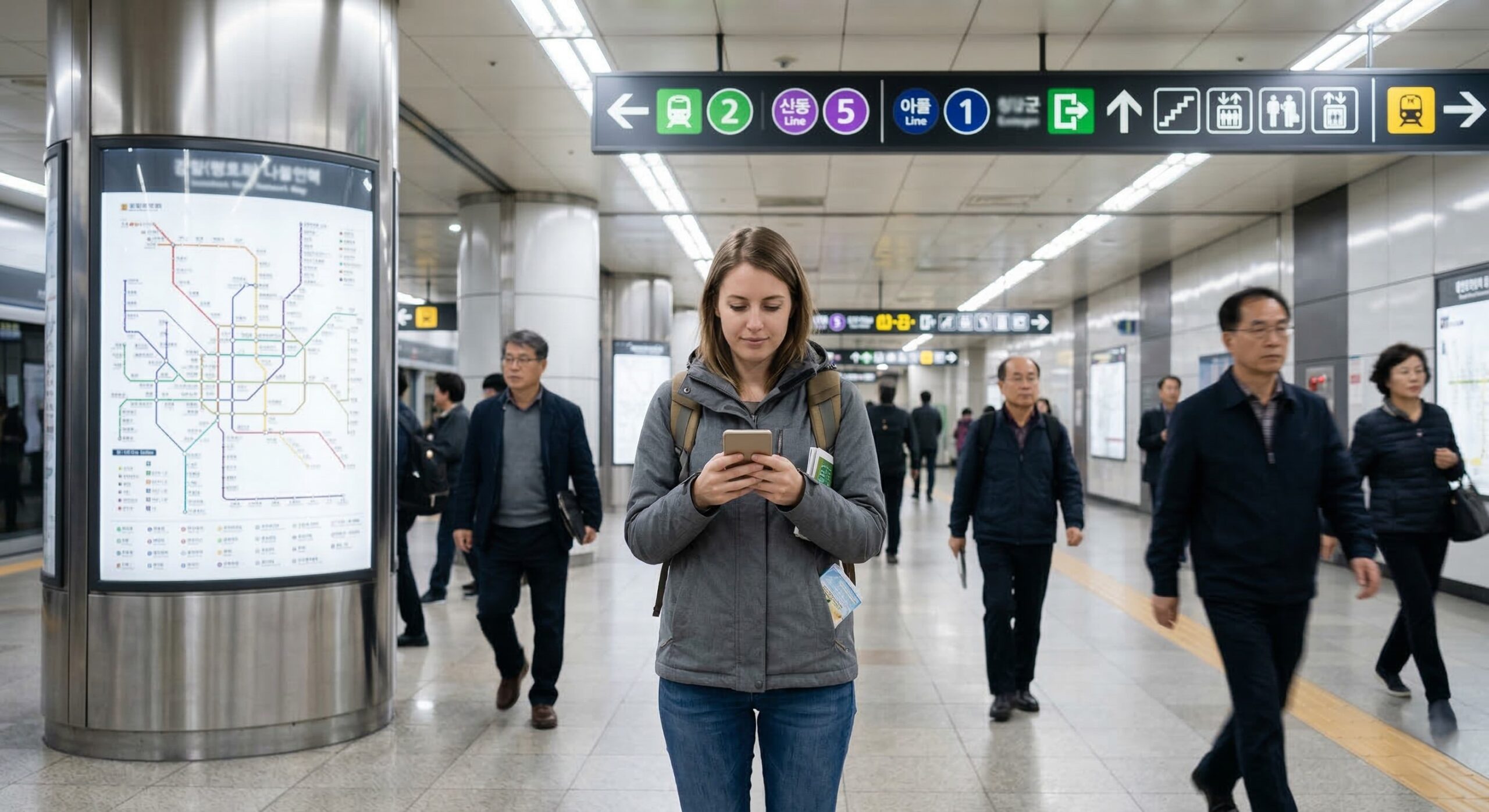
Seoul’s subway is not difficult in the way many first-time visitors expect. The ride itself is usually the easy part. What wastes time is everything around it: choosing the wrong platform when both sides look similar, underestimating a transfer inside a large station, or taking the first exit you see and finding out too late that your hotel is closer to a different one.
If you have used metros in cities like Tokyo, London, Paris, or New York, parts of Seoul will feel familiar. The system is large, heavily used, and generally efficient. The problem is that familiarity can create the wrong kind of confidence. Many visitors assume that once they have the right station name, the rest will sort itself out. In Seoul, that assumption often causes more trouble than the train ride itself.
What helps most is not trying to memorize the whole network. It is knowing which details matter in the order you actually need them.
Line
Make sure you entered the right part of the system.
Direction
Check the platform and terminal direction before boarding.
Transfer
Treat each change of line as a fresh decision point.
Exit
Know which exit matches your actual destination.
The station name is only the beginning
Many visitors plan a subway trip as if the station name is the destination. That is understandable, but it is not enough in Seoul. A station can have many exits. Some are close together. Some are not. In dense neighborhoods, the difference between one exit and another can mean an uphill walk you did not expect, an unnecessary crossing at a wide intersection, or several extra minutes pulling luggage through a street that looked much simpler on a booking page.
Example: Say you are staying near Myeongdong Station and your hotel listing only says “3 minutes from the station.” That may be true from one exit and considerably less true from another. If you come out on the wrong side of a large road with luggage, a short arrival can turn into an irritating detour.
This is why “my hotel is near Myeongdong Station” is only partial information. The better question is which exit is closest to the hotel and what the walk looks like once you get outside. A more reliable sequence is neighborhood → station → exit → final walking route.
That last layer matters because Seoul often feels well organized underground and more ambiguous once you surface. You can make every correct decision on the subway and still lose time above ground because you came out in the wrong place.
Before you leave for the station, try to know these four things:
- the line you need
- the direction of travel
- the transfer station, if there is one
- the exit number closest to your final destination
Read subway signs in the order that actually helps
Seoul subway signs contain a lot of useful detail, but trying to take in everything at the same time makes the station feel more complicated than it really is. A simpler reading order works better.
- Start with the line number or line color. This tells you that you are in the correct part of the system.
- Check the direction of travel. On the platform, the important detail is often not the next station name but the terminal station or major direction shown on the sign.
- Confirm transfer information. Once line and direction are correct, transfer arrows become much easier to follow.
- Think about the exit last. Exit planning matters, but it only matters after the first three decisions are right.
If your map shows that you should be traveling toward City Hall, Jamsil, Sadang, or another endpoint shown in the station, match that direction before you board. Do not rely on the crowd. Do not assume both sides will take you somewhere close enough.
Example: A common mistake is boarding the correct line from the wrong platform. You see the right line color, tap through the gate, and get on quickly because the train arrives right away. Two stops later, the station names are moving in the opposite direction from what your map showed.
The simplest mental check inside the station is this:
- Am I on the right line?
- Am I going in the right direction?
- Do I need to transfer?
- Which exit will I need at the end?
Transfers are a walking problem as much as a train problem
On a map, transfers look straightforward. In practice, they are often the part of the trip that wears people down. Some transfers in Seoul are short and simple. Others involve long corridors, multiple escalators, stairs, or a considerable amount of walking inside a large station complex.
If you are carrying only a backpack, this may barely register. If you have a suitcase, shopping bags, a stroller, or tired legs after a full day out, the same transfer can feel completely different.
Example: A route with one transfer may look easy when you check it at your hotel. It can feel very different when you are dragging a suitcase through a long corridor, going down and up escalators again, and trying to confirm the next platform before the train arrives.
This is one reason visitors misjudge routes. They compare total ride time and overlook the walking time between lines. A one-transfer route may still be the right choice, but not all transfers cost the same in energy.
There is also a mental reset that needs to happen every time you change lines. Many travelers handle the first leg well, then relax too much during the transfer. They follow the arrows, reach the next platform, and board too quickly without checking direction again. That is how you end up on the correct line while heading the wrong way.
Treat every transfer as a fresh decision point. Follow the signs to the new line, then confirm direction again before you board.
One practical rule: do not exit the fare gates unless your route specifically requires it. In many cases, the transfer is meant to happen entirely inside the station. If you walk out too early because you saw daylight or confused an exit sign with your next step, you create an unnecessary problem.
Exit numbers do far more work than most visitors realize
If there is one detail that repeatedly saves time in Seoul, it is the exit number. Many visitors treat exits as a minor detail they can sort out on arrival. In Seoul, that approach often fails. The station can be correct, the ride can be correct, and you can still lose several extra minutes simply because you picked an exit without checking it first.
This happens most often in areas with broad roads, underground shopping passages, large intersections, and clusters of similar-looking buildings. From below ground, everything feels organized. Once you surface, the wrong side of the street can change the entire walk.
Example: Imagine you are meeting someone at a café near a busy intersection in a crowded neighborhood. The station is right, but if you take the first exit you see, you may surface on the opposite side of a wide road and spend extra time crossing, circling the block, and checking your map again.
For hotels, clinics, pop-up events, language schools, concert venues, and restaurants tucked into dense blocks, the exit matters almost as much as the station itself. Treat the exit number as part of the address, not as something to figure out after you have already arrived underground.
If your accommodation page, reservation email, or map pin does not make the exit obvious, check it beforehand. In many cases, a local map app makes the exit logic clearer than guessing once you are already in the station. Even if you cannot identify the perfect exit with complete confidence, narrowing it down in advance is better than surfacing at random and correcting on foot.
This matters even more when you are traveling with luggage. A short final walk on the map can still include stairs, a slope, a long crosswalk cycle, or a block layout that feels less obvious in person. The wrong exit makes all of that worse.
The last few hundred meters are often the hardest part
Many visitors assume the subway ride itself is the main challenge. It is usually the most orderly part. The harder section begins when the train doors open and you have to move from platform to street, or from street to a doorway that is not as obvious as it looked online.
This is especially true in neighborhoods where buildings sit close together, side streets are dense, and the layout of the area only becomes clear after you have already spent a few minutes walking around.
Example: This comes up regularly with small guesthouses, clinics, and restaurants inside commercial buildings. The subway gets you close, but not all entrances are visible from the main road. You may arrive at the right station on time and still spend several more minutes finding the correct door.
If you are heading to a hotel, guesthouse, clinic, studio stay, or reservation-based location, do not stop planning at the station. Save the final destination clearly in your map app before you leave. If necessary, save the place name, a nearby landmark, or the building name as well. In some situations, the building is easier to identify than the street address.
It also helps to think about what kind of destination you are trying to find. A large hotel on a main road is usually straightforward. A small guesthouse on a side street may require more care. A café or restaurant inside a commercial building may mean the station only gets you close; the entrance itself becomes the actual task.
Where trips start to unravel
1. Boarding without checking direction
People confirm the line, see others waiting, and assume they are fine. Then the station names start moving the wrong way.
2. Underestimating transfer distance
A route with fewer minutes on paper can still feel worse if the internal walk is longer than expected.
3. Leaving exit decisions until the very end
This is one of the easiest mistakes to avoid and one of the most common.
4. Deciding too late
If you start planning while standing on the platform with trains arriving and battery running low, even simple decisions feel stressful.
5. Forcing the subway to do every part of the trip
The subway may handle most of the route well, but the last segment is sometimes easier by taxi or bus.
6. Assuming “near the station” means easy on foot
Without the right exit and a clear final route, “near” can still involve stairs, crossings, slopes, or confusing blocks.
When the subway is not the smartest choice
Once the subway starts working well, it is tempting to use it for everything. That is not always the best move. The goal is not to stay loyal to one transport type. The goal is to reduce hassle for the trip in front of you.
| Situation | Subway is usually a strong choice | Consider a taxi or bus for the last segment |
|---|---|---|
| Luggage | You are traveling light and can move easily through stairs, escalators, and transfers. | You have large suitcases or multiple bags that make long station walks annoying. |
| Destination access | The station and exit are both convenient for your destination. | The final walk is awkward, uphill, or buried inside a confusing block. |
| Route shape | The route is straightforward and the transfer burden is reasonable. | One short taxi or bus ride would remove a long transfer and a difficult last stretch on foot. |
| Timing | You are traveling during normal operating hours and want predictable travel time. | You are traveling late enough that options narrow and a direct final segment matters more. |
Example: Say you arrive late in the evening with two large suitcases and your accommodation is uphill from the nearest station. On the map, the subway may still look efficient. In practice, a short taxi ride for the last segment may save more stress than the subway saves in fare.
A lot of wasted time in Seoul comes from applying the subway to the wrong segment, not from using it poorly. On some days, the cleanest plan is a combination: subway for the main distance, then a short taxi or bus ride for the part that would otherwise cost you the most effort.
A routine that works well trip after trip
Before leaving
- Open your map app and check the full route.
- Note the line, direction, transfer station, and exit number.
- Make sure your transportation card has enough balance.
- Save a screenshot in case you lose signal, battery, or focus inside a busy station.
At the station entrance
- Confirm the station name before you go downstairs.
- If multiple lines pass through the same area, make sure you are entering for the right one.
On the platform
- Check direction again using the terminal station or route guidance on the sign.
- Do not board just because the train arrived on your side.
During the transfer
- Follow the signs for the new line.
- Once you reach the next platform, reset and confirm direction again.
- Do not rush this step.
Before leaving the station
- Check the exit number one more time.
- If your destination depends on exact location, open the map before you walk down the final corridor to the street.
After exiting
- Do not assume you are essentially there.
- Use the map for the last stretch with the same care you used for the subway itself.
The biggest shift is simple: stop treating a subway trip as one action. In Seoul, it is usually four linked steps: line, direction, transfer, exit.
When travelers think only about the line, they board the wrong side of the platform. When they handle line and direction but ignore the transfer, they lose time inside a large station. When they manage the transfer but overlook the exit, they surface in the wrong place and undo the decisions they already got right.
Seoul’s subway is large, but it is not arbitrary. What helps most is not memorizing the whole network. It is knowing which details deserve your attention before the train arrives.